Julian F J, Rome L C, Stephenson D G, Striz S
J Physiol. 1986 Jan;370:181-99. doi: 10.1113/jphysiol.1986.sp015929.
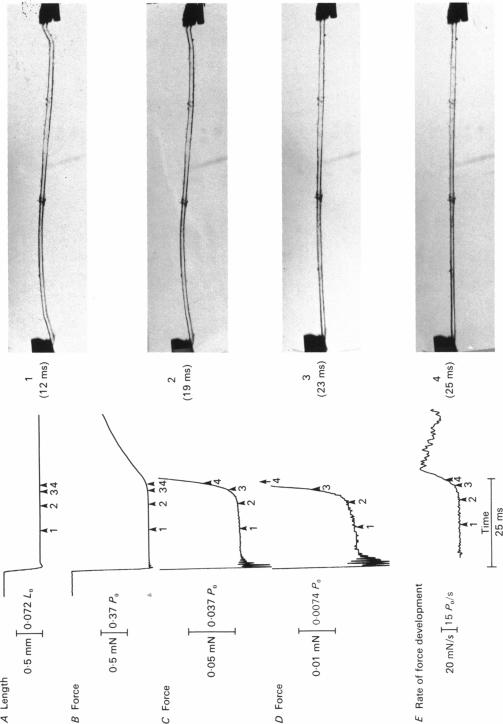
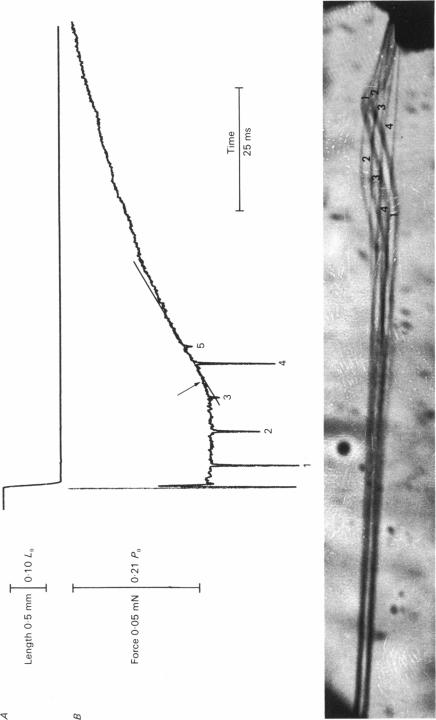
This study was performed to determine whether Viso (the maximum speed of shortening extrapolated from force-velocity curves) equalled Vu (the unloaded speed of shortening determined by the slack test) in both living fibres from Rana temporaria and mechanically skinned fibres from Rana pipiens. In living fibres (R. temporaria) we obtained improved estimates of Viso by performing force clamps (isotonic) and length ramps (isovelocity) down to very low loads (0.005 isometric tension, P0). Force-velocity characteristics determined by force clamps and length ramps were the same. The hyperbolic Hill curves deviated from the force-velocity data at both high and low loads and underestimated Viso by varying degrees. A better estimate of Viso was obtained by linear extrapolation of data at loads from 0.005-0.02 P0 and the mean Viso at 7.5 degrees C was 4.08 muscle lengths/s +/- 0.11 (mean +/- S.E., n = 14). Improved estimates of Vu in living fibres were obtained by photographically calibrating the slack test. The mean Vu was 4.05 muscle lengths/s +/- 0.13 (mean +/- S.E., n = 14) and the intercept was 0.0156 fibre lengths (L0) +/- 0.0013 (mean +/- S.E., n = 14). The step-ramp photographic method, in which the motor speed is matched to Vu, was developed as an independent way to measure Vu in living fibres. Vu measured in this way agreed well with Vu measured by the slack test. In all living fibres, the improved estimates of Vu agreed well with the improved estimates of Viso. Vu/Viso = 0.99 +/- 0.01 (mean +/- S.E., n = 14). In mechanically skinned R. pipiens fibres, force clamps were performed down to loads of 0.01 mN. The force-velocity curve of the skinned fibres differed in shape from that of the living fibres. Although there was significant deviation from the Hill equation at low loads, the data at high loads were well fitted by the Hill curve. Viso determined by extrapolating the Hill equation to zero load was 5.87 muscle lengths/s +/- 0.38 (mean +/- S.E., n = 9) at 7.5 degrees C. In five fibres, the linear extrapolation of low loads (0.01-0.05 P0) showed that the Hill equation underestimated the true Viso by 6%. The slack test with mechanically skinned fibres was calibrated by taking a series of photographic exposures of the fibre at various times following each length step. Vu = 6.12 muscle lengths/s +/- 0.44 (mean +/- S.E., n = 10) and the intercept was 0.0585 L0 +/- 0.0069 (mean +/- S.E., n = 10).(ABSTRACT TRUNCATED AT 400 WORDS)
本研究旨在确定在林蛙的活纤维以及豹蛙的机械去表皮纤维中,视在缩短最大速度(Viso,从力-速度曲线外推得出)是否等于卸载缩短速度(Vu,通过松弛试验确定)。在活纤维(林蛙)中,我们通过进行力钳制(等张)和长度斜坡(等速)直至非常低的负荷(0.005等长张力,P0),获得了对视在缩短最大速度的改进估计。通过力钳制和长度斜坡确定的力-速度特性是相同的。双曲型希尔曲线在高负荷和低负荷下均偏离力-速度数据,并不同程度地低估了视在缩短最大速度。通过对0.005 - 0.02 P0负荷下的数据进行线性外推,对视在缩短最大速度有了更好的估计,7.5摄氏度时视在缩短最大速度的平均值为4.08肌肉长度/秒±0.11(平均值±标准误,n = 14)。通过对松弛试验进行摄影校准,获得了活纤维中卸载缩短速度的改进估计。卸载缩短速度的平均值为4.05肌肉长度/秒±0.13(平均值±标准误,n = 14),截距为0.0156纤维长度(L0)±0.0013(平均值±标准误,n = 14)。开发了步长斜坡摄影方法,其中电机速度与卸载缩短速度匹配,并将其作为测量活纤维中卸载缩短速度的一种独立方法。用这种方法测量的卸载缩短速度与通过松弛试验测量的结果吻合良好。在所有活纤维中,卸载缩短速度的改进估计与视在缩短最大速度的改进估计吻合良好。卸载缩短速度/视在缩短最大速度 = 0.99±0.01(平均值±标准误,n = 14)。在豹蛙的机械去表皮纤维中,进行力钳制直至负荷为0.01 mN。去表皮纤维的力-速度曲线形状与活纤维不同。尽管在低负荷下与希尔方程有显著偏差,但高负荷下的数据能很好地拟合希尔曲线。通过将希尔方程外推至零负荷确定的7.5摄氏度时视在缩短最大速度为5.87肌肉长度/秒±0.38(平均值±标准误,n = 9)。在五根纤维中,低负荷(0.01 - 0.05 P0)的线性外推表明,希尔方程低估了真实的视在缩短最大速度6%。通过在每个长度步长后的不同时间对纤维进行一系列摄影曝光,对机械去表皮纤维的松弛试验进行了校准。卸载缩短速度 = 6.12肌肉长度/秒±0.44(平均值±标准误,n = 10),截距为0.0585 L0±0.0069(平均值±标准误,n = 10)。(摘要截短至400字)