Department of Medicine and Surgery, Center for Hemato-Oncology Research (C.R.E.O.), University of Perugia, Perugia, Italy.
Department of Chemistry, Biology and Biotechnology, University of Perugia, Perugia, Italy.
Ann Hematol. 2022 Feb;101(2):297-307. doi: 10.1007/s00277-021-04712-8. Epub 2021 Dec 2.
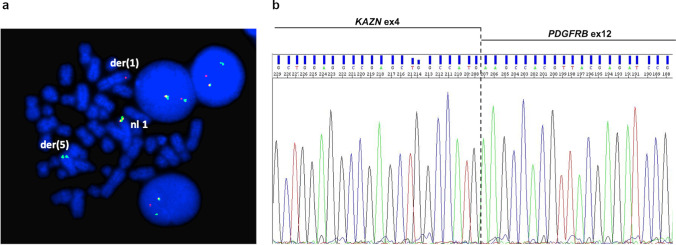
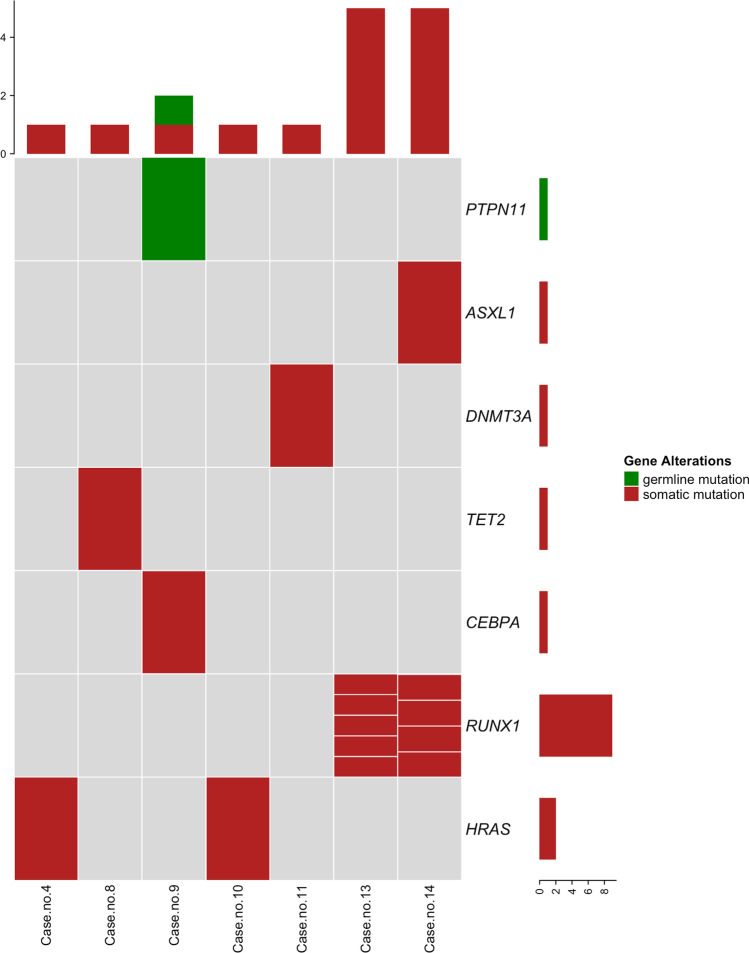
Platelet-derived growth factor receptor B (PDGFRB) gene rearrangements define a unique subgroup of myeloid and lymphoid neoplasms frequently associated with eosinophilia and characterized by high sensitivity to tyrosine kinase inhibition. To date, various PDGFRB/5q32 rearrangements, involving at least 40 fusion partners, have been reported. However, information on genomic and clinical features accompanying rearrangements of PDGFRB is still scarce. Here, we characterized a series of 14 cases with a myeloid neoplasm using cytogenetic, single nucleotide polymorphism array, and next-generation sequencing. We identified nine PDGFRB translocation partners, including the KAZN gene at 1p36.21 as a novel partner in a previously undescribed t(1;5)(p36;q33) chromosome change. In all cases, the PDGFRB recombination was the sole cytogenetic abnormality underlying the phenotype. Acquired somatic variants were mainly found in clinically aggressive diseases and involved epigenetic genes (TET2, DNMT3A, ASXL1), transcription factors (RUNX1 and CEBPA), and signaling modulators (HRAS). By using both cytogenetic and nested PCR monitoring to evaluate response to imatinib, we found that, in non-AML cases, a low dosage (100-200 mg) is sufficient to induce and maintain longstanding hematological, cytogenetic, and molecular remissions.
血小板衍生生长因子受体 B(PDGFRB)基因重排定义了一组独特的髓系和淋巴系肿瘤亚群,这些肿瘤常伴有嗜酸性粒细胞增多,并对酪氨酸激酶抑制具有高度敏感性。迄今为止,已经报道了至少 40 种涉及各种 PDGFRB/5q32 重排的融合伙伴。然而,关于 PDGFRB 重排伴随的基因组和临床特征的信息仍然很少。在这里,我们使用细胞遗传学、单核苷酸多态性阵列和下一代测序对 14 例髓系肿瘤病例进行了特征描述。我们鉴定了 9 个 PDGFRB 易位伙伴,包括 1p36.21 上的 KAZN 基因,这是一种以前未描述的 t(1;5)(p36;q33)染色体变化中的新伙伴。在所有病例中,PDGFRB 重组是唯一导致表型的细胞遗传学异常。获得性体细胞变异主要发生在临床上侵袭性疾病中,涉及表观遗传基因(TET2、DNMT3A、ASXL1)、转录因子(RUNX1 和 CEBPA)和信号调节剂(HRAS)。通过使用细胞遗传学和嵌套 PCR 监测来评估对伊马替尼的反应,我们发现,在非 AML 病例中,低剂量(100-200mg)足以诱导和维持长期的血液学、细胞遗传学和分子缓解。