Tianjin's Clinical Research Center for Cancer, Key Laboratory of Cancer Prevention and Therapy, Tianjin, Key Laboratory of Breast Cancer Prevention and Therapy, Tianjin Medical University, Ministry of Education, National Clinical Research Center for Cancer, Tianjin Medical University Cancer Institute and Hospital, Tianjin, China.
Key Laboratory of Radiopharmacokinetics for Innovative Drugs, Chinese Academy of Medical Sciences, and Institute of Radiation Medicine, Chinese Academy of Medical Sciences and Peking Union Medical College, Tianjin, China.
Cancer Sci. 2022 Feb;113(2):733-743. doi: 10.1111/cas.15230. Epub 2021 Dec 18.
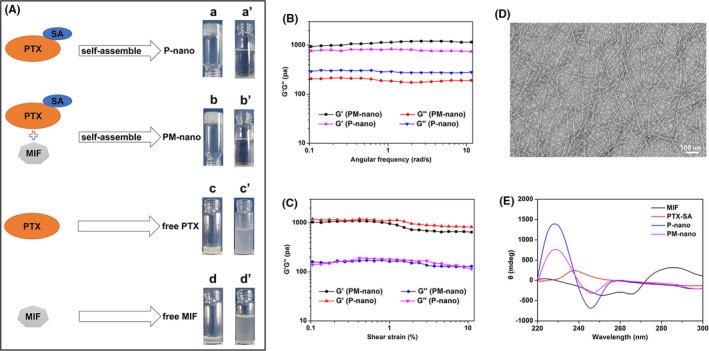
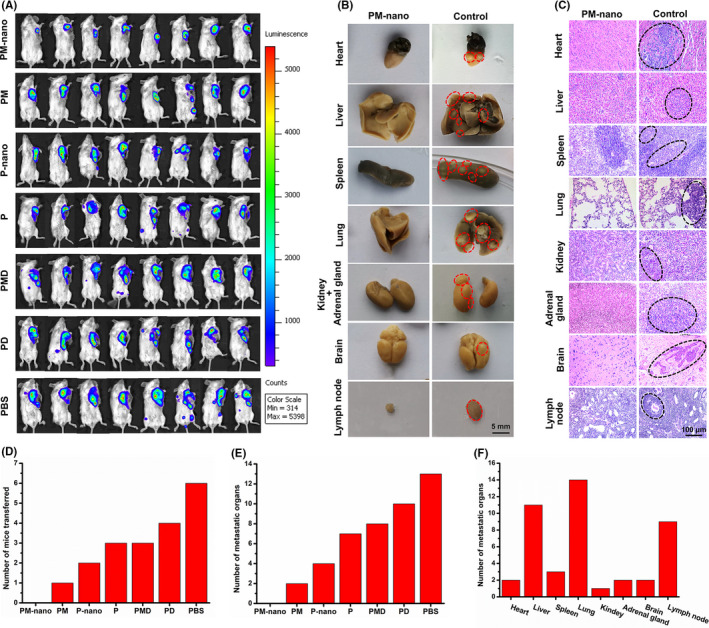
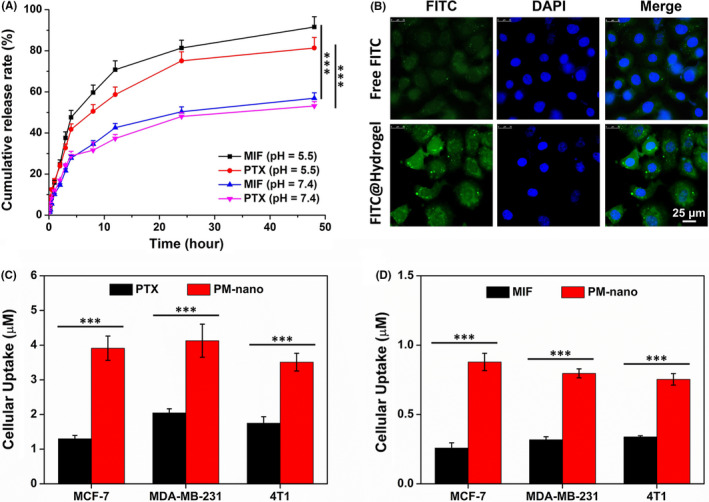
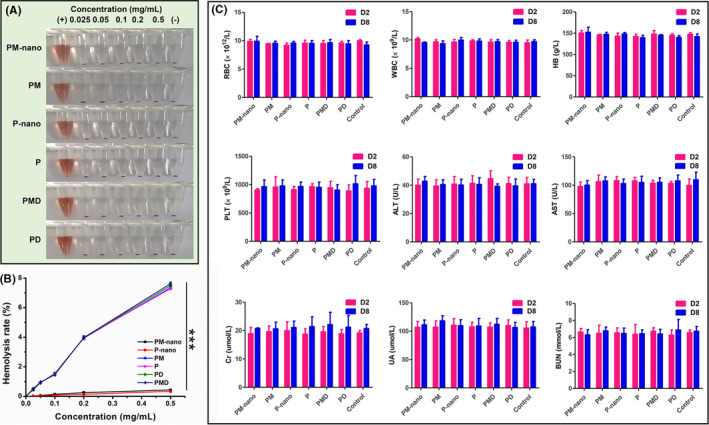
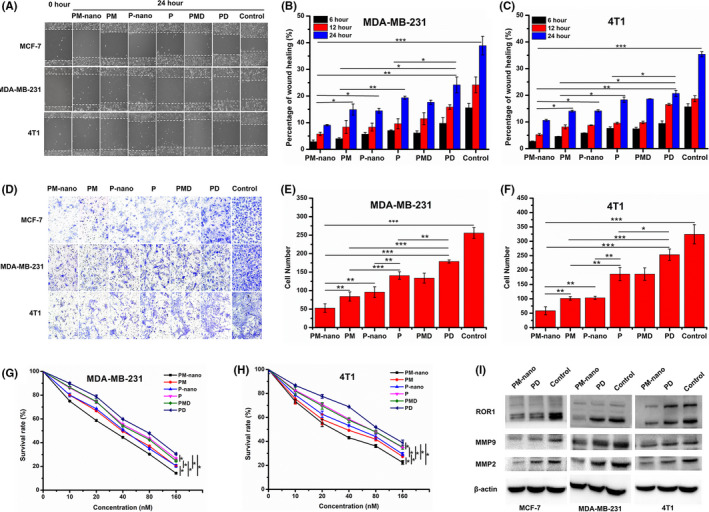
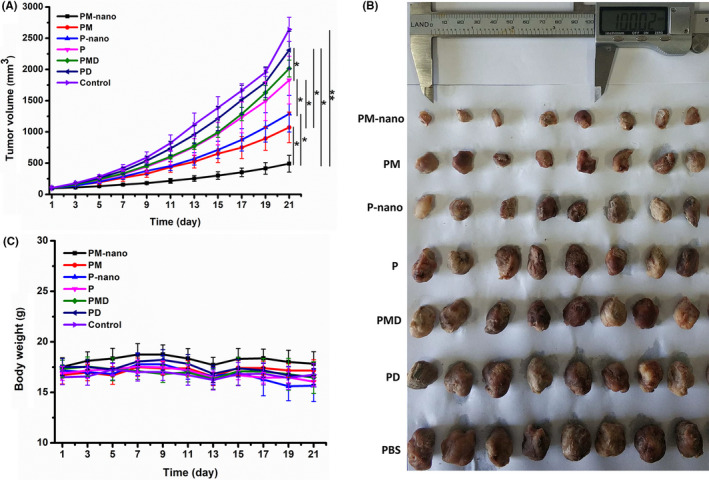
Breast cancer is the leading cause of cancer death among women and almost all of the breast cancer-caused mortality is related to metastasis. It has been reported that glucocorticoid facilitates the metastasis of breast cancer in mice, and mifepristone can antagonize the effect of glucocorticoid. Paclitaxel is one of the important drugs in the treatment of breast cancer. Mifepristone combined with paclitaxel could be an effective strategy for inhibiting breast cancer metastasis. However, their inherent defects, in terms of short blood circulation half-life and lack of tumor targeting, not only limit their effectiveness but also cause adverse reactions. Therefore, our aim is to explore a novel protocol against breast cancer metastasis, further optimize its therapeutic efficacy by a nanodelivery system, and explore its mechanism. Herein, a paclitaxel-conjugated and mifepristone-loaded hydrogel (PM-nano) was prepared by self-assembly. Its characterizations were studied. The antimetastatic effect was evaluated in vitro and in vivo and its mechanism was also explored by western blot assay. The resultant PM-nano was developed with favorable water solubility and good biocompatibility. Moreover, PM-nano displayed increased cell uptake properties and stimulated drug release in the tumor micro-acidic environment. The PM-nano was more effective in inhibiting the proliferation and metastasis of breast cancer than other groups in vitro and in vivo. The PM-nano might inhibit metastasis through glucocorticoid receptor/receptor tyrosine kinase-like orphan receptor 1 and MMPs. Taken together, PM-nano showed superior antimetastatic effects against breast cancer and excellent biocompatibility in vitro and in vivo, providing a new option for limiting metastasis.
乳腺癌是女性癌症死亡的主要原因,几乎所有乳腺癌死亡都与转移有关。有报道称,糖皮质激素促进小鼠乳腺癌转移,米非司酮可以拮抗糖皮质激素的作用。紫杉醇是治疗乳腺癌的重要药物之一。米非司酮联合紫杉醇可能是抑制乳腺癌转移的有效策略。然而,它们固有的缺陷,如血液循环半衰期短和缺乏肿瘤靶向性,不仅限制了它们的疗效,而且还引起了不良反应。因此,我们的目的是探索一种针对乳腺癌转移的新方案,通过纳米递药系统进一步优化其治疗效果,并探讨其机制。本文通过自组装制备了一种紫杉醇偶联和米非司酮负载的水凝胶(PM-nano),并对其进行了表征。研究了其在体外和体内的抗转移作用,并通过 Western blot 检测探讨了其作用机制。结果表明,PM-nano 具有良好的水溶性和生物相容性。此外,PM-nano 在肿瘤微酸性环境中表现出更高的细胞摄取特性和药物释放能力。在体外和体内,PM-nano 比其他组更有效地抑制乳腺癌的增殖和转移。PM-nano 可能通过糖皮质激素受体/受体酪氨酸激酶样孤儿受体 1 和 MMPs 抑制转移。综上所述,PM-nano 表现出优异的抗乳腺癌转移效果和良好的体内外生物相容性,为限制转移提供了一种新的选择。