Takeda Development Center Americas, Inc., Cambridge, MA, USA.
Shire (a member of the Takeda group of companies), Lexington, MA, USA.
Orphanet J Rare Dis. 2021 Dec 4;16(1):501. doi: 10.1186/s13023-021-02118-3.
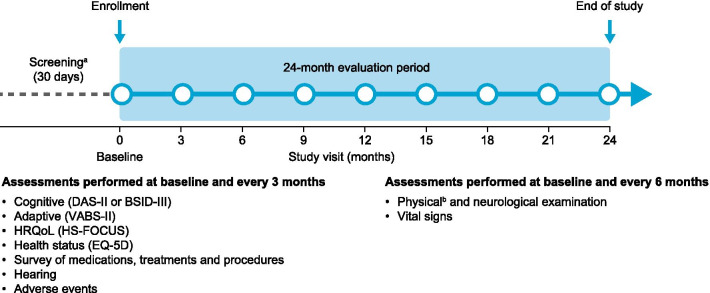
Mucopolysaccharidosis II (MPS II) is a rare lysosomal storage disease characterized by cognitive impairment in most patients. This post hoc analysis evaluated changes in cognitive function, adaptive behavior and functional outcomes in patients with neuronopathic MPS II over time. Fifty-five children with MPS II were enrolled in a 24-month observational study (NCT01822184). The Differential Ability Scales, second edition (DAS-II; early years battery for ages 2 years 6 months to 6 years 11 months, school age battery for ages 7 years to 17 years 11 months), Vineland Adaptive Behavior Scales, second edition (VABS-II) and the Hunter Syndrome-Functional Outcomes for Clinical Understanding Scale (HS-FOCUS) were performed at baseline and 3-month intervals over 2 years. A subgroup of 38 children with a DAS-II General Conceptual Ability (GCA) score of 55-85 (below average-very low abilities) at any time during the study were included in this analysis.
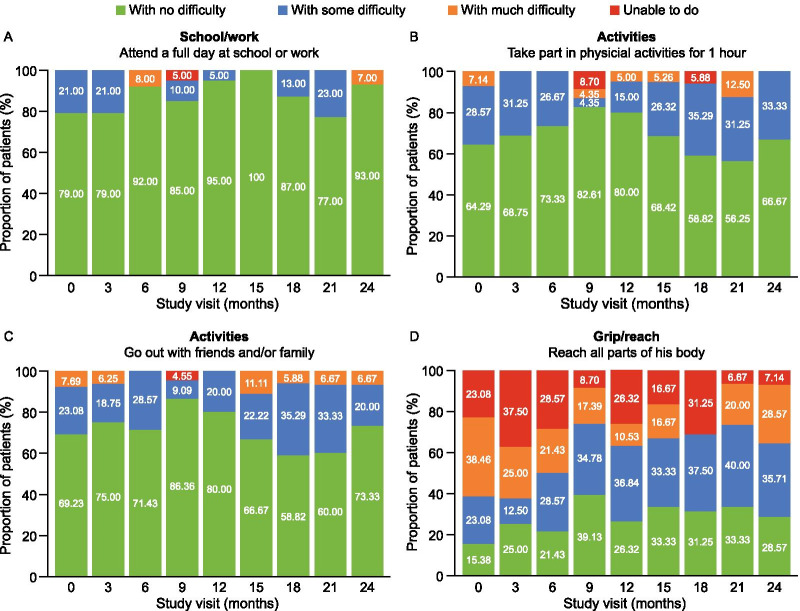
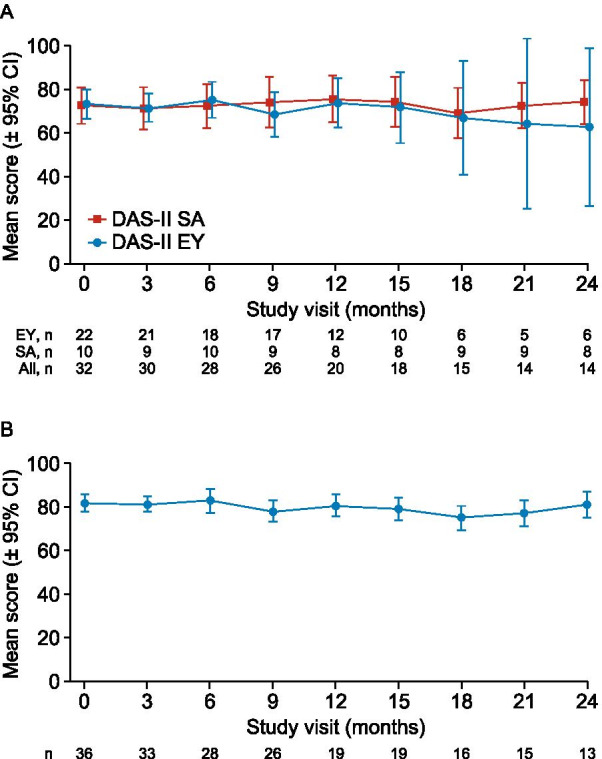
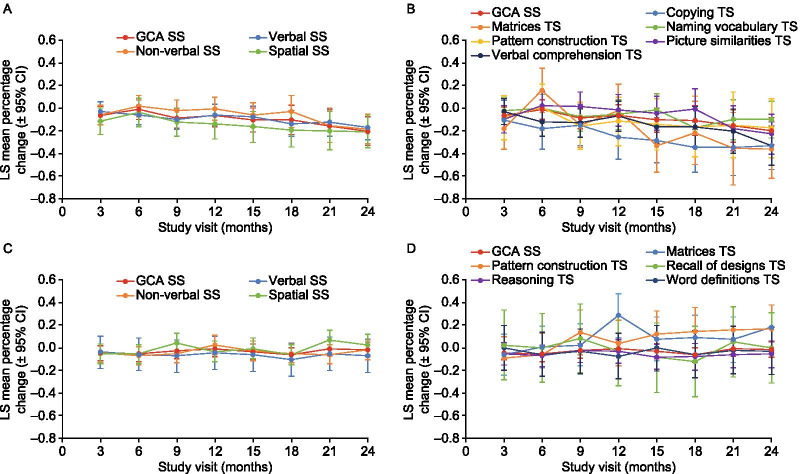
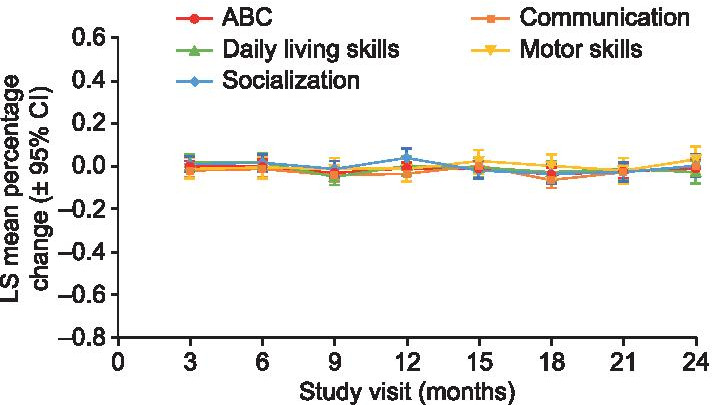
Mean (standard deviation [SD]) early years DAS-II GCA score decreased from 73.4 (15.7, n = 22) at baseline to 62.7 (34.9, n = 6) at month 24. For the six patients with early years GCA assessments at baseline and month 24, mean (SD) GCA scores decreased from 72.3 (21.3) at baseline to 62.7 (34.9) at month 24. School age GCA scores were stable over 2 years: mean (SD) 72.4 (11.8, n = 10) at baseline; 74.3 (12.3, n = 8) at month 24. Mean (SD) VABS-II Adaptive Behavior Composite (ABC) scores were stable throughout the study (baseline, 81.8 [11.8, n = 36]; month 24, 81.0 [10.2, n = 13]). Some associations between items and domains of HS-FOCUS (p < 0.05) and DAS-II GCA and VABS-II ABC scores were shown, but there was no clear pattern of changes in HS-FOCUS over 2 years.
The DAS-II measured changes in cognitive function over 2 years in younger patients with MPS II, whereas cognitive function in older patients remained stable. Further research is required to confirm the content validity of the DAS-II in different patient populations with MPS II. The VABS-II and HS-FOCUS were not sensitive tools for measuring behavioral and functional changes over 2 years. These findings may inform selection of appropriate cognitive and behavioral assessment tools for future studies.
黏多糖贮积症 II 型(MPS II)是一种罕见的溶酶体贮积病,大多数患者都存在认知障碍。本事后分析评估了神经病变型 MPS II 患者随时间推移认知功能、适应行为和功能结局的变化。55 名 MPS II 患儿入组一项为期 24 个月的观察性研究(NCT01822184)。在 2 年内每 3 个月进行一次评估,使用的评估工具包括差异能力量表第二版(DAS-II;早期年龄组为 2 岁 6 个月至 6 岁 11 个月,学龄年龄组为 7 岁至 17 岁 11 个月)、适应行为量表第二版(VABS-II)和亨特综合征临床理解功能量表(HS-FOCUS)。在研究期间的任何时候,DAS-II 一般概念能力(GCA)评分均为 55-85(低于平均水平-极低能力)的 38 名儿童亚组纳入了本分析。
早期 DAS-II GCA 评分的平均值(标准差 [SD])从基线时的 73.4(15.7,n=22)下降至 24 个月时的 62.7(34.9,n=6)。对于基线和 24 个月时均有早期 GCA 评估的 6 名患者,GCA 评分的平均值(SD)从基线时的 72.3(21.3)下降至 24 个月时的 62.7(34.9)。2 年内,学龄 DAS-II GCA 评分保持稳定:基线时平均值(SD)为 72.4(11.8,n=10);24 个月时平均值(SD)为 74.3(12.3,n=8)。VABS-II 适应行为综合评分(ABC)在整个研究期间保持稳定(基线时,81.8[11.8,n=36];24 个月时,81.0[10.2,n=13])。HS-FOCUS 的一些项目和领域与 DAS-II GCA 和 VABS-II ABC 评分之间存在关联(p<0.05),但 2 年内 HS-FOCUS 没有明显的变化模式。
DAS-II 可在 2 年内测量 MPS II 年轻患者的认知功能变化,而年长患者的认知功能保持稳定。需要进一步研究来确认 DAS-II 在不同 MPS II 患者人群中的内容效度。VABS-II 和 HS-FOCUS 不能在 2 年内敏感地测量行为和功能变化。这些发现可能为未来研究选择适当的认知和行为评估工具提供信息。