Sheehan Michael T, Li Ya-Huei, Doi Suhail A, Onitilo Adedayo A
Department of Endocrinology, Marshfield Clinic Health System, Weston, WI, USA.
Cancer Care and Research Center, Marshfield Clinic Research Institute, Marshfield, WI, USA.
Clin Med Insights Endocrinol Diabetes. 2021 Nov 24;14:11795514211059494. doi: 10.1177/11795514211059494. eCollection 2021.
The purpose of this study was to evaluate whether a prior diagnosis of malignancy affected the assessment of parathyroid hormone (PTH) in hypercalcemic patients and whether the rate of this assessment changed over time.
A retrospective cohort study was designed that included adult patients with hypercalcemia with and without a history of malignancy between January 1, 2000 and December 31, 2019 in the Marshfield Clinic Health System (MCHS). The overall and annual rates of PTH assessment in each group was determined. In patients with a PTH assessment, duration of time and number of elevated serum calcium levels between the first documentation of hypercalcemia and the assessment of PTH were recorded, as was the degree of hypercalcemia.
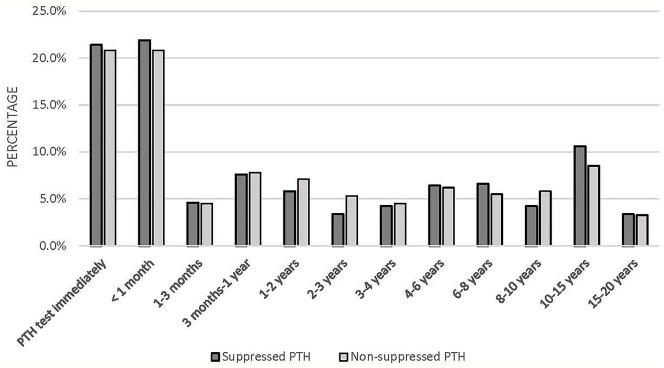
Approximately a quarter (23%) of the patients in each group had a PTH assessment. The rate of PTH assessment initially increased over time but later declined significantly. Although a more severe degree of hypercalcemia predicted a greater probability of PTH assessment, the rate of assessment declined with all degrees of hypercalcemia in the last 5 years. While most patients who had a PTH assessed did so within a few months of the first documentation of hypercalcemia, less than half (40%) had a delay of more than 2 years before a PTH level was drawn.
This lack of appropriate and timely assessment may have significant health consequences in both groups of patients. Better education of providers about the appropriate and timely assessment of PTH in the evaluation of hypercalcemia is urgently needed.
本研究的目的是评估既往恶性肿瘤诊断是否会影响高钙血症患者甲状旁腺激素(PTH)的评估,以及该评估率是否随时间变化。
设计了一项回顾性队列研究,纳入2000年1月1日至2019年12月31日期间在马什菲尔德诊所健康系统(MCHS)中患有或未患有恶性肿瘤病史的成年高钙血症患者。确定每组中PTH评估的总体率和年率。在进行PTH评估的患者中,记录从首次记录高钙血症到评估PTH之间的时间持续长度和血清钙水平升高的次数,以及高钙血症的程度。
每组中约四分之一(23%)的患者进行了PTH评估。PTH评估率最初随时间增加,但后来显著下降。尽管更严重程度的高钙血症预示着PTH评估的可能性更大,但在过去5年中,所有程度的高钙血症患者的评估率均下降。虽然大多数接受PTH评估的患者在首次记录高钙血症后的几个月内进行了评估,但不到一半(40%)的患者在进行PTH水平检测前延迟超过2年。
这种缺乏适当和及时评估的情况可能对两组患者都产生重大健康后果。迫切需要对医疗服务提供者进行更好的教育,使其了解在评估高钙血症时对PTH进行适当和及时评估的方法。