Zhou Chun-Hua, Yang Feng, Jiang Wen-Juan, Zhang Yong-Chang, Yang Hai-Yan, Zeng Liang, Liu Li, Xiong Yi, Zeng Fan-Xu, Wang Zhan, Yang Nong
Lung Cancer and Gastrointestinal Unit, Department of Medical Oncology, Hunan Cancer Hospital/The Affiliated Cancer Hospital of Xiangya School of Medicine, Central South University, Changsha, China.
Center of New Drug Clinical Trial, Hunan Cancer Hospital and The Affiliated Cancer Hospital of Xiangya School of Medicine, Central South University, Changsha, China.
Front Pharmacol. 2021 Nov 17;12:727102. doi: 10.3389/fphar.2021.727102. eCollection 2021.
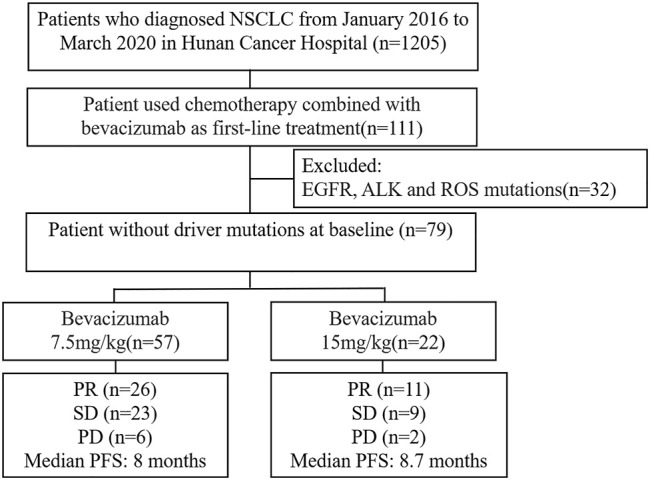
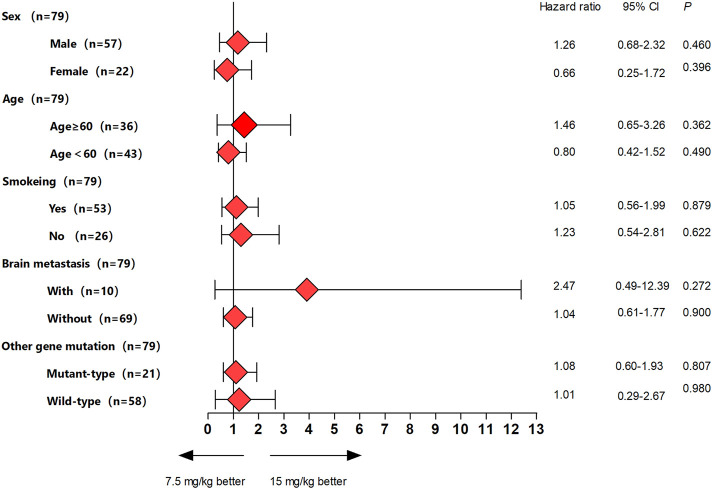
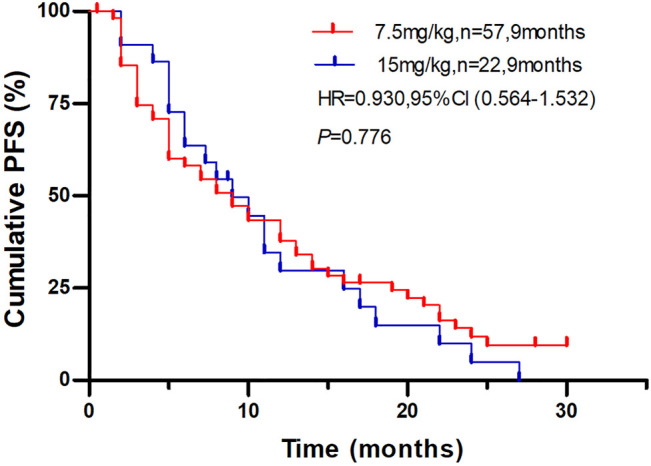
Bevacizumab was demonstrated to have efficacy in patients with NSCLC. However, application of different doses of bevacizumab in different clinical trials was overlooked. This study aims to investigate the effects and safety of different doses of bevacizumab in the treatment. From January 2016 to March 2020, 79 patients with NSCLC received first-line combination treatment with chemotherapy (pemetrexed + platinum) and bevacizumab for four cycles; patients without progression after four cycles were randomly assigned to maintenance therapy with bevacizumab combined with pemetrexed, of which 57 patients received bevacizumab at a dose of 7.5 mg/kg and 22 patients at a dose of 15 mg/kg. The primary endpoint was progression-free survival, and secondary endpoints were overall response rate, disease control rate, and adverse events. There was no significant difference between two groups in effectiveness; Median PFS in 7.5 mg/kg group and in 15 mg/kg group were 8.0 and 8.7 months, respectively ( = 0.663), reaching the primary endpoint. The ORR and DCR in the bevacizumab 7.5 and 15 mg/kg group were 45.46 and 86.0% vs. 50 and 90.9% showing no statistical significance ( = 0.804 and 0.717). Most of side effects were tolerable. The incidences of overall toxicities were higher in 15 mg/kg group ( = 0.001). No new safety signals were observed. We did not detect significant difference of efficacy and safety between 7.5 mg/kg group and 15 mg/kg group for bevacizumab administration, the cost-effectiveness of the 7.5 mg/kg group was significantly better than that of the 15 mg/kg group.
贝伐单抗已被证明对非小细胞肺癌(NSCLC)患者有效。然而,不同临床试验中贝伐单抗不同剂量的应用被忽视了。本研究旨在探讨不同剂量贝伐单抗治疗的效果和安全性。2016年1月至2020年3月,79例NSCLC患者接受了化疗(培美曲塞+铂类)联合贝伐单抗的一线治疗四个周期;四个周期后无进展的患者被随机分配接受贝伐单抗联合培美曲塞的维持治疗,其中57例患者接受7.5mg/kg剂量的贝伐单抗,22例患者接受15mg/kg剂量的贝伐单抗。主要终点是无进展生存期,次要终点是总缓解率、疾病控制率和不良事件。两组在有效性方面无显著差异;7.5mg/kg组和15mg/kg组的中位无进展生存期分别为8.0个月和8.7个月(P=0.663),达到主要终点。贝伐单抗7.5mg/kg组和15mg/kg组的ORR和DCR分别为45.46%和86.0%,以及50%和90.9%,无统计学意义(P=0.804和0.717)。大多数副作用是可耐受的。15mg/kg组的总体毒性发生率更高(P=0.001)。未观察到新的安全信号。我们未检测到7.5mg/kg组和15mg/kg组在贝伐单抗给药的疗效和安全性上有显著差异,7.5mg/kg组的成本效益明显优于15mg/kg组。