Luo Yixiao, Ullah Rafi, Wang Jinfeng, Du Yuru, Huang Shihao, Meng Li, Gao Yuan, Gong Miao, Galaj Ewa, Yin Xi, Shi Haishui
Key Laboratory of Molecular Epidemiology of Hunan Province, School of Medicine, Hunan Normal University, Changsha, China.
Neuroscience Research Center, Institute of Medical and Health Science of HeBMU, Hebei Medical University, Shijiazhuang, China.
Front Pharmacol. 2021 Nov 18;12:757417. doi: 10.3389/fphar.2021.757417. eCollection 2021.
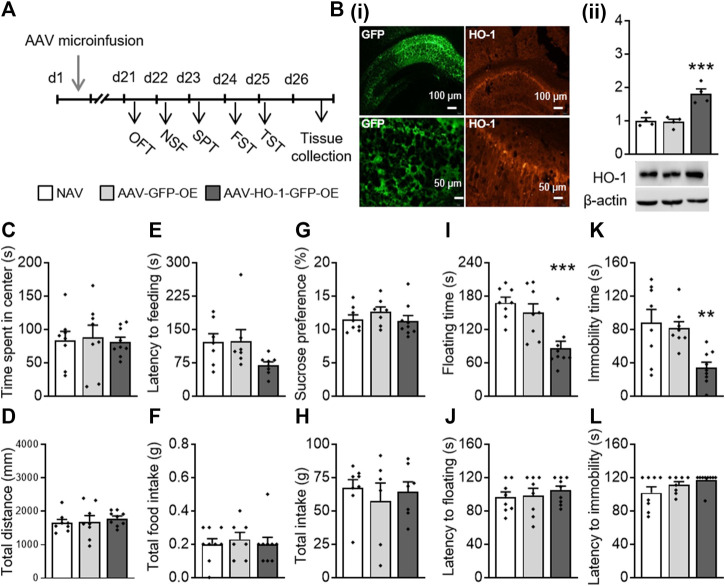
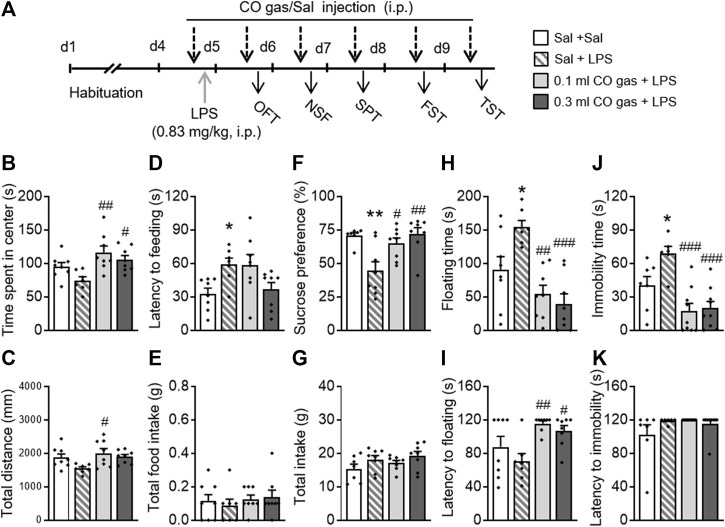
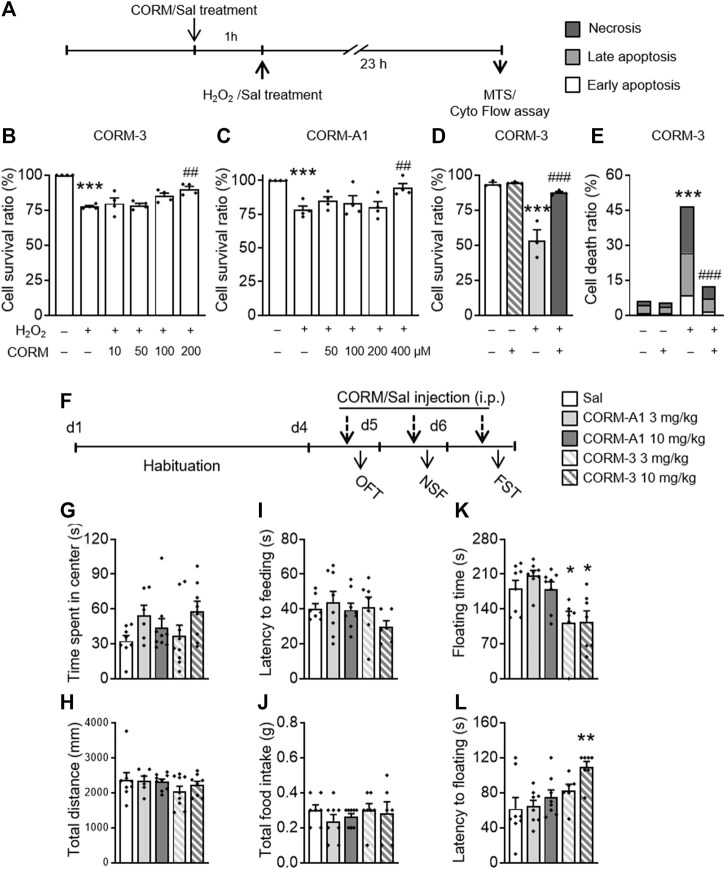
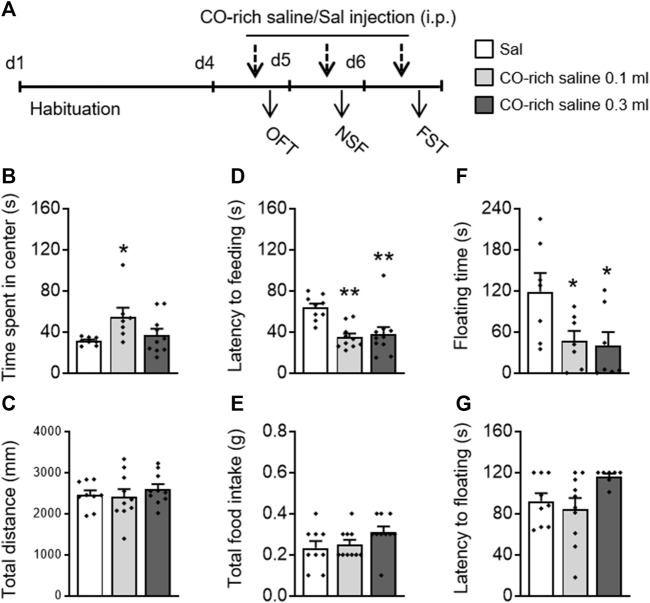
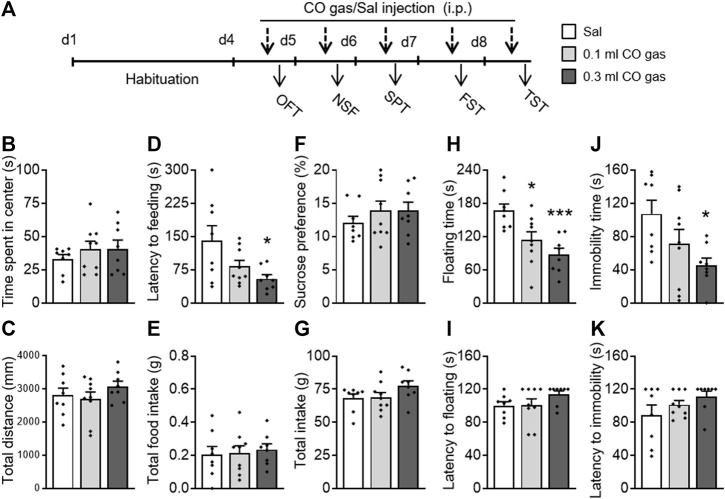
Carbon monoxide (CO), a byproduct of heme catalyzed by heme oxygenase (HO), has been reported to exert antioxidant and anti-inflammatory actions, and to produce significant neuroprotective effects. The potential effects of CO and even HO on depressive-like behaviors are still poorly understood. Utilizing several approaches including adeno-associated virus (AAV)-mediated overexpression of HO-1, systemic CO-releasing molecules (CO-RMs), CO-rich saline or CO gas treatment procedures in combination with hydrogen peroxide (HO)-induced PC12 cell injury model, and lipopolysaccharide (LPS)-induced depression mouse model, the present study aimed to investigate the potential antidepressant- and anxiolytic-like effects of endogenous and exogenous CO administration and . The results of experiments showed that both CO-RM-3 and CO-RM-A1 pretreatment blocked HO-induced cellular injuries by increasing cell survival and decreasing cell apoptosis and necrosis. Similar to the effects of CO-RM-3 and CO-RM-A1 pretreatment, AAV-mediated HO-1 overexpression in the dorsal hippocampus produced significant antidepressant-like activities in mice under normal conditions. Further investigation showed that the CO gas treatment significantly blocked LPS-induced depressive- and anxiety-like behaviors in mice. Taken together, our results suggest that the activation of HO-1 and/or exogenous CO administration produces protective effects and exerts antidepressant- and anxiolytic-like effects. These data uncover a novel function of the HO-1/CO system that appears to be a promising therapeutic target for the treatment of depression and anxiety.
一氧化碳(CO)是血红素加氧酶(HO)催化血红素产生的一种副产物,据报道它具有抗氧化和抗炎作用,并能产生显著的神经保护作用。然而,CO乃至HO对抑郁样行为的潜在影响仍知之甚少。本研究采用多种方法,包括腺相关病毒(AAV)介导的HO-1过表达、全身一氧化碳释放分子(CO-RMs)、富CO生理盐水或CO气体处理程序,结合过氧化氢(HO)诱导的PC12细胞损伤模型和脂多糖(LPS)诱导的抑郁小鼠模型,旨在研究内源性和外源性CO给药的潜在抗抑郁和抗焦虑样作用。实验结果表明,CO-RM-3和CO-RM-A1预处理均通过提高细胞存活率、降低细胞凋亡和坏死来阻断HO诱导的细胞损伤。与CO-RM-3和CO-RM-A1预处理的效果相似,AAV介导的背侧海马HO-1过表达在正常条件下的小鼠中产生了显著的抗抑郁样活性。进一步研究表明,CO气体处理显著阻断了LPS诱导的小鼠抑郁和焦虑样行为。综上所述,我们的结果表明,HO-1的激活和/或外源性CO给药具有保护作用,并发挥抗抑郁和抗焦虑样作用。这些数据揭示了HO-1/CO系统的一种新功能,它似乎是治疗抑郁症和焦虑症的一个有前景的治疗靶点。