Li Yujie, Zhang Mingzi, Tupin Simon, Mitsuzuka Kohei, Nakayama Toshio, Anzai Hitomi, Ohta Makoto
Institute of Fluid Science, Tohoku University, Sendai, Japan.
Centre of Health Research, Torrens University Australia, Pyrmont, NSW, Australia.
Front Physiol. 2021 Nov 19;12:733767. doi: 10.3389/fphys.2021.733767. eCollection 2021.
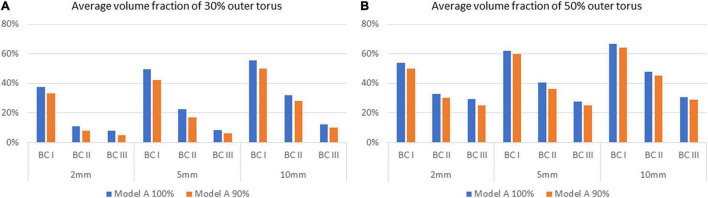
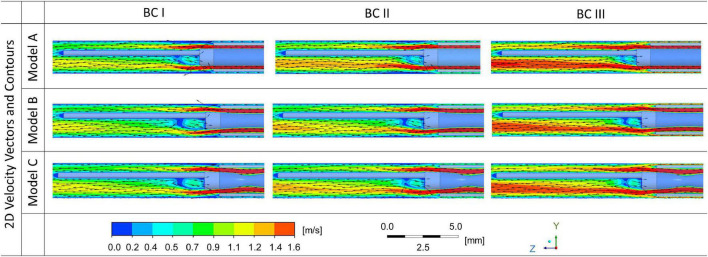
Whilst intravascular endoscopy can be used to identify lesions and assess the deployment of endovascular devices, it requires temporary blockage of the local blood flow during observation, posing a serious risk of ischaemia. To aid the design of a novel flow-blockage-free intravascular endoscope, we explored changes in the haemodynamic behaviour of the flush flow with respect to the flow injection speed and the system design. We first constructed the computational models for three candidate endoscope designs (, Model A, B, and C). Using each of the three endoscopes, flow patterns in the target vessels (straight, bent, and twisted) under three different sets of boundary conditions (, injection speed of the flush flow and the background blood flowrate) were then resolved through use of computational fluid dynamics and flow experiments. The design of endoscope and its optimal operating condition were evaluated in terms of the volume fraction within the vascular segment of interest, as well as the percentage of high-volume-fraction area (PHVFA) corresponding to three cross-sectional planes distal to the microcatheter tip. With a mild narrowing at the endoscope neck, Model B exhibited the highest PHVFA, irrespective of location of the cross-sectional plane, compared with Models A and C which, respectively, had no narrowing and a moderate narrowing. The greatest difference in the PHVFA between the three models was observed on the cross-sectional plane 2 mm distal to the tip of the microcatheter (Model B: 33% vs. Model A: 18%). The background blood flowrate was found to have a strong impact on the resulting volume fraction of the flush flow close to the vascular wall, with the greatest difference being 44% (Model A). We found that the haemodynamic performance of endoscope Model B outperformed that of Models A and C, as it generated a flush flow that occupied the largest volume within the vascular segment of interest, suggesting that the endoscope design with a diameter narrowing of 30% at the endoscope neck might yield images of a better quality.
虽然血管内内窥镜可用于识别病变并评估血管内装置的部署,但在观察过程中需要暂时阻断局部血流,这带来了严重的缺血风险。为了辅助设计一种新型的无血流阻断血管内内窥镜,我们研究了冲洗流的血流动力学行为随流注速度和系统设计的变化。我们首先构建了三种候选内窥镜设计(模型A、B和C)的计算模型。然后,使用这三种内窥镜中的每一种,通过计算流体动力学和流动实验,解析了在三组不同边界条件(冲洗流的注入速度和背景血流速度)下目标血管(直血管、弯血管和扭曲血管)中的流动模式。根据感兴趣血管段内的体积分数以及与微导管尖端远端三个横截面相对应的高体积分数区域百分比(PHVFA),对内窥镜的设计及其最佳操作条件进行了评估。与分别没有变窄和有适度变窄的模型A和C相比,模型B在内窥镜颈部有轻微变窄,无论横截面位置如何,其PHVFA最高。在微导管尖端远端2毫米处的横截面上观察到三种模型之间PHVFA的最大差异(模型B:33% 对模型A:18%)。发现背景血流速度对靠近血管壁的冲洗流的最终体积分数有很大影响,最大差异为44%(模型A)。我们发现内窥镜模型B的血流动力学性能优于模型A和C,因为它产生的冲洗流在感兴趣血管段内占据的体积最大,这表明在内窥镜颈部直径变窄30%的内窥镜设计可能会产生质量更好的图像。