Aix-Marseille Université, Centre National de la Recherche Scientifique (CNRS), Institut National de la Santé et de la Recherche Médicale (INSERM), Institut Paoli Calmettes, Centre de Recherche en Cancérologie de Marseille (CRCM), Equipe Labellisée Ligue Nationale Contre le Cancer 2020, Marseille, France.
Front Immunol. 2021 Nov 12;12:756231. doi: 10.3389/fimmu.2021.756231. eCollection 2021.
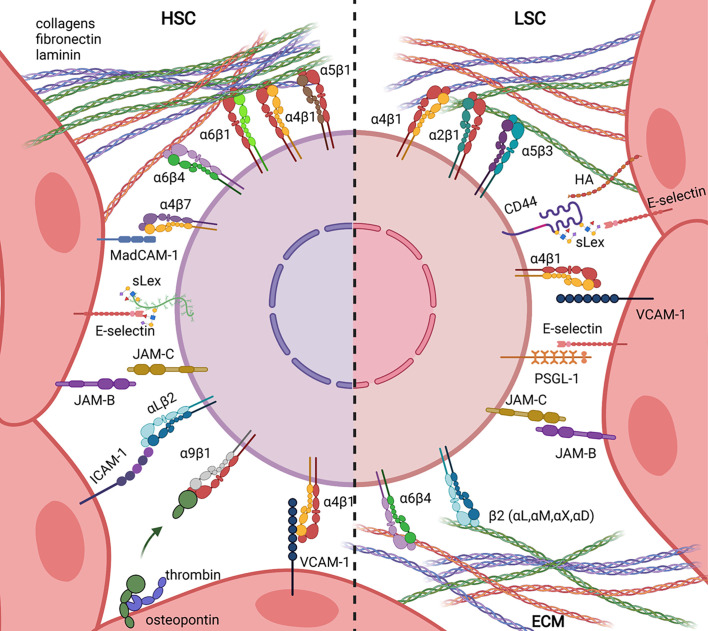
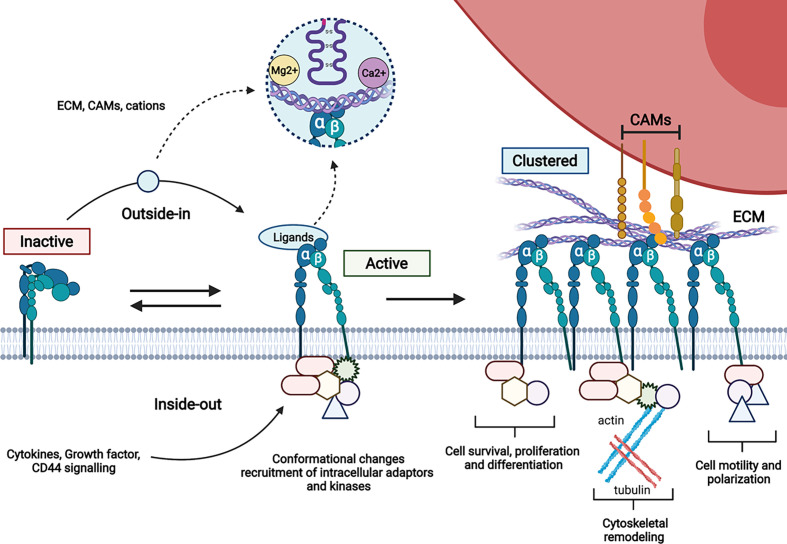
In the bone marrow (BM) of adult mammals, haematopoietic stem cells (HSCs) are retained in micro-anatomical structures by adhesion molecules that regulate HSC quiescence, proliferation and commitment. During decades, researchers have used engraftment to study the function of adhesion molecules in HSC's homeostasis regulation. Since the 90's, progress in genetically engineered mouse models has allowed a better understanding of adhesion molecules involved in HSCs regulation by BM niches and raised questions about the role of adhesion mechanisms in conferring drug resistance to cancer cells nested in the BM. This has been especially studied in acute myeloid leukaemia (AML) which was the first disease in which the concept of cancer stem cell (CSC) or leukemic stem cells (LSCs) was demonstrated. In AML, it has been proposed that LSCs propagate the disease and are able to replenish the leukemic bulk after complete remission suggesting that LSC may be endowed with drug resistance properties. However, whether such properties are due to extrinsic or intrinsic molecular mechanisms, fully or partially supported by molecular crosstalk between LSCs and surrounding BM micro-environment is still matter of debate. In this review, we focus on adhesion molecules that have been involved in HSCs or LSCs anchoring to BM niches and discuss if inhibition of such mechanism may represent new therapeutic avenues to eradicate LSCs.
在成年哺乳动物的骨髓 (BM) 中,造血干细胞 (HSCs) 通过黏附分子保留在微解剖结构中,这些黏附分子调节 HSC 的静止、增殖和定向分化。几十年来,研究人员一直利用植入来研究黏附分子在 HSC 稳态调节中的功能。自 90 年代以来,基因工程小鼠模型的进展使人们能够更好地了解 BM 龛位中参与 HSCs 调节的黏附分子,并提出了黏附机制在赋予 BM 中嵌套的癌细胞耐药性方面的作用问题。这在急性髓系白血病 (AML) 中得到了特别研究,AML 是第一个证明癌症干细胞 (CSC) 或白血病干细胞 (LSCs) 概念的疾病。在 AML 中,有人提出 LSCs 会导致疾病的发生,并在完全缓解后能够补充白血病细胞群,这表明 LSC 可能具有耐药性。然而,这些特性是完全或部分由 LSCs 与周围 BM 微环境之间的分子串扰来支持的,是否归因于外在或内在的分子机制,仍然存在争议。在这篇综述中,我们重点讨论了参与 HSCs 或 LSCs 锚定到 BM 龛位的黏附分子,并讨论了抑制这些机制是否可能代表消灭 LSCs 的新治疗途径。