
代谢组学和转录组学揭示猕猴桃早熟性状的新形成机制()。
Metabolome and Transcriptome Reveal Novel Formation Mechanism of Early Mature Trait in Kiwifruit ().
作者信息
Liao Guanglian, Liu Qing, Xu Xiaobiao, He Yanqun, Li Yiqi, Wang Hailing, Ye Bin, Huang Chunhui, Zhong Min, Jia Dongfeng
机构信息
Jiangxi Provincial Key Laboratory of Silviculture, College of Forestry, Jiangxi Agricultural University, Nanchang, China.
College of Agronomy, Kiwifruit Institute of Jiangxi Agricultural University, Jiangxi Agricultural University, Nanchang, China.
出版信息
Front Plant Sci. 2021 Nov 19;12:760496. doi: 10.3389/fpls.2021.760496. eCollection 2021.
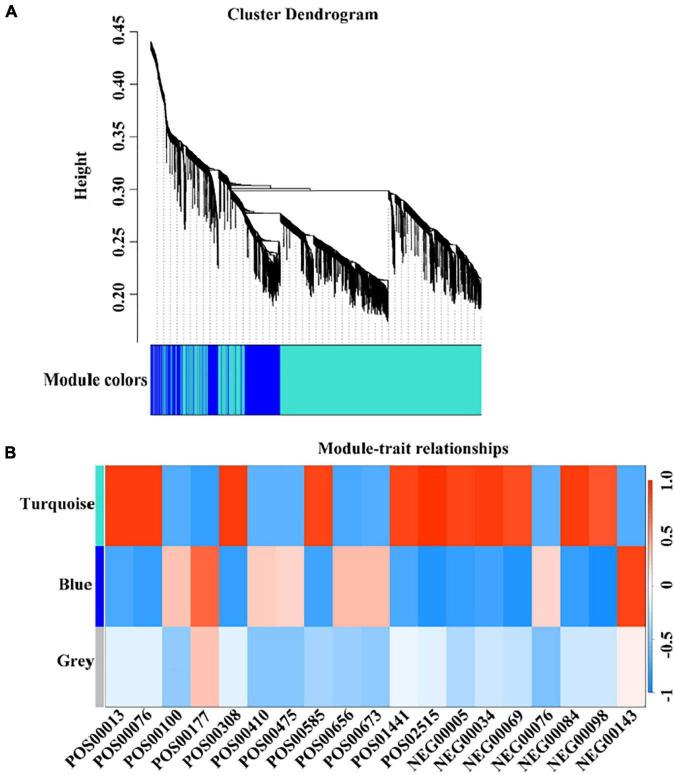
Kiwifruit () is a peculiar berry resource in China, and the maturation period is generally late. Fortunately, we found an early mature germplasm. In order to explore the formation mechanism of its early mature trait, we determined the main carbohydrate and endogenous hormone content of the fruit, and used off-target metabolomics and transcriptomics to identify key regulatory metabolites and genes. We found that early mature germplasm had faster starch conversion rate and higher sucrose, glucose, and fructose content when harvested, while with lower auxin (IAA), abscisic acid (ABA), and zeatin (ZR) content. Through the non-targeted metabolome, 19 and 20 metabolites closely related to fruit maturity and early maturity were identified, respectively. At the same time, weighted correlation network analysis (WGCNA) showed that these metabolites were regulated by 73 and 99 genes, respectively, especially genes related to sugar metabolism were mostly. Based on above, the formation of early mature trait of was mainly due to the sucrose decomposition rate was reduced and the soluble solid content (SSC) accumulated at low levels of endogenous hormones, so as to reach the harvest standard earlier than the late mature germplasm. Finally, ten single nucleotide polymorphism (SNP) loci were developed which can be used for the identification of early mature trait of .
猕猴桃()是中国特有的浆果资源,成熟期一般较晚。幸运的是,我们发现了一种早熟种质。为了探究其早熟性状的形成机制,我们测定了果实的主要碳水化合物和内源激素含量,并利用非靶向代谢组学和转录组学来鉴定关键调控代谢物和基因。我们发现,早熟种质在采收时淀粉转化率更快,蔗糖、葡萄糖和果糖含量更高,而生长素(IAA)、脱落酸(ABA)和玉米素(ZR)含量较低。通过非靶向代谢组学,分别鉴定出19种和20种与果实成熟和早熟密切相关的代谢物。同时,加权基因共表达网络分析(WGCNA)表明,这些代谢物分别受73个和99个基因调控,尤其是与糖代谢相关的基因居多。基于以上研究,猕猴桃早熟性状的形成主要是由于蔗糖分解速率降低,可溶性固形物含量(SSC)在低水平内源激素作用下积累,从而比晚熟种质更早达到采收标准。最后,开发了10个单核苷酸多态性(SNP)位点,可用于猕猴桃早熟性状的鉴定。




 Zotero 插件