Noguchi Kyotaro, Matsuura Yojiro, Morishita Tomoaki, Toriyama Jumpei, Kim Yongwon
Tohoku Research Center, Forestry and Forest Products Research Institute (FFPRI), Morioka, Japan.
Research Planning Department, Forestry and Forest Products Research Institute (FFPRI), Tsukuba, Japan.
Front Plant Sci. 2021 Nov 16;12:769710. doi: 10.3389/fpls.2021.769710. eCollection 2021.
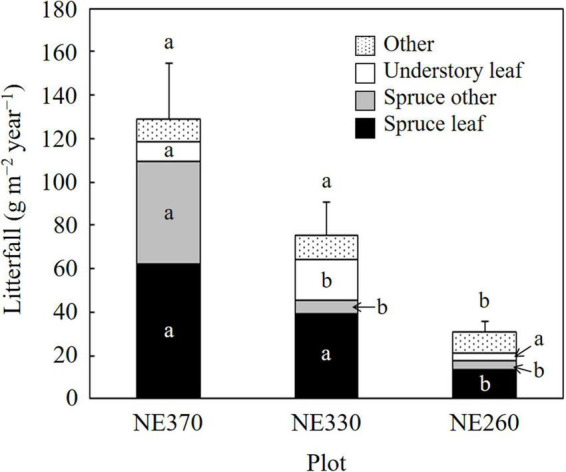
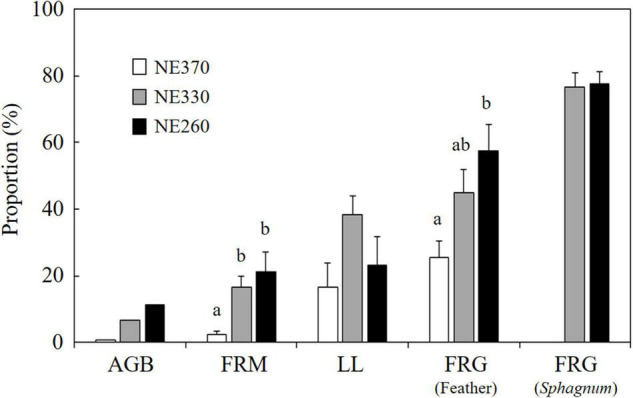
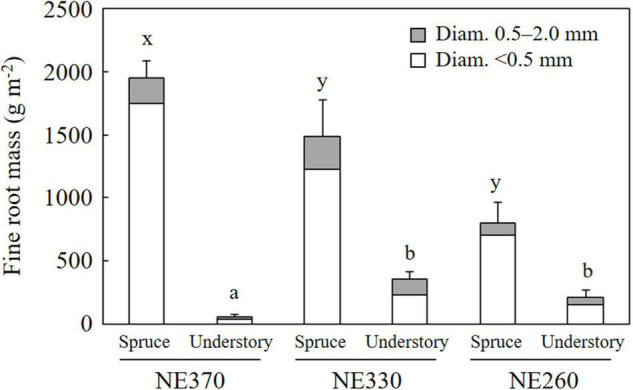
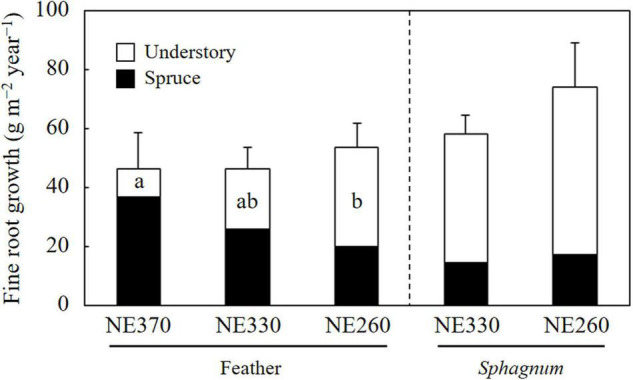
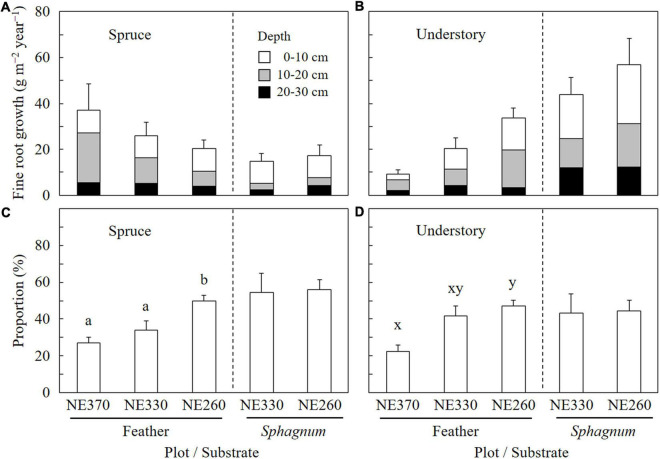
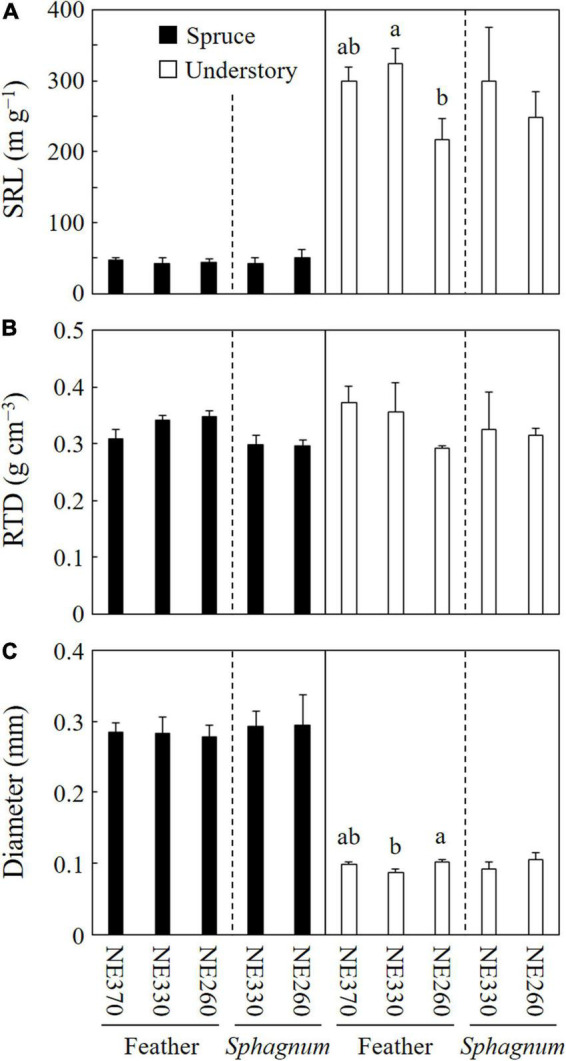
Permafrost forests play an important role in the global carbon budget due to the huge amounts of carbon stored below ground in these ecosystems. Although fine roots are considered to be a major pathway of belowground carbon flux, separate contributions of overstory trees and understory shrubs to fine root dynamics in these forests have not been specifically characterized in relation to permafrost conditions, such as active layer thickness. In this study, we investigated fine root growth and morphology of trees and understory shrubs using ingrowth cores with two types of moss substrates (feather- and mosses) in permafrost black spruce () stands along a north-facing slope in Interior Alaska, where active layer thickness varied substantially. Aboveground biomass, litterfall production rate, and fine root mass were also examined. Results showed that aboveground biomass, fine root mass, and fine root growth of black spruce trees tended to decrease downslope, whereas those of understory Ericaceae shrubs increased. Belowground allocation (e.g., ratio of fine root growth/leaf litter production) increased downslope in both of black spruce and understory plants. These results suggested that, at a lower slope, belowground resource availability was lower than at upper slope, but higher light availability under open canopy seemed to benefit the growth of the understory shrubs. On the other hand, understory shrubs were more responsive to the moss substrates than black spruce, in which moss substrates increased fine root growth of the shrubs as compared with feather moss substrates, whereas the effect was unclear for black spruce. This is probably due to higher moisture contents in moss substrates, which benefited the growth of small diameter (high specific root length) fine roots of understory shrubs. Hence, the contribution of understory shrubs to fine root growth was greater at lower slope than at upper slope, or in than in feather-moss substrates in our study site. Taken together, our data show that fine roots of Ericaceae shrubs are a key component in belowground carbon flux at permafrost black spruce forests with shallow active layer and/or with dominated forest floor.
由于这些生态系统中地下储存着大量碳,永久冻土森林在全球碳预算中发挥着重要作用。尽管细根被认为是地下碳通量的主要途径,但在这些森林中,上层树木和下层灌木对细根动态的单独贡献,尚未针对诸如活动层厚度等永久冻土条件进行具体表征。在本研究中,我们在阿拉斯加内陆北向坡的永久冻土黑云杉林分中,使用带有两种苔藓基质(羽苔和藓类)的内生长芯,研究了树木和下层灌木的细根生长及形态,该区域活动层厚度变化很大。还检查了地上生物量、凋落物产生率和细根质量。结果表明,黑云杉树的地上生物量、细根质量和细根生长倾向于下坡减少,而下层杜鹃花科灌木则增加。黑云杉和下层植物的地下分配(例如,细根生长/落叶产生率的比率)均下坡增加。这些结果表明,在较低坡度处,地下资源可用性低于上坡,但开阔树冠下较高的光照可用性似乎有利于下层灌木的生长。另一方面,下层灌木对苔藓基质的反应比黑云杉更敏感,其中藓类基质与羽苔基质相比增加了灌木的细根生长,而对黑云杉的影响尚不清楚。这可能是由于藓类基质中较高的水分含量,有利于下层灌木小直径(高比根长)细根的生长。因此,在我们的研究地点,下层灌木对细根生长的贡献在较低坡度处比在上坡更大,或在藓类基质中比在羽苔基质中更大。综上所述,我们的数据表明,杜鹃花科灌木的细根是活动层浅和/或藓类为主的森林地面的永久冻土黑云杉林中地下碳通量的关键组成部分。