Bowman Teresa V, Trompouki Eirini
Department of Developmental and Molecular Biology, Albert Einstein College of Medicine, Bronx, NY USA.
Gottesman Institute for Stem Cell Biology and Regenerative Medicine, Albert Einstein College of Medicine, Bronx, NY USA.
Curr Stem Cell Rep. 2021;7(4):219-228. doi: 10.1007/s40778-021-00201-w. Epub 2021 Oct 6.
Hematopoietic stem cells (HSCs) are formed embryonically during a dynamic developmental process and later reside in adult hematopoietic organs in a quiescent state. In response to their changing environment, HSCs have evolved diverse mechanisms to cope with intrinsic and extrinsic challenges. This review intends to discuss how HSCs and other stem cells co-opted DNA and RNA innate immune pathways to fine-tune developmental processes.
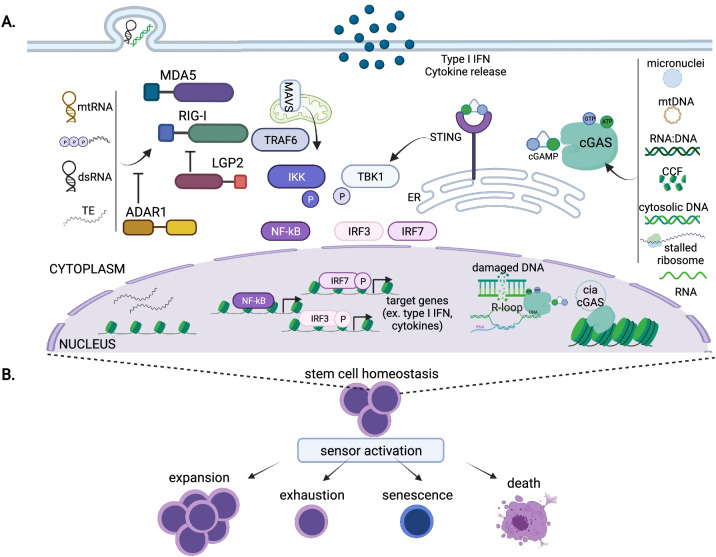
Innate immune receptors for nucleic acids like the RIG-I-like family receptors and members of DNA sensing pathways are expressed in HSCs and other stem cells. Even though the "classic" role of these receptors is recognition of foreign DNA or RNA from pathogens, it was recently shown that cellular transposable element (TE) RNA or R-loops activate such receptors, serving as endogenous triggers of inflammatory signaling that can shape HSC formation during development and regeneration.
Endogenous TEs and R-loops activate RNA and DNA sensors, which trigger distinct inflammatory signals to fine-tune stem cell decisions. This phenomenon could have broad implications for diverse somatic stem cells, for a variety of diseases and during aging.
造血干细胞(HSCs)在胚胎期一个动态发育过程中形成,随后以静止状态存在于成体造血器官中。为应对不断变化的环境,造血干细胞进化出多种机制来应对内在和外在挑战。本综述旨在探讨造血干细胞和其他干细胞如何利用DNA和RNA固有免疫途径来微调发育过程。
像RIG-I样家族受体等核酸的固有免疫受体以及DNA感应途径的成员在造血干细胞和其他干细胞中表达。尽管这些受体的“经典”作用是识别来自病原体的外源DNA或RNA,但最近研究表明,细胞转座元件(TE)RNA或R环可激活此类受体,作为炎症信号的内源性触发因素,在发育和再生过程中塑造造血干细胞的形成。
内源性转座元件和R环激活RNA和DNA传感器,触发不同的炎症信号以微调干细胞的决定。这种现象可能对多种体细胞干细胞、各种疾病以及衰老过程具有广泛影响。