Buja Alessandra, Bardin Andrea, Damiani Giovanni, Zorzi Manuel, De Toni Chiara, Fusinato Riccardo, Spina Romina, Vecchiato Antonella, Del Fiore Paolo, Mocellin Simone, Baldo Vincenzo, Rugge Massimo, Rossi Carlo Riccardo
Department of Cardiologic, Vascular and Thoracic Sciences, and Public Health, University of Padua, Padua, Italy.
Clinical Dermatology, Istituto di Ricovero e Cura a Carattere Scientifico (IRCCS) Istituto Ortopedico Galeazzi, Milan, Italy.
Front Oncol. 2021 Nov 16;11:737399. doi: 10.3389/fonc.2021.737399. eCollection 2021.
Among white people, the incidence of cutaneous malignant melanoma (CMM) has been increasing steadily for several decades. Meanwhile, there has also been a significant improvement in 5-year survival among patients with melanoma. This population-based cohort study investigates the five-year melanoma-specific survival (MSS) for all melanoma cases recorded in 2015 in the Veneto Tumor Registry (North-Est Italian Region), taking both demographic and clinical-pathological variables into consideration.
The cumulative melanoma-specific survival probabilities were calculated with the Kaplan-Meier method, applying different sociodemographic and clinical-pathological variables. Cox's proportional hazards model was fitted to the data to assess the association between independent variables and MSS, and also overall survival (OS), calculating the hazard ratios (HR) relative to a reference condition, and adjusting for sex, age, site of tumor, histotype, melanoma ulceration, mitotic count, tumor-infiltrating lymphocytes (TIL), and stage at diagnosis.
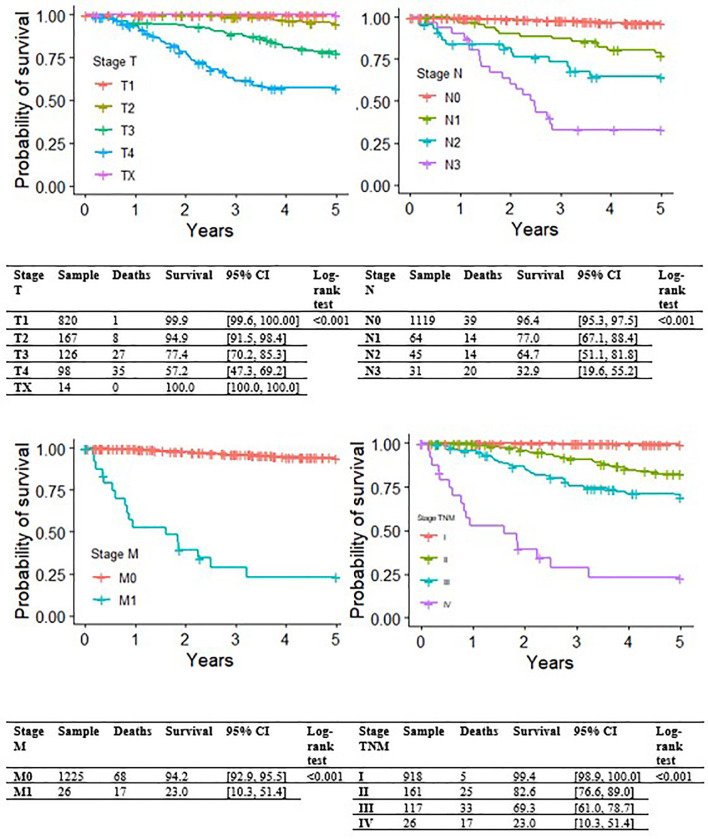
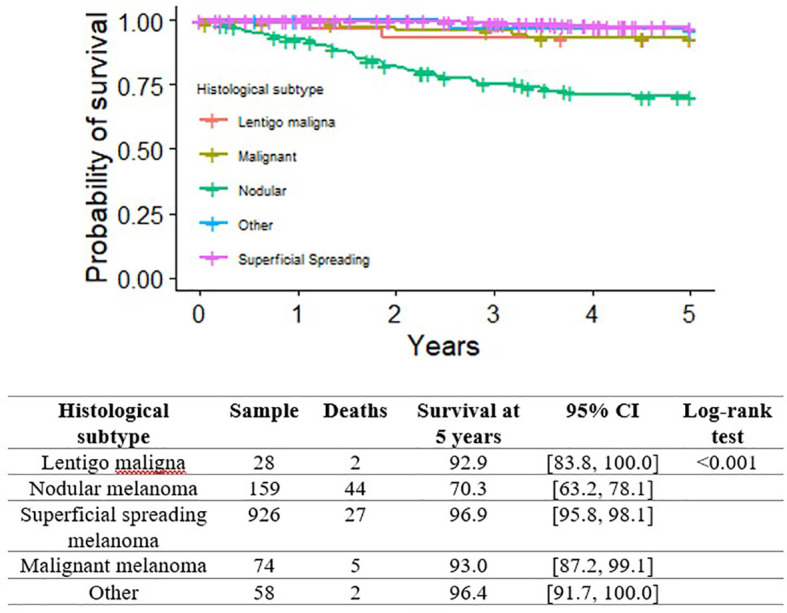
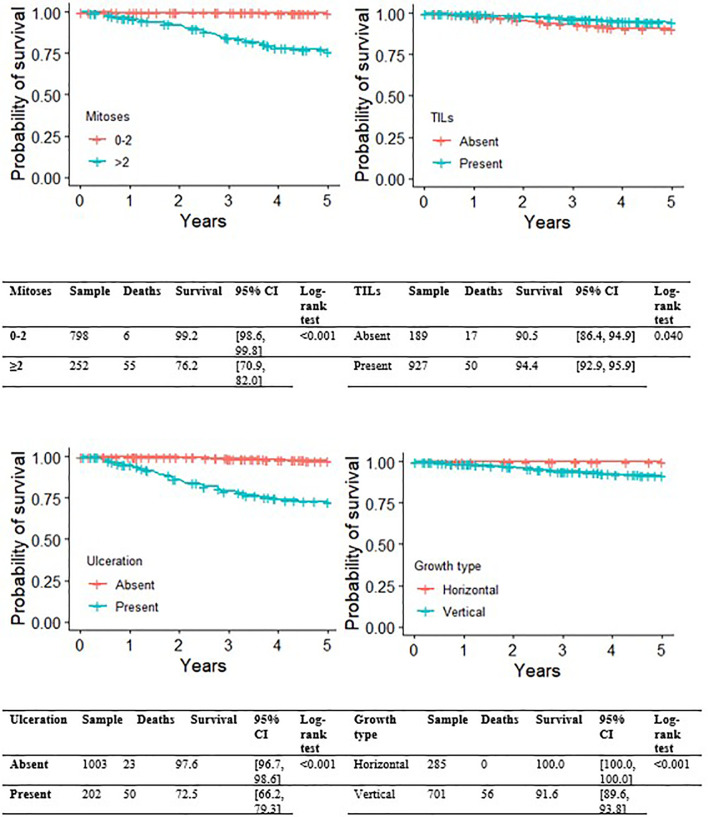
Compared with stage I melanoma, the risk of death was increased for stage II (HR 3.31, 95% CI: 0.94-11.76, p=0.064), almost ten times higher for stage III (HR 10.51, 95% CI: 3.16-35.02, p<0.001), and more than a hundred times higher for stage IV (HR 117.17, 95% CI: 25.30-542.62, p<0.001). Among the other variables included in the model, the presence of mitoses and histological subtype emerged as independent risk factors for death.
The multivariable analysis disclosed that older age, tumor site, histotype, mitotic count, and tumor stage were independently associated with a higher risk of death. Data on survival by clinical and morphological characteristics could be useful in modelling, planning, and managing the most appropriate treatment and follow-up for patients with CMM.
在白人中,皮肤恶性黑色素瘤(CMM)的发病率在几十年间一直稳步上升。与此同时,黑色素瘤患者的5年生存率也有了显著提高。这项基于人群的队列研究调查了2015年在威尼托肿瘤登记处(意大利东北部地区)记录的所有黑色素瘤病例的五年黑色素瘤特异性生存率(MSS),同时考虑了人口统计学和临床病理变量。
采用Kaplan-Meier方法计算累积黑色素瘤特异性生存概率,并应用不同的社会人口统计学和临床病理变量。将Cox比例风险模型应用于数据,以评估自变量与MSS以及总生存率(OS)之间的关联,计算相对于参考条件的风险比(HR),并对性别、年龄、肿瘤部位、组织类型、黑色素瘤溃疡、有丝分裂计数、肿瘤浸润淋巴细胞(TIL)和诊断时的分期进行调整。
与I期黑色素瘤相比,II期的死亡风险增加(HR 3.31,95%CI:0.94-11.76,p=0.064),III期几乎高出十倍(HR 10.51,95%CI:3.16-35.02,p<0.001),IV期则高出一百多倍(HR 117.17,95%CI:25.30-542.62,p<0.001)。在模型纳入的其他变量中,有丝分裂的存在和组织学亚型是死亡的独立危险因素。
多变量分析显示,年龄较大、肿瘤部位、组织类型、有丝分裂计数和肿瘤分期与较高的死亡风险独立相关。根据临床和形态学特征得出的生存数据可能有助于对CMM患者进行建模、规划和管理最合适的治疗及随访。