Tian Wentao, Liu Yi, Cao Chenghui, Zeng Yue, Pan Yue, Liu Xiaohan, Peng Yurong, Wu Fang
Department of Oncology, The Second Xiangya Hospital, Central South University, Changsha, China.
Xiangya School of Medicine, Central South University, Changsha, China.
Front Cell Dev Biol. 2021 Nov 19;9:777018. doi: 10.3389/fcell.2021.777018. eCollection 2021.
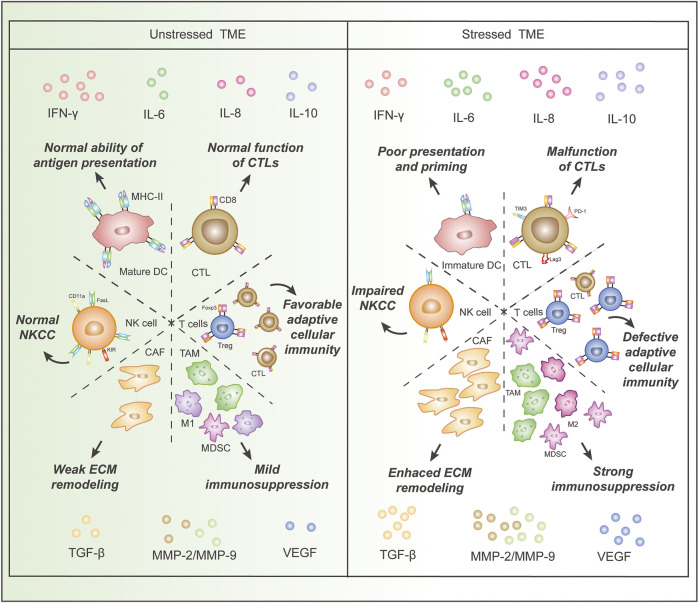
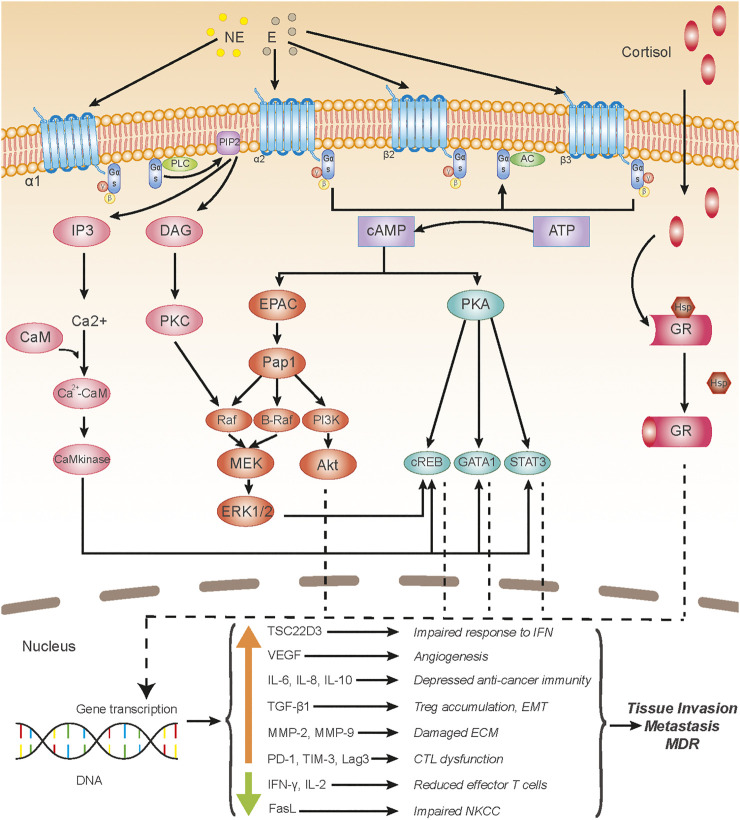
Chronic stress is common among cancer patients due to the psychological, operative, or pharmaceutical stressors at the time of diagnosis or during the treatment of cancers. The continuous activations of the hypothalamic-pituitary-adrenal (HPA) axis and the sympathetic nervous system (SNS), as results of chronic stress, have been demonstrated to take part in several cancer-promoting processes, such as tumorigenesis, progression, metastasis, and multi-drug resistance, by altering the tumor microenvironment (TME). Stressed TME is generally characterized by the increased proportion of cancer-promoting cells and cytokines, the reduction and malfunction of immune-supportive cells and cytokines, augmented angiogenesis, enhanced epithelial-mesenchymal transition, and damaged extracellular matrix. For the negative effects that these alterations can cause in terms of the efficacies of anti-cancer treatments and prognosis of patients, supplementary pharmacological or psychotherapeutic strategies targeting HPA, SNS, or psychological stress may be effective in improving the prognosis of cancer patients. Here, we review the characteristics and mechanisms of TME alterations under chronic stress, their influences on anti-cancer therapies, and accessory interventions and therapies for stressed cancer patients.
由于癌症诊断或治疗期间的心理、手术或药物应激源,慢性应激在癌症患者中很常见。慢性应激导致下丘脑-垂体-肾上腺(HPA)轴和交感神经系统(SNS)持续激活,已被证明通过改变肿瘤微环境(TME)参与多种癌症促进过程,如肿瘤发生、进展、转移和多药耐药。应激的TME通常表现为促癌细胞和细胞因子比例增加、免疫支持细胞和细胞因子减少及功能障碍、血管生成增加、上皮-间质转化增强以及细胞外基质受损。鉴于这些改变可能在抗癌治疗效果和患者预后方面产生负面影响,针对HPA、SNS或心理应激的补充药物或心理治疗策略可能有效改善癌症患者的预后。在此,我们综述了慢性应激下TME改变的特征和机制、它们对抗癌治疗的影响以及针对应激癌症患者的辅助干预和治疗。