Hu Chaur-Jong, Chiu Ming-Jang, Pai Ming-Chyi, Yan Sui-Hing, Wang Pei-Ning, Chiu Pai-Yi, Lin Chin-Hsien, Chen Ta-Fu, Yang Fu-Chi, Huang Kuo-Lun, Hsu Yi-Ting, Hou Yi-Chou, Lin Wei-Che, Lu Cheng-Hsien, Huang Li-Kai, Yang Shieh-Yueh
Department of Neurology, School of Medicine, College of Medicine, Taipei Medical University, Taipei, Taiwan.
Department of Neurology, Dementia Center, Shuang Ho Hospital, Taipei Medical University, New Taipei City, Taiwan.
J Alzheimers Dis Rep. 2021 Oct 21;5(1):761-770. doi: 10.3233/ADR-210310. eCollection 2021.
In Alzheimer's disease (AD), cognitive impairment begins 10-15 years later than neurodegeneration in the brain. Plasma biomarkers are promising candidates for assessing neurodegeneration in people with normal cognition. It has been reported that subjects with the concentration of plasma amyloid-β 1-42×total tau protein higher than 455 pg/ml are assessed as having a high risk of amnesic mild impairment or AD, denoted as high risk of AD (HRAD).
The prevalence of high-risk for dementia in cognitively normal controls is explored by assaying plasma biomarkers.
422 subjects with normal cognition were enrolled around Taiwan. Plasma Aβ, Aβ, and T-Tau levels were assayed using immunomagnetic reduction to assess the risk of dementia.
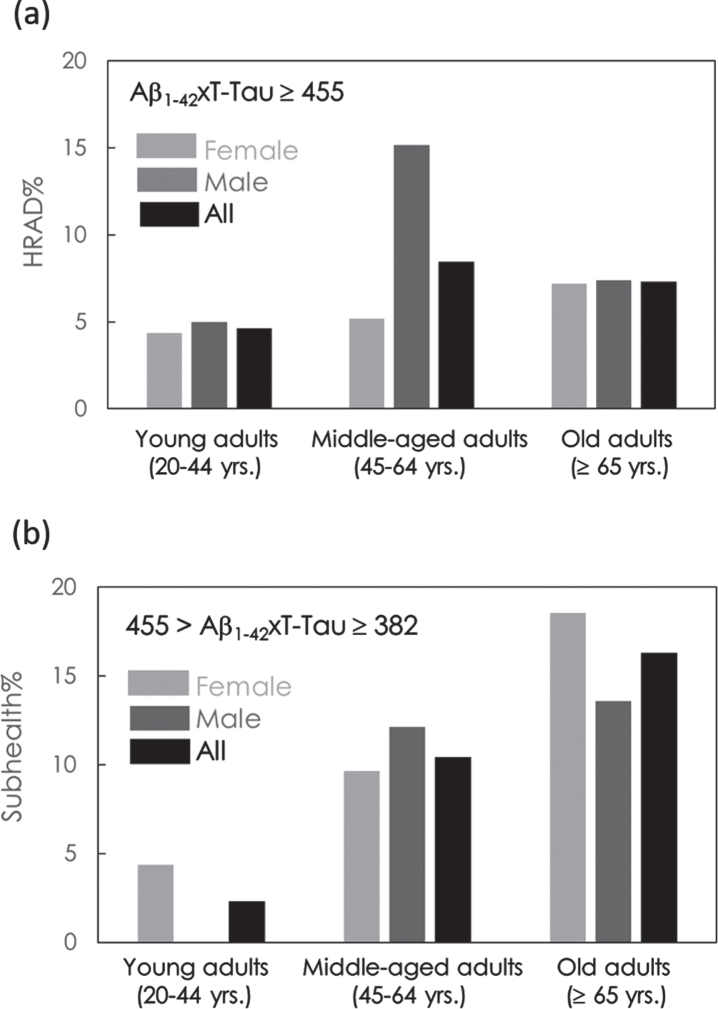
The results showed that 4.6% of young adults (age: 20-44 years), 8.5% of middle-aged adults (age: 45-64 years), and 7.3% of elderly adults (age: 65-90 years) had HRAD. The percentage of individuals with HRAD dramatically increased in middle-aged and elderly adults compared to young adults.
The percentage of HRAD in cognitively normal subjects are approximately 10%, which reveals that the potentially public-health problem of AD in normal population. Although the subject having abnormal levels of Aβ or tau is not definitely going on to develop cognitive declines or AD, the risk of suffering cognitive impairment in future is relatively high. Suitable managements are suggested for these high-risk cognitively normal population. Worth noting, attention should be paid to preventing cognitive impairment due to AD, not only in elderly adults but also middle-aged adults.
在阿尔茨海默病(AD)中,认知障碍比大脑神经退行性变晚10 - 15年出现。血浆生物标志物有望用于评估认知正常人群的神经退行性变。据报道,血浆淀粉样β蛋白1 - 42与总tau蛋白浓度高于455 pg/ml的受试者被评估为有失忆性轻度认知障碍或AD的高风险,即AD高风险(HRAD)。
通过检测血浆生物标志物来探究认知正常对照人群中痴呆高风险的患病率。
在台湾地区招募了422名认知正常的受试者。采用免疫磁珠法检测血浆Aβ、Aβ和T - Tau水平,以评估痴呆风险。
结果显示,年轻成年人(年龄:20 - 44岁)中4.6%有HRAD,中年成年人(年龄:45 - 64岁)中8.5%有HRAD,老年人(年龄:65 - 90岁)中7.3%有HRAD。与年轻成年人相比,中年和老年成年人中HRAD个体的百分比显著增加。
认知正常受试者中HRAD的百分比约为10%,这揭示了正常人群中AD潜在的公共卫生问题。虽然Aβ或tau水平异常的个体不一定会发展为认知衰退或AD,但未来患认知障碍的风险相对较高。建议对这些高风险认知正常人群进行适当管理。值得注意的是,不仅要关注老年人,也要关注中年人的AD所致认知障碍预防。