Zarghamravanbakhsh Paria, Frenkel Michael, Poretsky Leonid
Division of Endocrinology, Department of Medicine, Lenox Hill Hospital, Northwell Health, 110 East 59th St #8B, New York, NY, 10022, USA.
The Gerald J. Friedman Diabetes Institute, Northwell Health, 110 East 59th St #8B, New York, NY, 10022, USA.
Metabol Open. 2021 Nov 16;12:100149. doi: 10.1016/j.metop.2021.100149. eCollection 2021 Dec.
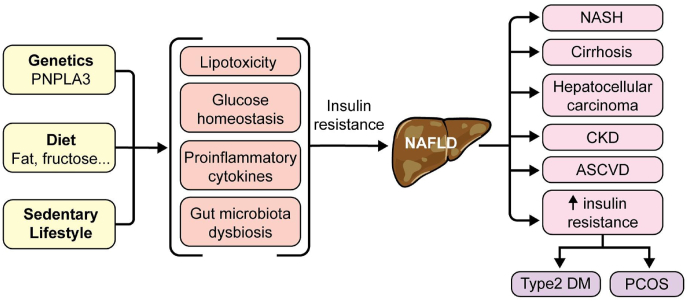
Nonalcoholic fatty liver disease (NAFLD) is a multifactorial metabolic disorder that was first described in 1980. It has been prevalent and on the rise for many years and is associated with other metabolic disorders such as obesity and type 2 diabetes mellitus (T2DM). NAFLD can be best described as a metabolic dysfunction that stems from insulin resistance-induced hepatic lipogenesis. This lipogenesis increases oxidative stress and hepatic inflammation and is often potentiated by genetic and gut microbiome dysfunction. As NAFLD progresses from simple steatosis to non-alcoholic steatohepatitis (NASH) and to cirrhosis and hepatocellular carcinoma (HCC), the odds of complications including cardiovascular disease (CVD), chronic kidney disease (CKD), and overall mortality increase. The aim of this review is to describe the metabolic causes and consequences of NAFLD while examining the risks that each stage of NAFLD poses. In this review, the etiology of "lean" NAFLD, the impact of obesity, T2DM, genetics, and microbiome dysbiosis on NAFLD progression are all explored. This review will also discuss the core issue behind the progression of NAFLD: insulin resistance (IR). Upon describing the causes and consequences of NAFLD, the effectiveness of diet modification, lifestyle changes, and glucagon-like peptide 1 receptor (GLP-1) agonists to retard NAFLD progression and stem the rate of complications is examined.
非酒精性脂肪性肝病(NAFLD)是一种多因素代谢紊乱疾病,于1980年首次被描述。多年来它一直普遍存在且呈上升趋势,并与肥胖和2型糖尿病(T2DM)等其他代谢紊乱有关。NAFLD可以被最好地描述为一种源于胰岛素抵抗诱导的肝脏脂肪生成的代谢功能障碍。这种脂肪生成增加了氧化应激和肝脏炎症,并且常常因遗传和肠道微生物群功能障碍而加剧。随着NAFLD从单纯性脂肪变性发展为非酒精性脂肪性肝炎(NASH),再发展为肝硬化和肝细胞癌(HCC),包括心血管疾病(CVD)、慢性肾脏病(CKD)和总体死亡率在内的并发症发生几率增加。本综述的目的是描述NAFLD的代谢原因和后果,同时研究NAFLD各个阶段所带来的风险。在本综述中,探讨了“瘦型”NAFLD的病因、肥胖、T2DM、遗传学和微生物群失调对NAFLD进展的影响。本综述还将讨论NAFLD进展背后的核心问题:胰岛素抵抗(IR)。在描述了NAFLD的原因和后果之后,研究了饮食调整、生活方式改变和胰高血糖素样肽1受体(GLP-1)激动剂延缓NAFLD进展和降低并发症发生率的有效性。