Institute of Cardiovascular and Medical Sciences, University of Glasgow, Glasgow, Scotland, U.K.
Department of Medicine, University of Padua, Padua, Italy.
Clin Sci (Lond). 2021 Dec 22;135(24):2749-2761. doi: 10.1042/CS20211017.
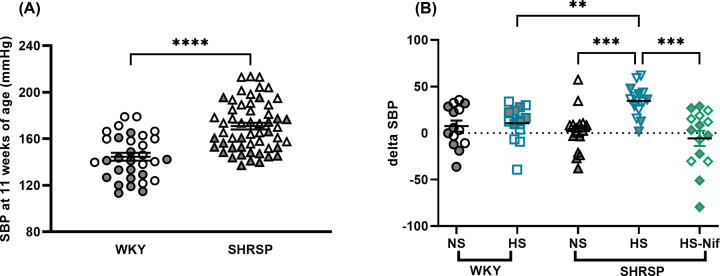
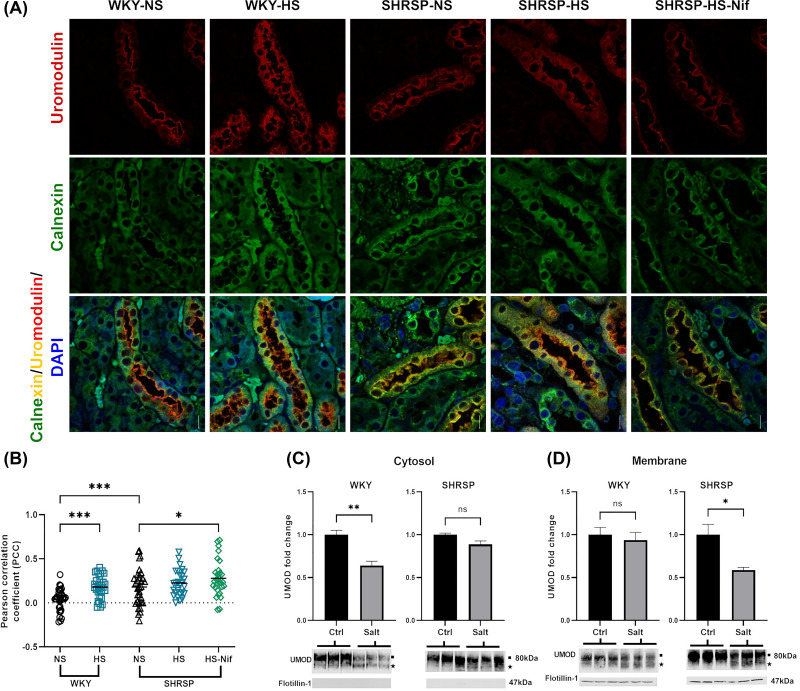
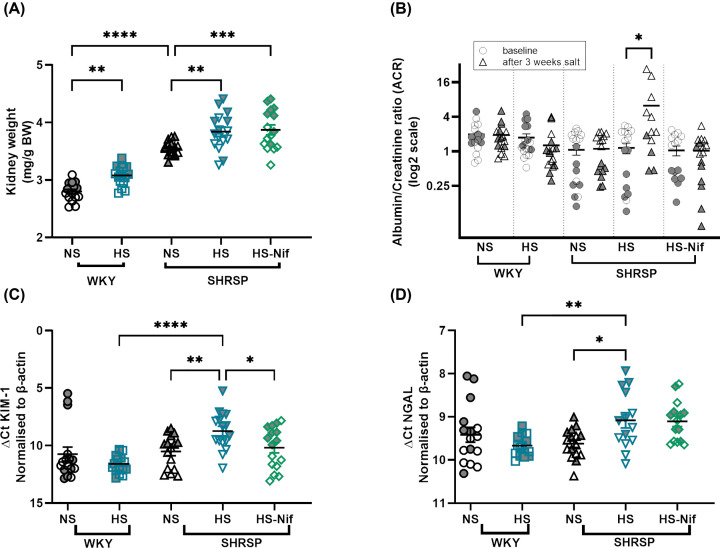
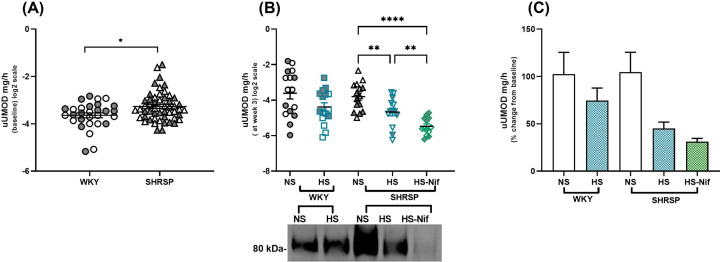
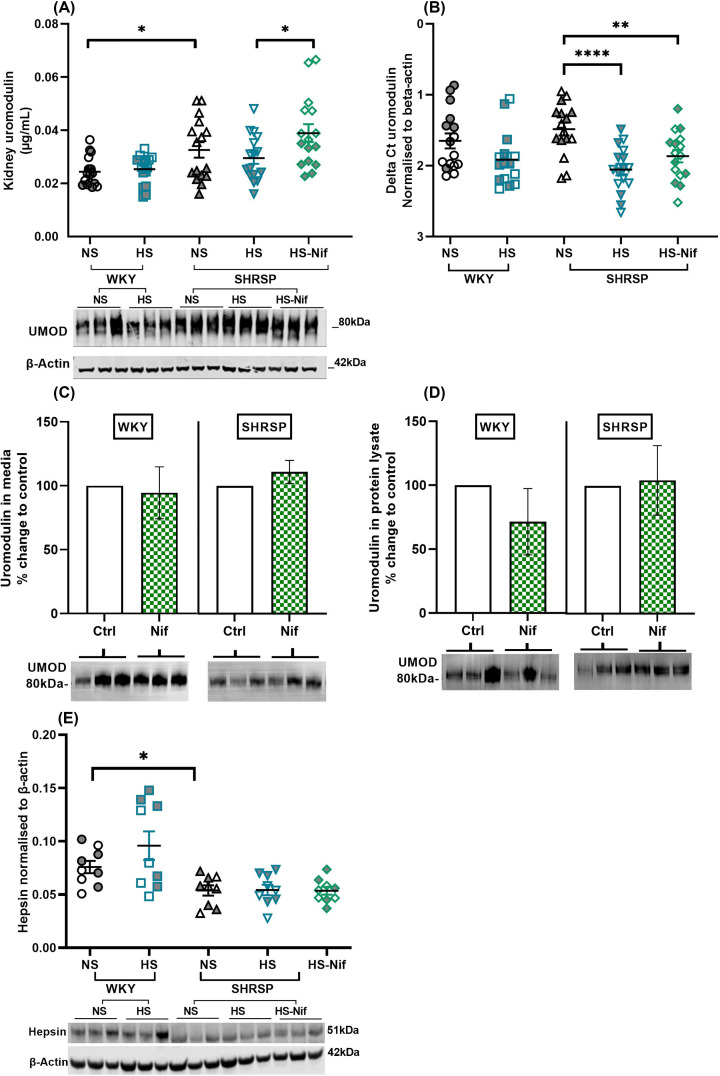
Uromodulin (UMOD) is the most abundant renal protein secreted into urine by the thick ascending limb (TAL) epithelial cells of the loop of Henle. Genetic studies have demonstrated an association between UMOD risk variants and hypertension. We aimed to dissect the role of dietary salt in renal UMOD excretion in normotension and chronic hypertension. Normotensive Wistar-Kyoto rats (WKY) and stroke-prone spontaneously hypertensive rats (SHRSP) (n=8/sex/strain) were maintained on 1% NaCl for 3 weeks. A subset of salt-loaded SHRSP was treated with nifedipine. Salt-loading in SHRSP increased blood pressure (ΔSBP 35 ± 5 mmHg, P<0.0001) and kidney injury markers such as kidney injury marker-1 (KIM-1; fold change, FC 3.4; P=0.003), neutrophil gelatinase-associated lipocalin (NGAL; FC, 2.0; P=0.012) and proteinuria. After salt-loading there was a reduction in urinary UMOD excretion in WKY and SHRSP by 26 and 55% respectively, compared with baseline. Nifedipine treatment reduced blood pressure (BP) in SHRSP, however, did not prevent salt-induced reduction in urinary UMOD excretion. In all experiments, changes in urinary UMOD excretion were dissociated from kidney UMOD protein and mRNA levels. Colocalization and ex-vivo studies showed that salt-loading increased intracellular UMOD retention in both WKY and SHRSP. Our study provides novel insights into the interplay among salt, UMOD, and BP. The role of UMOD as a cardiovascular risk marker deserves mechanistic reappraisal and further investigations based on our findings.
尿调蛋白(UMOD)是由亨利氏袢升支粗段(TAL)上皮细胞分泌到尿液中的最丰富的肾脏蛋白。遗传研究表明,UMOD 风险变异与高血压之间存在关联。我们旨在剖析饮食盐在正常血压和慢性高血压中对肾脏 UMOD 排泄的作用。将正常血压的 Wistar-Kyoto 大鼠(WKY)和易发生卒中的自发性高血压大鼠(SHRSP)(n=8/性别/品系)维持在 1%NaCl 饮食 3 周。盐负荷的 SHRSP 亚组接受硝苯地平治疗。盐负荷使 SHRSP 的血压升高(ΔSBP 增加 35±5mmHg,P<0.0001),并增加了肾脏损伤标志物,如肾损伤标志物-1(KIM-1;倍数变化,FC 3.4;P=0.003)、中性粒细胞明胶酶相关脂质运载蛋白(NGAL;FC 2.0;P=0.012)和蛋白尿。与基线相比,盐负荷使 WKY 和 SHRSP 的尿 UMOD 排泄分别减少了 26%和 55%。硝苯地平治疗降低了 SHRSP 的血压,但不能预防盐诱导的尿 UMOD 排泄减少。在所有实验中,尿 UMOD 排泄的变化与肾脏 UMOD 蛋白和 mRNA 水平无关。共定位和离体研究表明,盐负荷增加了 WKY 和 SHRSP 细胞内 UMOD 的保留。我们的研究为盐、UMOD 和血压之间的相互作用提供了新的见解。基于我们的发现,UMOD 作为心血管风险标志物的作用值得进行机制再评价和进一步研究。