Department of Hepatobiliary Surgery, the First Affiliated Hospital of Xi'an Jiaotong University, No. 277 Yanta West Road, Xi'an, 710061, China.
Key Laboratory of Tumor Molecular Diagnosis and Individualized Medicine of Zhejiang Province, Zhejiang Provincial People's Hospital (People's Hospital of Hangzhou Medical College), Hangzhou, Zhejiang, 310014, China.
Cell Death Dis. 2021 Dec 6;12(12):1134. doi: 10.1038/s41419-021-04418-9.
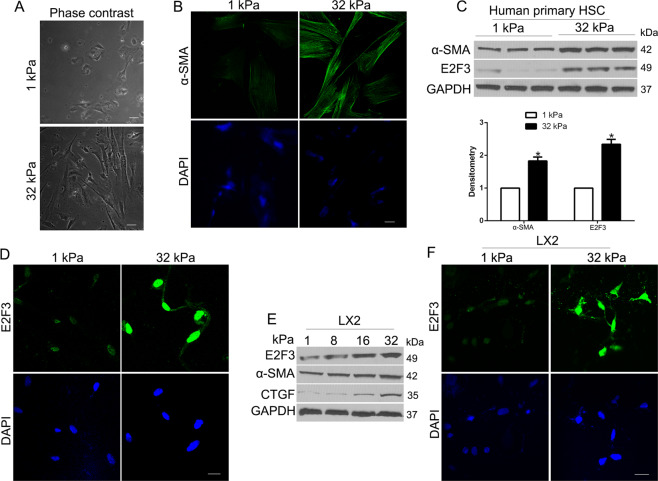
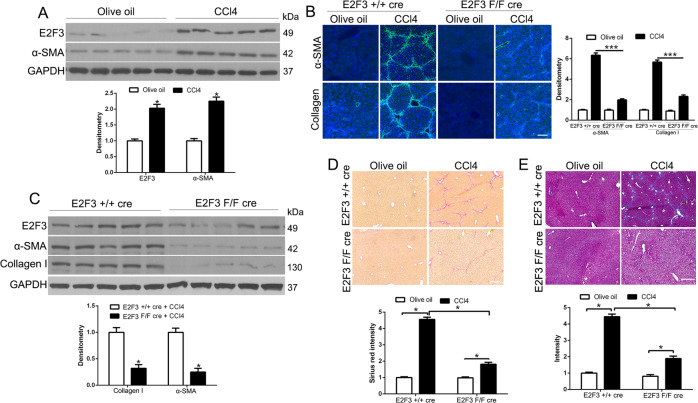
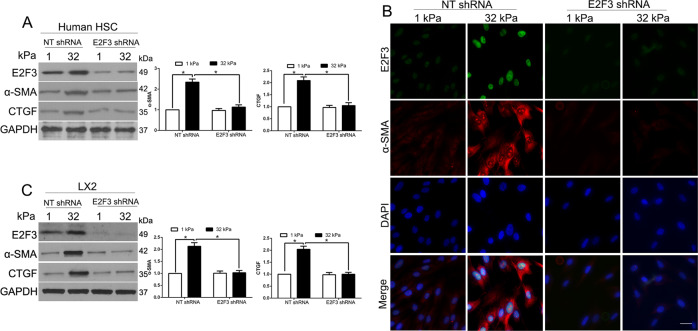
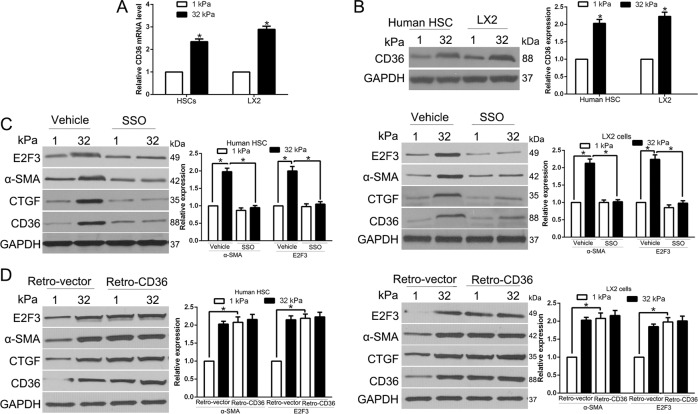
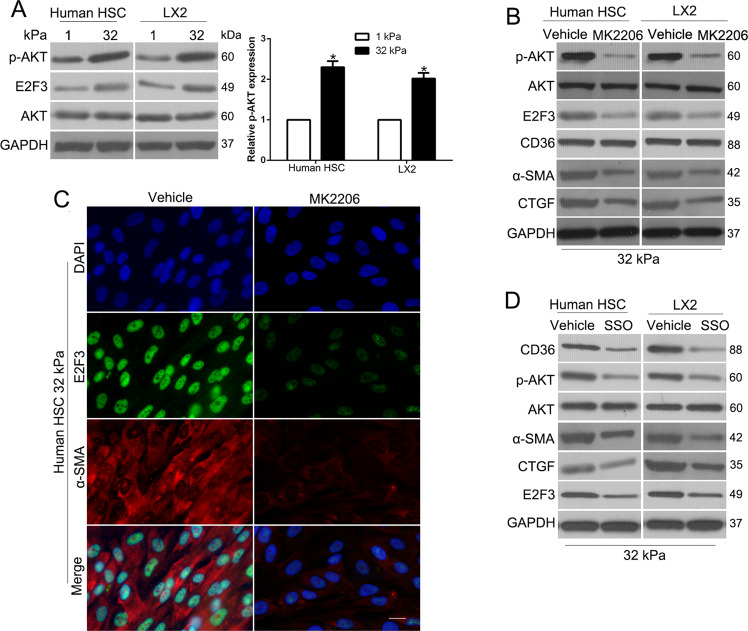
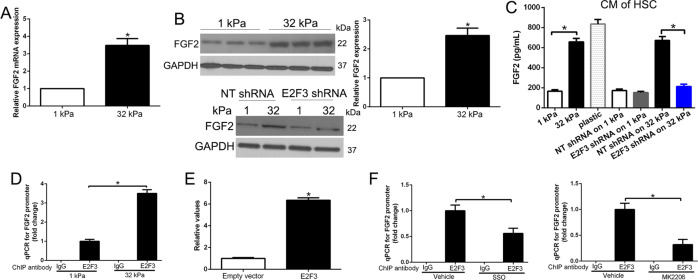
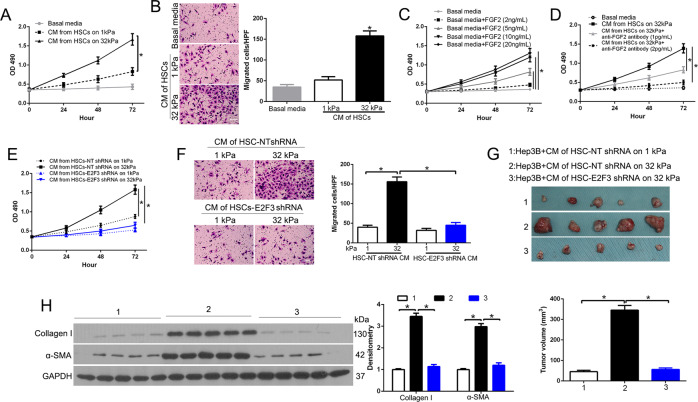
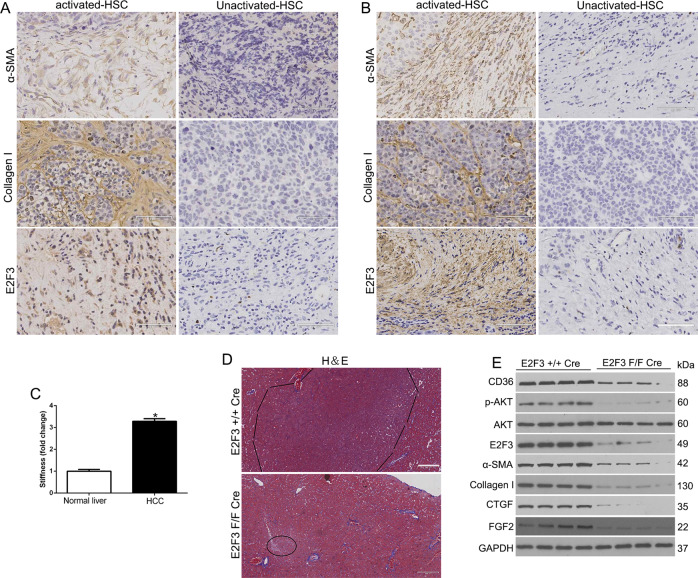
The hepatic stellate cells (HSCs) activation by myofibroblastic differentiation is critical for liver fibrosis. Crosstalk between stromal cells and tumor cells in the microenvironment alters the properties and facilitates the growth and metastasis of tumor cells. How mechanical stimuli originally stiffness of extracellular matrix (ECM) contribute to tumor development remains poorly understood. Here, we demonstrated that stiffness contributes to mechanosignal transduction in HSCs, which promotes hepatocellular carcinoma (HCC) cells growth and metastasis through secretion of FGF2. On stiffness matrix, HSCs activation was confirmed by immunofluorescence (IF) and Western blot (WB) for α-smooth muscle actin (SMA). Increasing matrix stiffness promoted HSCs activation by CD36-AKT-E2F3 mechanosignaling through shRNA-mediated E2F3 knockdown, AKT inhibitors, and CD36 shRNA. Moreover, ChIP-qPCR. Confirmed that E2F3 combined the promoter of FGF2, and stiffness promoted FGF2 expression. On a stiff matrix, HCC cells cultured with conditioned media (CM) from HSCs increased HCC cells growth and metastasis by binding FGFR1 to activate PI3K/AKT and MEK/ERK signaling pathways. Moreover, conditional E2F3 knockout mice were subjected to CCl4 treatment to assess the role of E2F3 in HSC activation. Additionally, the DEN-induced HCC model was also used to evaluate the role of E2F3 in liver fibrosis and HCC growth. In conclusion, we demonstrated that stiffness-induced HSC activation by E2F3 dependent. Stiffness activated CD36-AKT-E2F3 signaling and targeted FGF2 transcription, subsequently, activated HCC growth and metastasis by FGFR1-mediated PI3K/AKT and MEK/ERK signaling.
肝星状细胞(HSCs)的肌成纤维细胞分化激活对于肝纤维化至关重要。微环境中基质细胞与肿瘤细胞之间的串扰改变了肿瘤细胞的特性,并促进了其生长和转移。机械刺激最初是细胞外基质(ECM)的刚性如何促进肿瘤的发展,目前仍知之甚少。在这里,我们证明了刚性有助于 HSCs 中的机械信号转导,通过分泌 FGF2 促进肝细胞癌(HCC)细胞的生长和转移。通过免疫荧光(IF)和 Western blot(WB)检测α-平滑肌肌动蛋白(SMA),在刚性基质上证实了 HSCs 的激活。通过 shRNA 介导的 E2F3 敲低、AKT 抑制剂和 CD36 shRNA,增加基质刚性通过 CD36-AKT-E2F3 机械信号促进 HSCs 激活。此外,ChIP-qPCR 证实 E2F3 结合了 FGF2 的启动子,并且刚性促进了 FGF2 的表达。在刚性基质上,用 HSCs 的条件培养基(CM)培养 HCC 细胞通过结合 FGFR1 激活 PI3K/AKT 和 MEK/ERK 信号通路,增加 HCC 细胞的生长和转移。此外,还对条件性 E2F3 敲除小鼠进行 CCl4 处理以评估 E2F3 在 HSC 激活中的作用。此外,还使用 DEN 诱导的 HCC 模型来评估 E2F3 在肝纤维化和 HCC 生长中的作用。总之,我们证明了 E2F3 依赖性的刚性诱导的 HSC 激活。刚性激活 CD36-AKT-E2F3 信号,并靶向 FGF2 转录,随后通过 FGFR1 介导的 PI3K/AKT 和 MEK/ERK 信号激活 HCC 生长和转移。