Miyachi Ryo, Sawai Shun, Maeta Kazuki, Miyazaki Junya
Faculty of Health and Medical Sciences, Hokuriku University: 1-1 Taiyogaoka, Kanazawa, Ishikawa 920-1180, Japan.
Department of Rehabilitation, Ikuseikai, Kyoto Kuno Hospital, Japan.
J Phys Ther Sci. 2021 Dec;33(12):912-916. doi: 10.1589/jpts.33.912. Epub 2021 Dec 1.
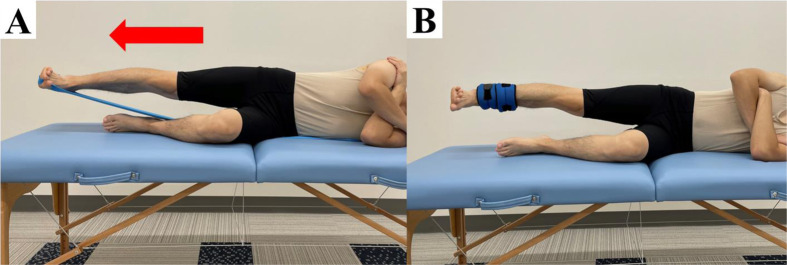
[Purpose] This study investigated the effects of elongation training on the hip abductor muscles in comparison with the effects of general hip abductor training. [Participants and Methods] This study included 39 healthy male university students. The participants were divided into elongation training and general-weighted hip abduction training groups. An elastic band was used for elongation training, and hip abduction exercises were performed with instructions to extend the foot as far as possible to stretch the band. Measurements were taken before and after training, and the surface electromyographic data of the gluteus medius and the tensor fasciae latae were measured during isometric contraction of the hip abductor muscles. The surface electromyogram data were used to calculate integral values and median power frequencies to compare the effects of training. [Results] In comparison with general hip abductor training, elongation training yielded a larger change in the ratio of muscle integral values (gluteus medius/tensor fasciae latae). [Conclusion] Elongation training of the hip abductor muscles was more useful than general training in increasing the activity of the gluteus medius while suppressing the activity of the tensor fasciae latae.
[目的] 本研究比较了伸展训练与一般髋外展训练对髋外展肌的影响。[参与者与方法] 本研究纳入39名健康男性大学生。参与者被分为伸展训练组和一般负重髋外展训练组。伸展训练使用弹力带,进行髋外展练习时按要求尽可能伸展足部以拉伸弹力带。在训练前后进行测量,在髋外展肌等长收缩期间测量臀中肌和阔筋膜张肌的表面肌电图数据。表面肌电图数据用于计算积分值和中位功率频率,以比较训练效果。[结果] 与一般髋外展训练相比,伸展训练使肌肉积分值(臀中肌/阔筋膜张肌)的比值变化更大。[结论] 髋外展肌的伸展训练在增加臀中肌活动的同时抑制阔筋膜张肌的活动方面比一般训练更有效。