Finnish Institute for Health and Welfare, Helsinki, Finland.
The Finnish Foundation for Alcohol Studies, Helsinki, Finland.
J Gambl Stud. 2022 Dec;38(4):1243-1256. doi: 10.1007/s10899-021-10091-6. Epub 2021 Dec 7.
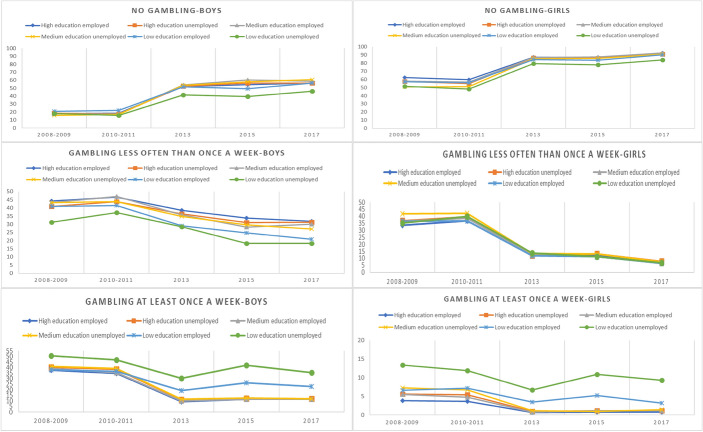
Legislation prohibiting minors from engaging in gambling is a gambling policy measure set to protect adolescents from the harmful effects of gambling. The Finnish gambling system is based on a state monopoly, regulated by the Lotteries Act. After an amendment to the Lotteries Act, the new minimum legal gambling age was raised to 18 years old between 2010 and 2011. The main purpose of this study was to discover how the amendment to the act altered adolescents' gambling (14-16-year-olds) and to examine whether the amendment decreased socio-economic differences. Adolescents gambling was studied before (2008-2009), during (2010-2011), and after (2013-2017) the age limit of gambling was raised in Finland. The study based on five waves (2008-2009, 2010-2011, 2013, 2015, 2017) of the national repeated cross-sectional School Health Promotion Study. Cross-tabulations where gambling was studied by study year and socio-economic status (SES) were formulated, and the statistical differences were studied by using χ-tests. Percentage change in gambling frequency was also examined by study year and SES. Study years were analyzed separately to model the weekly gambling via logistic regression models. Adolescent gambling significantly decreased over time. It appears that raising the legal gambling age had a permanent effect on under-aged gambling. However, differences in gambling by adolescents' family's SES increased during the study period, indicating widening inequalities in gambling among adolescents. Diminishing inequalities in adolescent gambling is likely to require both societal action and consensus on adolescent gambling being a significant social and public health concern.
禁止未成年人参与赌博的立法是一项旨在保护青少年免受赌博有害影响的赌博政策措施。芬兰的赌博制度基于国家垄断,由《彩票法》监管。在《彩票法》修正案通过后,新的最低合法赌博年龄在 2010 年至 2011 年间提高到 18 岁。本研究的主要目的是发现该法案修正案如何改变青少年(14-16 岁)的赌博行为,并检验该修正案是否减少了社会经济差异。在芬兰提高赌博年龄限制之前(2008-2009 年)、期间(2010-2011 年)和之后(2013-2017 年),对青少年赌博行为进行了研究。该研究基于五次全国重复横断面学校健康促进研究的调查(2008-2009 年、2010-2011 年、2013 年、2015 年和 2017 年)。通过研究年份和社会经济地位(SES)制定了赌博研究的交叉表,并通过使用 χ2 检验研究了统计差异。还通过研究年份和 SES 检查了赌博频率的百分比变化。按研究年份分别分析以通过逻辑回归模型对每周赌博进行建模。青少年赌博行为随时间显著减少。看来,提高法定赌博年龄对未成年赌博行为产生了永久性影响。然而,在研究期间,青少年家庭 SES 差异的赌博行为增加,表明青少年赌博的不平等现象扩大。减少青少年赌博的不平等现象可能需要社会行动和对青少年赌博是一个重大社会和公共卫生问题的共识。