Department of Pharmaceutics, College of Pharmacy, University of Florida, 1600 SW Archer Road, Gainesville, Florida, 32610, USA.
Recipharm, Morrisville, North Carolina, USA.
AAPS J. 2021 Dec 7;24(1):9. doi: 10.1208/s12248-021-00638-1.
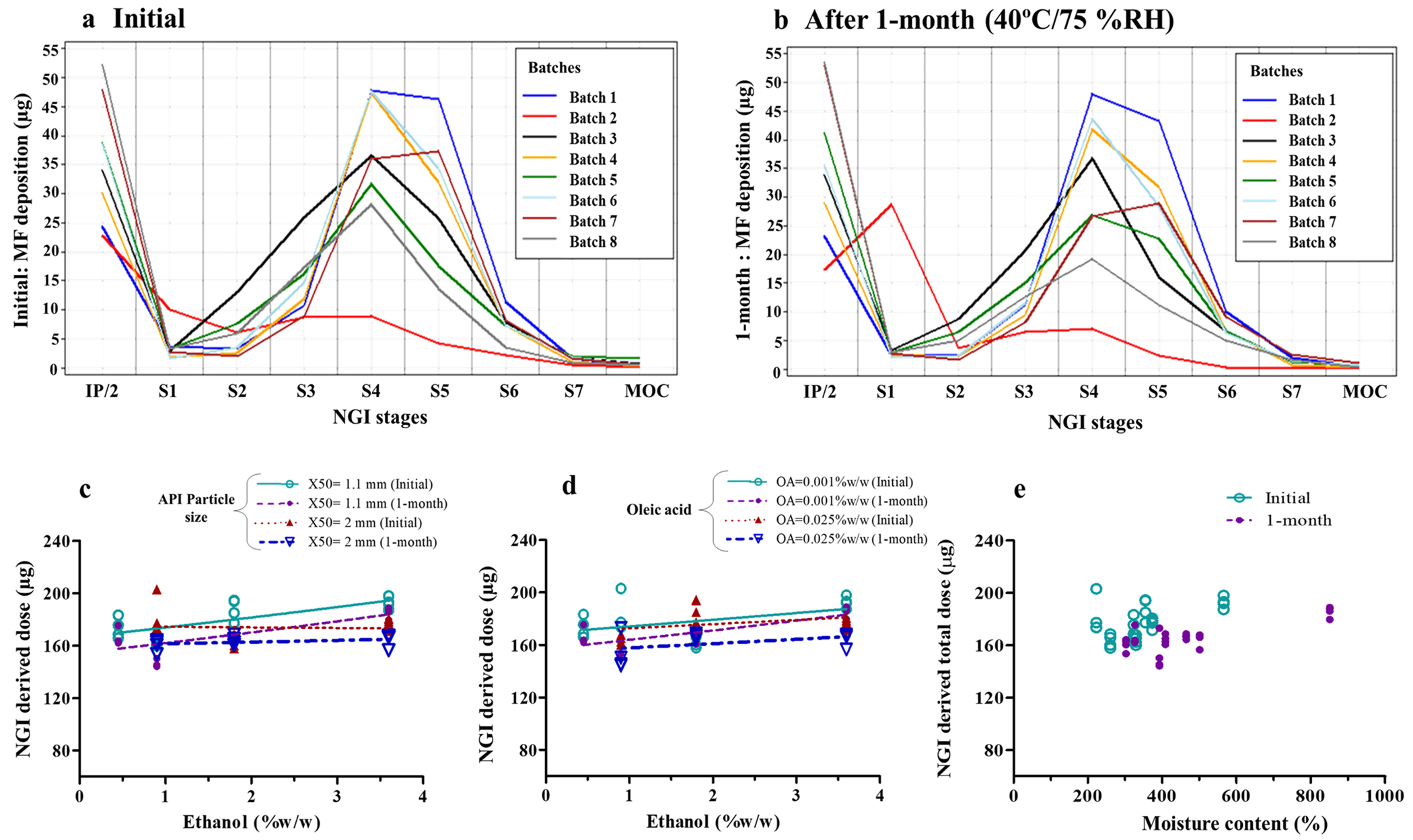
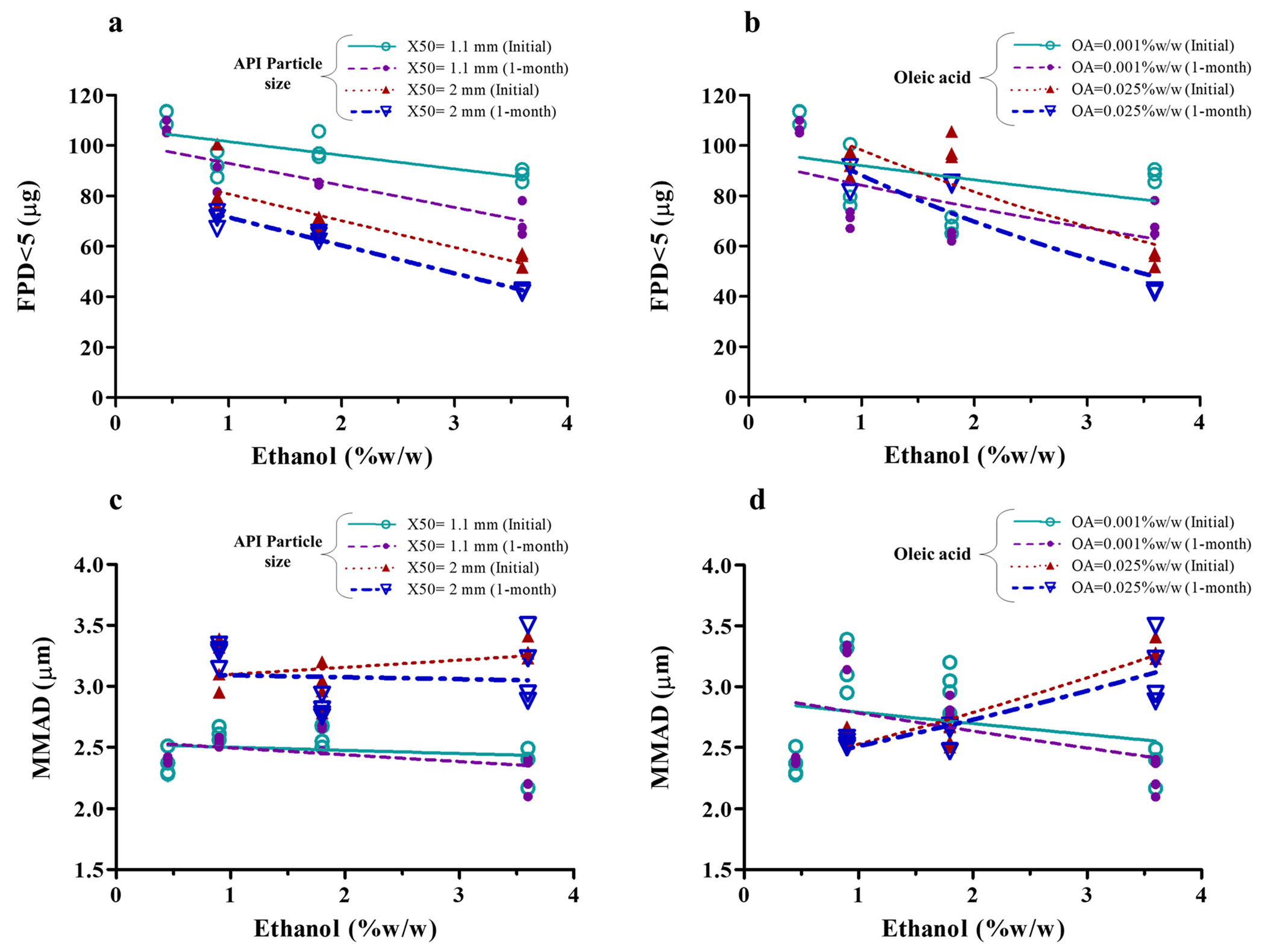
The therapeutic benefits of metered dose inhalers (MDIs) in pulmonary disorders are mainly driven by aerosol performance, which depends on formulation variables (drug and excipients), device design, and patient interactions. The present study provides a comprehensive investigation to better understand the effect of formulation variables on mometasone furoate (MF) suspension-based MDI product performance. The effects of MF particle size (volume median diameter; X) and excipient concentration (ethanol and oleic acid, cosolvent, and surfactant, respectively) on selected critical quality attributes (delivered dose (DD), fine particle dose of particles lesser than 5 µm (FPD < 5), ex-throat dose and median dissolution time (MDT)) were studied. Eight MF-MDI formulations (one per batch) were manufactured based on a reduced factorial design of experiment (DOE) approach, which included relevant formulation levels with varying X (1.1 and 2 μm), concentration of ethanol (0.45, 0.9, 1.8, and 3.6%w/w), and oleic acid (0.001 and 0.025%w/w). The in vitro evaluation of these MF-MDI formulations indicated the importance of drug particle's X, oleic acid, and ethanol canister concentration as critical formulation variables governing the performance of MF suspension-based MDI products. The effect of these formulation variables on DD, FPD < 5, ex-throat dose, and MDT was subsequently utilized to develop empirical relationships linking formulation factors with effects on in vitro performance measures. The developed strategy could be useful for predicting MF-MDI product performance during MDI product development and manufacturing. The systematic DOE approach utilized in this study may provide insights into the understanding of the formulation variables governing the MF-MDI product performance.
计量吸入器(MDI)在肺部疾病中的治疗益处主要取决于气雾剂性能,而气雾剂性能取决于制剂变量(药物和赋形剂)、装置设计和患者相互作用。本研究提供了一项全面的调查,以更好地了解制剂变量对糠酸莫米松(MF)混悬型 MDI 产品性能的影响。研究了 MF 粒径(体积中值直径;X)和赋形剂浓度(乙醇和油酸,分别为共溶剂和表面活性剂)对选定关键质量属性(递送剂量(DD)、粒径小于 5μm 的细颗粒剂量(FPD<5)、出喉剂量和中位溶解时间(MDT))的影响。基于部分因子设计实验(DOE)方法,制造了 8 种 MF-MDI 制剂(每个批次一种),其中包括具有不同 X(1.1 和 2μm)、乙醇浓度(0.45、0.9、1.8 和 3.6%w/w)和油酸浓度(0.001 和 0.025%w/w)的相关制剂水平。这些 MF-MDI 制剂的体外评估表明,药物颗粒的 X、油酸和乙醇罐浓度作为控制 MF 混悬型 MDI 产品性能的关键制剂变量非常重要。这些制剂变量对 DD、FPD<5、出喉剂量和 MDT 的影响随后用于建立将制剂因素与体外性能测量结果联系起来的经验关系。所开发的策略可用于在 MDI 产品开发和制造过程中预测 MF-MDI 产品的性能。本研究中使用的系统 DOE 方法可以深入了解控制 MF-MDI 产品性能的制剂变量。