Prosthodontic Department, School of Dentistry, The University of Jordan, Amman, 11942, Jordan.
Department of Paediatric Dentistry, Orthodontics, and Preventive Dentistry, School of Dentistry, The University of Jordan, Amman, Jordan.
BMC Oral Health. 2021 Dec 7;21(1):629. doi: 10.1186/s12903-021-01993-3.
Little is known about the oral disease burden in refugee children and associated risk factors. This cross-sectional study aimed to explore the oral hygiene status and prevalence of caries, and to investigate their association with malocclusion characteristics in a child refugee population.
606 Syrian refugee children and adolescents aged 7-19 years, registered as refugees in Jordan and residing in Zaatari camp, were recruited to the study. Oral hygiene and caries status were recorded using DMFT (mean of decayed, missing, and filled permanent teeth) and OHI-S (Simplified Oral Hygiene Index) according to WHO criteria. Oral health results were then cross tabulated with previously reported malocclusion traits for the same study sample (crowding, spacing, contact point deflection and IOTN) to detect any associations. Statistical analysis was conducted using chi-square test, independent sample t-test, one-way ANOVA, Welch test and Post Hoc testing (Gabriel and Games-Howell).
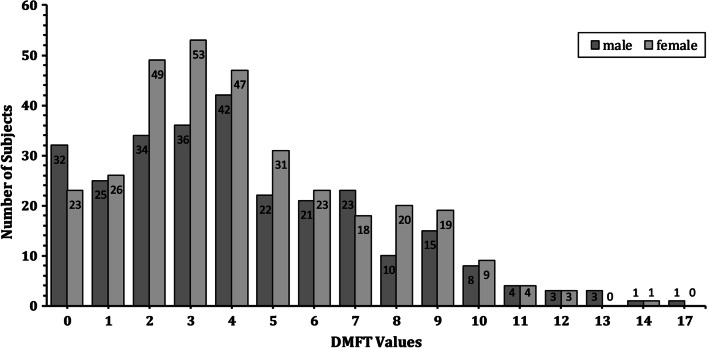
Overall DMFT and OHI-S were 4.32 and 1.33 respectively with no difference between males and females. Around 40% of the sample showed ≥ 5 DMFT score. 96.1% of the sample either do not brush or brush occasionally: females showed better oral hygiene practices (P = 0.002). No significant differences in DMFT scores were noted for gender or age, other than the 7-9.9 year old group having significantly higher mean DMFT scores than all other age groups (P < 0.01);the mean of OHI-S was not significantly different between different age groups (P = 0.927). Subjects with malocclusion, specifically crowding, contact point deflection and IOTN grades 3, 4 and 5 had higher scores in both arches for OHI-S and DMFT than subjects without malocclusion traits, although this was not statistically significant for DMFT scores. Overall, patients with generalized spacing had a significantly lower OHI-S score than those without spacing (P = 0.021). Significant correlations were found between parameters of intra-arch and inter-arch relationships and oral health indices (DMFT and OHI-S).
Malocclusion may increase the risk of caries and periodontal disease; the magnitude of this risk is amplified in populations with poor oral health and limited access to oral healthcare services, highlighting the need for preventive and curative oral health programs.
关于难民儿童的口腔疾病负担及其相关危险因素知之甚少。本横断面研究旨在探讨儿童难民人群的口腔卫生状况和龋齿患病率,并调查其与错畸形特征的关系。
本研究共纳入 606 名年龄在 7-19 岁的叙利亚难民儿童和青少年,这些儿童和青少年在约旦登记为难民,并居住在扎塔里难民营。根据世界卫生组织(WHO)的标准,使用 DMFT(恒牙龋失补均值)和 OHI-S(简化口腔卫生指数)记录口腔卫生和龋齿状况。然后,将口腔健康结果与同一研究样本的先前报告的错畸形特征(拥挤、间隙、接触点偏斜和 IOTN)进行交叉制表,以检测任何关联。使用卡方检验、独立样本 t 检验、单因素方差分析、Welch 检验和事后检验(Gabriel 和 Games-Howell)进行统计分析。
总体而言,DMFT 和 OHI-S 分别为 4.32 和 1.33,男女之间无差异。约 40%的样本显示≥5 的 DMFT 评分。96.1%的样本要么不刷牙,要么偶尔刷牙:女性的口腔卫生习惯更好(P=0.002)。性别或年龄对 DMFT 评分没有显著差异,但 7-9.9 岁组的平均 DMFT 评分显著高于其他年龄组(P<0.01);不同年龄组之间的 OHI-S 平均值没有显著差异(P=0.927)。有错畸形特征的受试者,特别是拥挤、接触点偏斜和 IOTN 等级 3、4 和 5 的受试者,在两个牙弓的 OHI-S 和 DMFT 评分均高于没有错畸形特征的受试者,尽管这在 DMFT 评分上没有统计学意义。总体而言,广泛间隙的患者的 OHI-S 评分显著低于无间隙的患者(P=0.021)。牙弓内和牙弓间关系参数与口腔健康指数(DMFT 和 OHI-S)之间存在显著相关性。
错畸形可能增加龋齿和牙周病的风险;在口腔卫生状况差且获得口腔保健服务有限的人群中,这种风险的程度会放大,这突显了需要预防和治疗性口腔卫生计划。