Division of Human Reproduction and Developmental Genetics, Women's Hospital, Zhejiang University School of Medicine, Hangzhou, Zhejiang 310058, China.
Institute of Genetics, Zhejiang University, 866 Yuhangtang Road, Hangzhou, Zhejiang 310058, China.
Nucleic Acids Res. 2021 Dec 16;49(22):13108-13121. doi: 10.1093/nar/gkab1187.
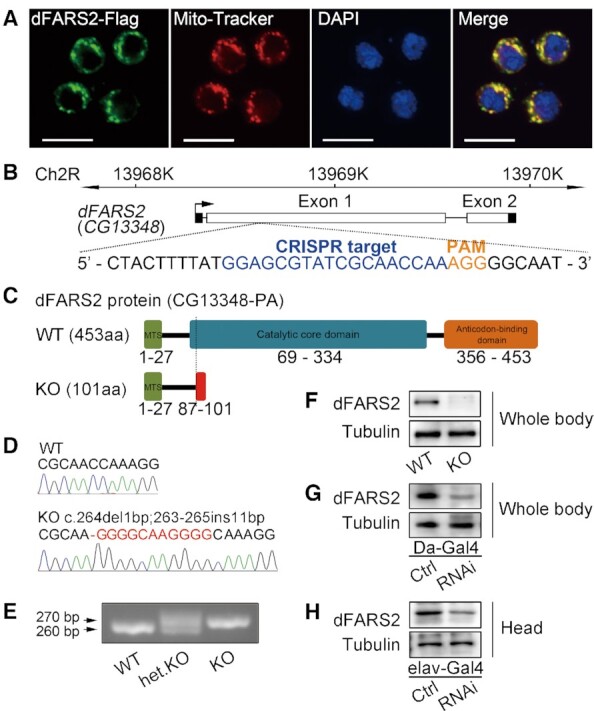
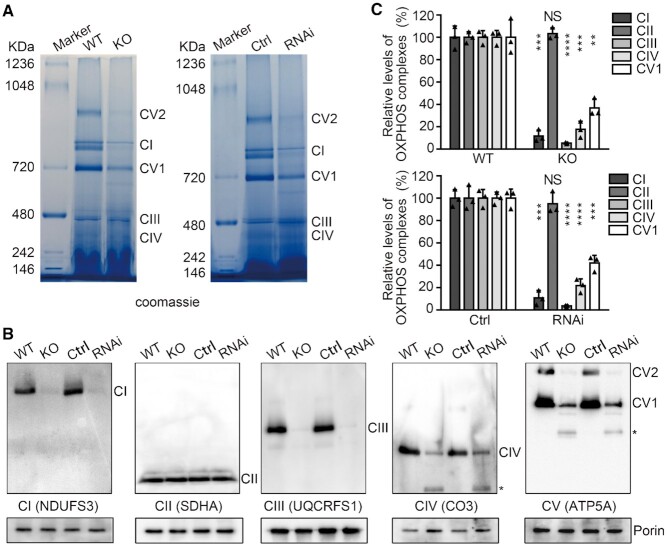
Mutations in genes encoding mitochondrial aminoacyl-tRNA synthetases are linked to diverse diseases. However, the precise mechanisms by which these mutations affect mitochondrial function and disease development are not fully understood. Here, we develop a Drosophila model to study the function of dFARS2, the Drosophila homologue of the mitochondrial phenylalanyl-tRNA synthetase, and further characterize human disease-associated FARS2 variants. Inactivation of dFARS2 in Drosophila leads to developmental delay and seizure. Biochemical studies reveal that dFARS2 is required for mitochondrial tRNA aminoacylation, mitochondrial protein stability, and assembly and enzyme activities of OXPHOS complexes. Interestingly, by modeling FARS2 mutations associated with human disease in Drosophila, we provide evidence that expression of two human FARS2 variants, p.G309S and p.D142Y, induces seizure behaviors and locomotion defects, respectively. Together, our results not only show the relationship between dysfunction of mitochondrial aminoacylation system and pathologies, but also illustrate the application of Drosophila model for functional analysis of human disease-causing variants.
线粒体氨酰-tRNA 合成酶编码基因突变与多种疾病有关。然而,这些突变如何影响线粒体功能和疾病发展的确切机制尚不完全清楚。在这里,我们建立了一个果蝇模型来研究线粒体苯丙氨酰-tRNA 合成酶的果蝇同源物 dFARS2 的功能,并进一步表征与人类疾病相关的 FARS2 变体。dFARS2 在果蝇中的失活导致发育迟缓和癫痫发作。生化研究表明,dFARS2 是线粒体 tRNA 氨酰化、线粒体蛋白稳定性以及 OXPHOS 复合物的组装和酶活性所必需的。有趣的是,通过在果蝇中模拟与人类疾病相关的 FARS2 突变,我们提供了证据表明两种人类 FARS2 变体 p.G309S 和 p.D142Y 的表达分别诱导癫痫发作行为和运动缺陷。总之,我们的研究结果不仅表明了线粒体氨酰化系统功能障碍与病理学之间的关系,还说明了利用果蝇模型进行人类致病变异体功能分析的应用。