Department of Applied Zoology/Animal Ecology, Dahlem Centre of Plant Sciences, Freie Universität Berlin, Haderslebener Str. 9, 12163, Berlin, Germany.
Biodiversity Unit, University of Turku, 20014, Turku, Finland.
Planta. 2021 Dec 8;255(1):16. doi: 10.1007/s00425-021-03803-0.
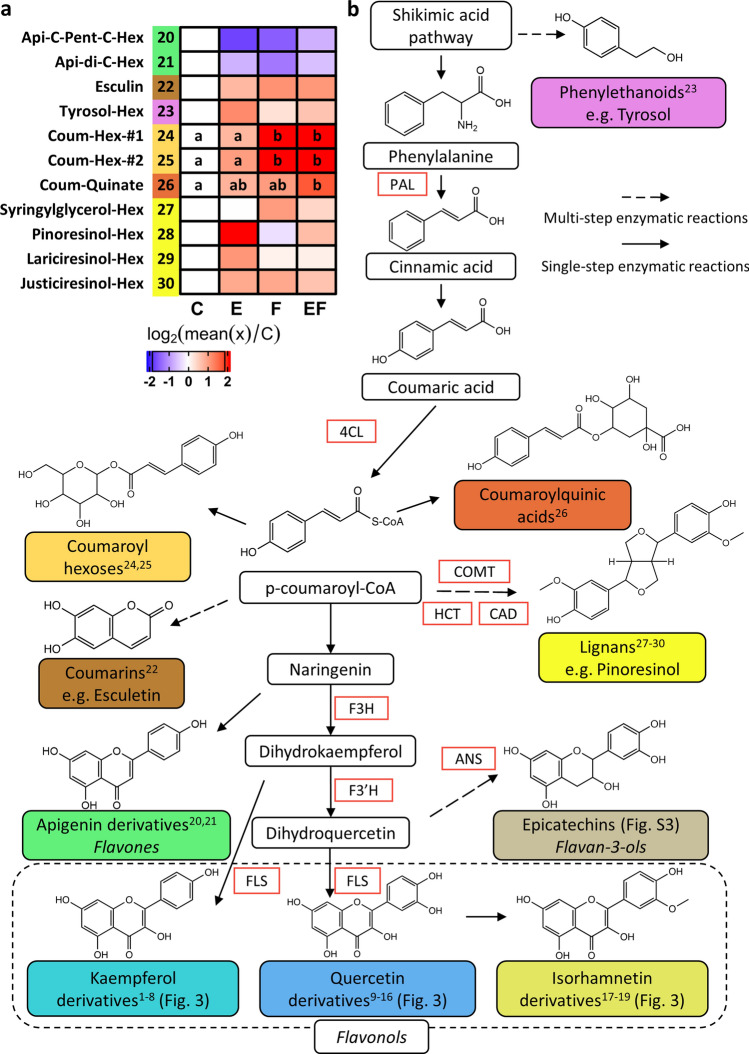
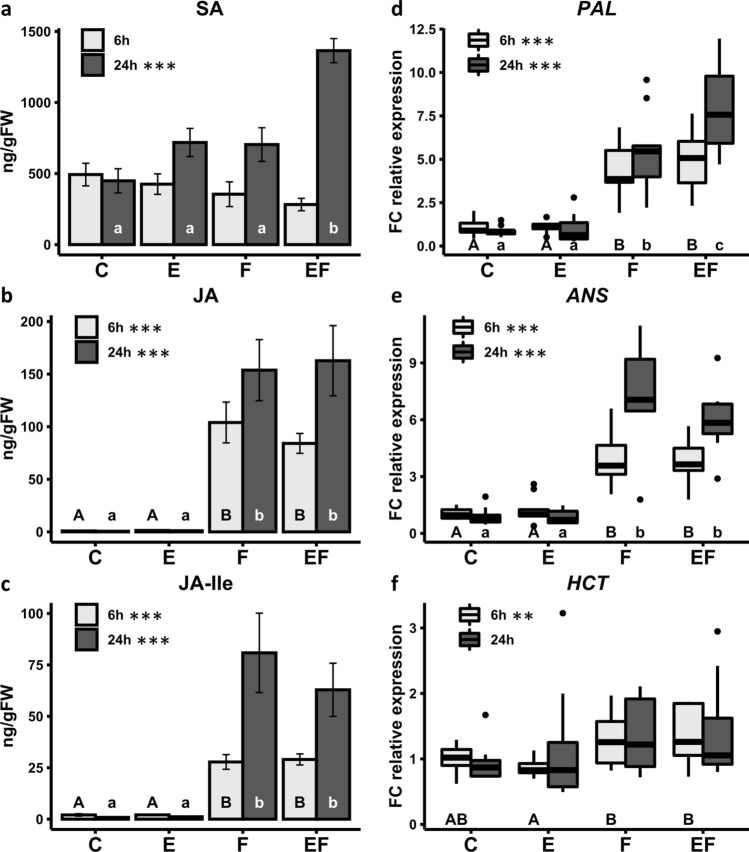
Elms, which have received insect eggs as a 'warning' of larval herbivory, enhance their anti-herbivore defences by accumulating salicylic acid and amplifying phenylpropanoid-related transcriptional and metabolic responses to hatching larvae. Plant responses to insect eggs can result in intensified defences against hatching larvae. In annual plants, this egg-mediated effect is known to be associated with changes in leaf phenylpropanoid levels. However, little is known about how trees-long-living, perennial plants-improve their egg-mediated, anti-herbivore defences. The role of phytohormones and the phenylpropanoid pathway in egg-primed anti-herbivore defences of a tree species has until now been left unexplored. Using targeted and untargeted metabolome analyses we studied how the phenylpropanoid pathway of Ulmus minor responds to egg-laying by the elm leaf beetle and subsequent larval feeding. We found that when compared to untreated leaves, kaempferol and quercetin concentrations increased in feeding-damaged leaves with prior egg deposition, but not in feeding-damaged leaves without eggs. PCR analyses revealed that prior insect egg deposition intensified feeding-induced expression of phenylalanine ammonia lyase (PAL), encoding the gateway enzyme of the phenylpropanoid pathway. Salicylic acid (SA) concentrations were higher in egg-treated, feeding-damaged leaves than in egg-free, feeding-damaged leaves, but SA levels did not increase in response to egg deposition alone-in contrast to observations made of Arabidopsis thaliana. Our results indicate that prior egg deposition induces a SA-mediated response in elms to feeding damage. Furthermore, egg deposition boosts phenylpropanoid biosynthesis in subsequently feeding-damaged leaves by enhanced PAL expression, which results in the accumulation of phenylpropanoid derivatives. As such, the elm tree shows similar, yet distinct, responses to insect eggs and larval feeding as the annual model plant A. thaliana.
柳树接收到昆虫卵作为幼虫取食的“预警”信号后,通过积累水杨酸并放大苯丙烷类相关的转录和代谢反应来增强其抗虫防御。植物对昆虫卵的反应会导致对孵化幼虫的防御加剧。在一年生植物中,这种由卵介导的效应与叶片苯丙烷水平的变化有关。然而,关于树木——多年生植物——如何增强其由卵介导的抗虫防御,人们知之甚少。植物激素和苯丙烷途径在树木物种的卵引发抗虫防御中的作用尚未得到探索。使用靶向和非靶向代谢组学分析,我们研究了柳树在榆叶蝉产卵及其随后的幼虫取食后,苯丙烷途径如何做出反应。我们发现,与未经处理的叶片相比,在产卵后受到取食损伤的叶片中,山奈酚和槲皮素的浓度增加,但在没有产卵的取食损伤叶片中没有增加。PCR 分析显示,与未处理的叶片相比,在产卵后受到取食损伤的叶片中,苯丙氨酸解氨酶(PAL)的表达增强,PAL 编码苯丙烷途径的关键酶。在受到取食损伤且经过卵处理的叶片中,水杨酸(SA)的浓度高于无卵处理的叶片,但单独的卵处理不会引起 SA 水平增加——这与对拟南芥的观察结果相反。我们的结果表明,先前的卵沉积诱导了柳树对取食损伤的水杨酸介导的反应。此外,卵沉积通过增强 PAL 表达来促进随后受到取食损伤的叶片中的苯丙烷生物合成,从而导致苯丙烷衍生物的积累。因此,柳树对昆虫卵和幼虫取食的反应与一年生模式植物拟南芥相似,但又有所不同。