University of Würzburg, Institute of Hygiene and Microbiology, Würzburg, Germany.
PLoS Negl Trop Dis. 2021 Dec 8;15(12):e0010027. doi: 10.1371/journal.pntd.0010027. eCollection 2021 Dec.
The metacestode larval stage of the fox-tapeworm Echinococcus multilocularis causes alveolar echinococcosis by tumour-like growth within the liver of the intermediate host. Metacestode growth and development is stimulated by host-derived cytokines such as insulin, fibroblast growth factor, and epidermal growth factor via activation of cognate receptor tyrosine kinases expressed by the parasite. Little is known, however, concerning signal transmission to the parasite nucleus and cross-reaction with other parasite signalling systems.
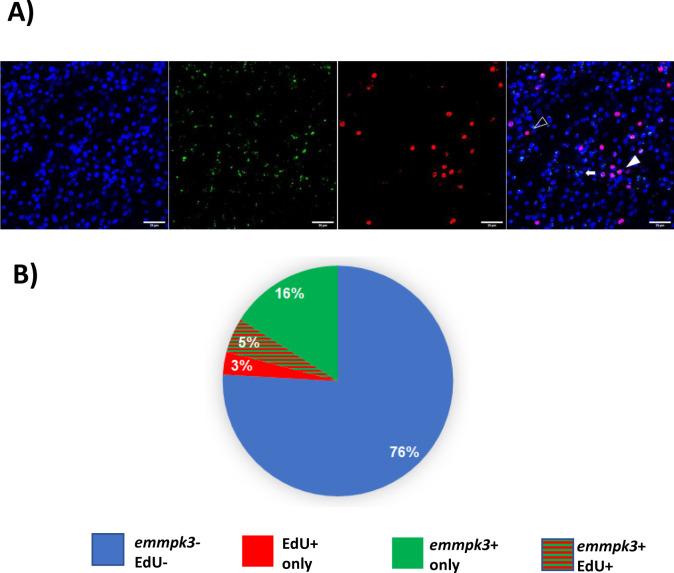
METHODOLOGY/PRINCIPAL FINDINGS: Using bioinformatic approaches, cloning, and yeast two-hybrid analyses we identified a novel mitogen-activated kinase (MAPK) cascade module that consists of E. multilocularis orthologs of the tyrosine kinase receptor interactor Growth factor receptor-bound 2, EmGrb2, the MAPK kinase kinase EmMEKK1, a novel MAPK kinase, EmMKK3, and a close homolog to c-Jun N-terminal kinase (JNK), EmMPK3. Whole mount in situ hybridization analyses indicated that EmMEKK1 and EmMPK3 are both expressed in E. multilocularis germinative (stem) cells but also in differentiated or differentiating cells. Treatment with the known JNK inhibitor SP600125 led to a significantly reduced formation of metacestode vesicles from stem cells and to a specific reduction of proliferating stem cells in mature metacestode vesicles.
CONCLUSIONS/SIGNIFICANCE: We provide evidence for the expression of a MEKK1-JNK MAPK cascade module which, in mammals, is crucially involved in stress responses, cytoskeletal rearrangements, and apoptosis, in E. multilocularis stem cells. Inhibitor studies indicate an important role of JNK signalling in E. multilocularis stem cell survival and/or maintenance. Our data are relevant for molecular and cellular studies into crosstalk signalling mechanisms that govern Echinococcus stem cell function and introduce the JNK signalling cascade as a possible target of chemotherapeutics against echinococcosis.
狐形绦虫多房棘球蚴的囊尾蚴幼虫阶段通过在中间宿主肝脏内类似肿瘤的生长引起泡型包虫病。囊尾蚴的生长和发育受到宿主来源的细胞因子(如胰岛素、成纤维细胞生长因子和表皮生长因子)的刺激,这些细胞因子通过激活寄生虫表达的同源受体酪氨酸激酶来发挥作用。然而,对于信号传递到寄生虫核和与其他寄生虫信号系统的交叉反应,我们知之甚少。
方法/主要发现:使用生物信息学方法、克隆和酵母双杂交分析,我们鉴定了一个新的有丝分裂原激活蛋白激酶(MAPK)级联模块,该模块由多房棘球绦虫的酪氨酸激酶受体相互作用蛋白生长因子受体结合蛋白 2(EmGrb2)、MAPK 激酶激酶 1(EmMEKK1)、一种新型的 MAPK 激酶 EmMKK3 和 c-Jun N 端激酶(JNK)的密切同源物 EmMPK3 的同源物组成。整体原位杂交分析表明,EmMEKK1 和 EmMPK3 均在多房棘球绦虫生殖(干细胞)细胞中表达,但也在分化或正在分化的细胞中表达。用已知的 JNK 抑制剂 SP600125 处理后,从干细胞形成的囊尾蚴泡显著减少,并且成熟囊尾蚴泡中的增殖干细胞特异性减少。
结论/意义:我们提供了证据表明,在多房棘球绦虫干细胞中存在 MEKK1-JNK MAPK 级联模块的表达,在哺乳动物中,该模块在应激反应、细胞骨架重排和细胞凋亡中起着至关重要的作用。抑制剂研究表明 JNK 信号在多房棘球绦虫干细胞存活和/或维持中起着重要作用。我们的数据对于研究控制棘球蚴干细胞功能的串扰信号机制以及将 JNK 信号级联作为抗包虫病化学疗法的潜在靶点具有重要意义。