Cardiovascular & Metabolism, Janssen Pharmaceuticals, Spring House, PA, United States of America.
Department of Medicine, University of California San Diego, La Jolla, CA, United States of America.
PLoS One. 2021 Dec 8;16(12):e0260721. doi: 10.1371/journal.pone.0260721. eCollection 2021.
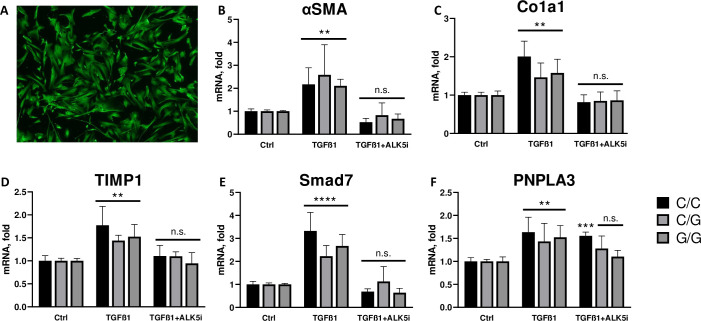
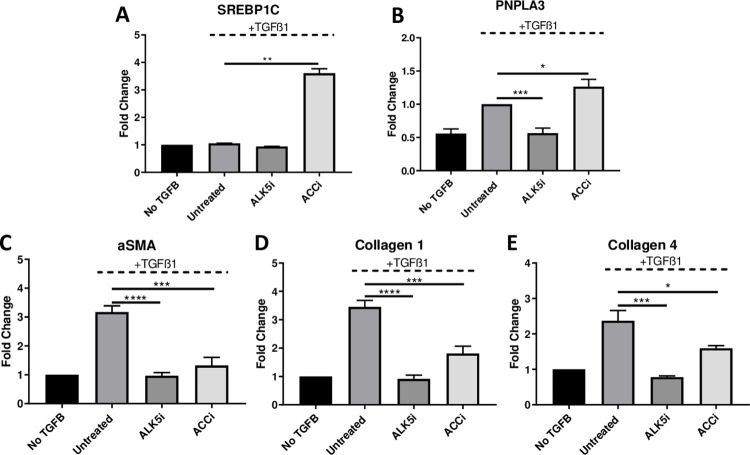
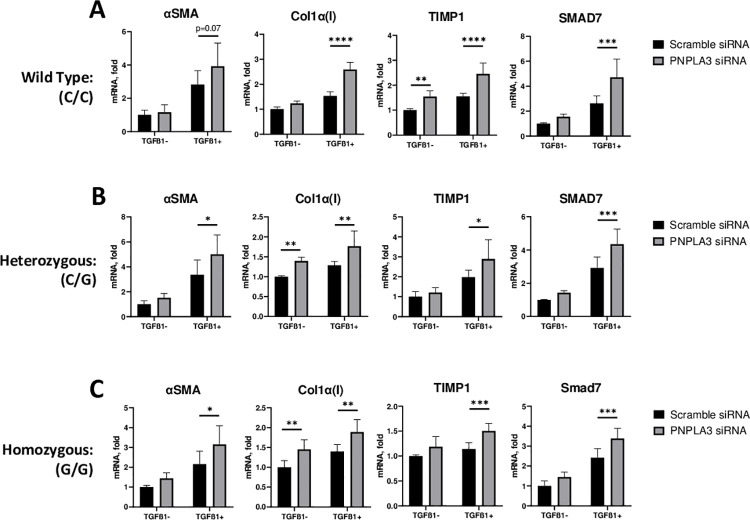
Non-alcoholic steatohepatitis (NASH) results, in part, from the interaction of metabolic derangements with predisposing genetic variants, leading to liver-related complications and mortality. The strongest genetic determinant is a highly prevalent missense variant in patatin-like phospholipase domain-containing protein 3 (PNPLA3 p.I148M). In human liver hepatocytes PNPLA3 localizes to the surface of lipid droplets where the mutant form is believed to enhance lipid accumulation and release of pro-inflammatory cytokines. Less is known about the role of PNPLA3 in hepatic stellate cells (HSCs). Here we characterized HSC obtained from patients carrying the wild type (n = 8 C/C) and the heterozygous (n = 6, C/G) or homozygous (n = 6, G/G) PNPLA3 I148M and investigated the effect of genotype and PNPLA3 downregulation on baseline and TGF-β-stimulated fibrotic gene expression. HSCs from all genotypes showed comparable baseline levels of PNPLA3 and expression of the fibrotic genes α-SMA, COL1A1, TIMP1 and SMAD7. Treatment with TGF-β increased PNPLA3 expression in all 3 genotypes (~2-fold) and resulted in similar stimulation of the expression of several fibrogenic genes. In primary human HSCs carrying wild-type (WT) PNPLA3, siRNA treatment reduced PNPLA3 mRNA by 79% resulting in increased expression of α-SMA, Col1a1, TIMP1, and SMAD7 in cells stimulated with TGF-β. Similarly, knock-down of PNPLA3 in HSCs carrying either C/G or G/G genotypes resulted in potentiation of TGF-β induced expression of fibrotic genes. Knockdown of PNPLA3 did not impact fibrotic gene expression in the absence of TGF-β treatment. Together, these data indicate that the presence of the I148M PNPLA3 mutation in HSC has no effect on baseline activation and that downregulation of PNPLA3 exacerbates the fibrotic response irrespective of the genotype.
非酒精性脂肪性肝炎 (NASH) 的部分原因是代谢紊乱与易患遗传变异的相互作用,导致与肝脏相关的并发症和死亡率。最强的遗传决定因素是一种普遍存在的错义变体,即载脂蛋白样磷脂酶结构域蛋白 3 (PNPLA3 p.I148M)。在人类肝实质细胞中,PNPLA3 定位于脂滴表面,突变形式被认为可增强脂质积累和促炎细胞因子的释放。关于 PNPLA3 在肝星状细胞 (HSC) 中的作用知之甚少。在这里,我们对携带野生型 (n = 8 C/C)、杂合子 (n = 6, C/G) 或纯合子 (n = 6, G/G) PNPLA3 I148M 的患者获得的 HSC 进行了特征描述,并研究了基因型和 PNPLA3 下调对基线和 TGF-β 刺激的纤维化基因表达的影响。所有基因型的 HSC 均显示出相当的 PNPLA3 基线水平和纤维化基因 α-SMA、COL1A1、TIMP1 和 SMAD7 的表达。在所有 3 种基因型中,TGF-β 的处理均增加了 PNPLA3 的表达 (~2 倍),并导致几个纤维生成基因的表达得到类似的刺激。在携带野生型 (WT) PNPLA3 的原代人 HSC 中,siRNA 处理使 PNPLA3 mRNA 减少了 79%,导致 TGF-β 刺激的细胞中 α-SMA、Col1a1、TIMP1 和 SMAD7 的表达增加。同样,在携带 C/G 或 G/G 基因型的 HSC 中敲低 PNPLA3 会增强 TGF-β 诱导的纤维化基因表达。在没有 TGF-β 处理的情况下,敲低 PNPLA3 不会影响纤维化基因的表达。总之,这些数据表明,HSC 中存在 I148M PNPLA3 突变对基线激活没有影响,并且下调 PNPLA3 会加剧纤维化反应,而与基因型无关。