Tiainen Tony, Mannisto Jere K, Tenhu Heikki, Hietala Sami
Department of Chemistry, University of Helsinki, P.O. Box 55, Helsinki FIN-00014 HU, Finland.
Langmuir. 2022 May 3;38(17):5197-5208. doi: 10.1021/acs.langmuir.1c02321. Epub 2021 Dec 8.
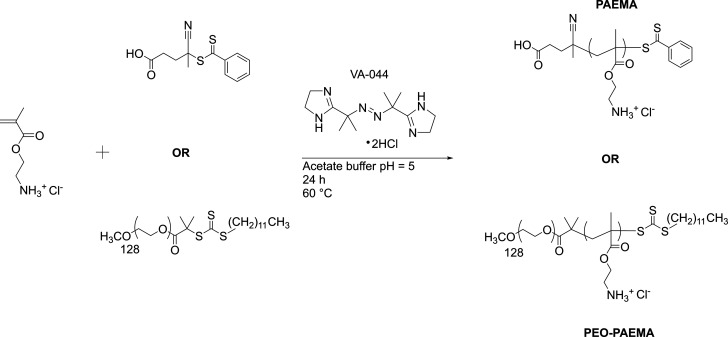
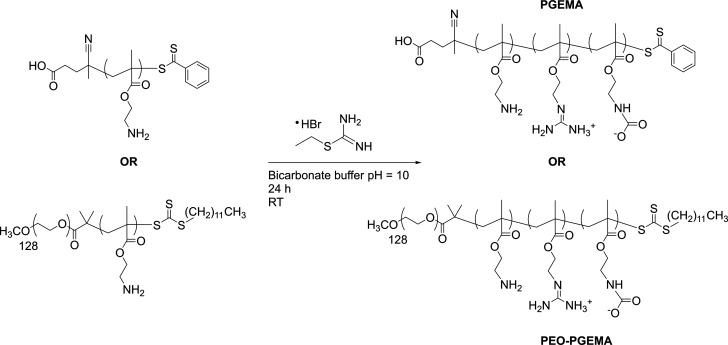
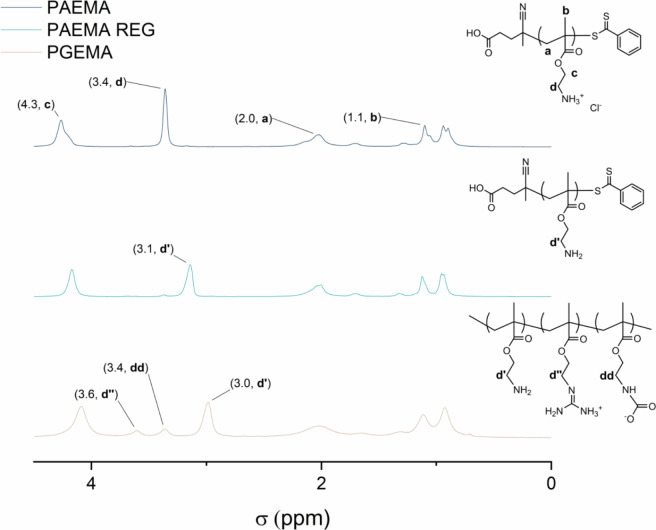
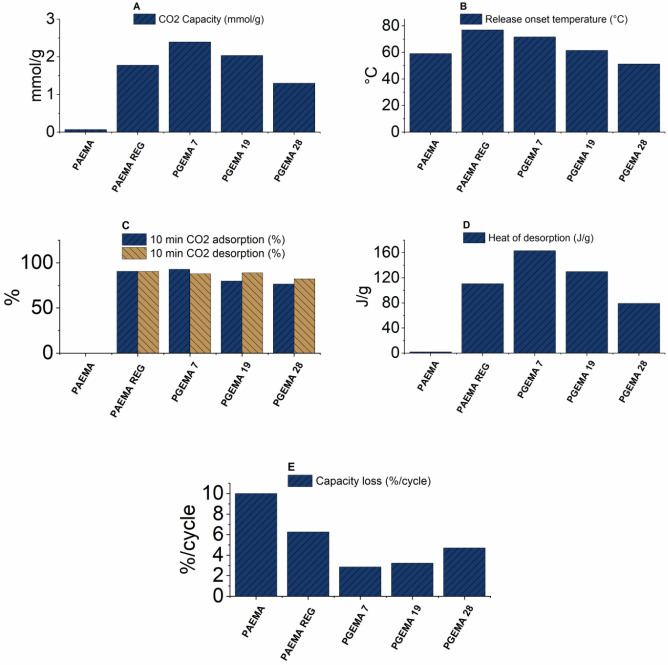
Poly(aminoethyl methacrylate) (PAEMA), poly(ethylene oxide)--(aminoethyl methacrylate) (PEO-PAEMA), and their guanidinylated derivates, poly(guanidine ethyl methacrylate) (PGEMA) and poly(ethylene oxide)--(guanidine ethyl methacrylate) (PEO-PGEMA), were prepared to study their capabilities for CO adsorption and release. The polymers of different forms or degree of guanidinylation were thoroughly characterized, and their interaction with CO was studied by NMR and calorimetry. The extent and kinetics of adsorption and desorption of N and CO were investigated by thermogravimetry under controlled gas atmospheres. The materials did not adsorb N, whereas CO could be reversibly adsorbed at room temperature and released by an elevated temperature. The most promising polymer was PGEMA with a guanidinylation degree of 7% showing a CO adsorption capacity of 2.4 mmol/g at room temperature and a desorption temperature of 72 °C. The study also revealed relations between the polymer chemical composition and CO adsorption and release characteristics that are useful in future formulations for CO adsorbent polymer materials.
制备了聚(甲基丙烯酸氨基乙酯)(PAEMA)、聚(环氧乙烷)-(甲基丙烯酸氨基乙酯)(PEO-PAEMA)及其胍基化衍生物聚(甲基丙烯酸胍乙酯)(PGEMA)和聚(环氧乙烷)-(甲基丙烯酸胍乙酯)(PEO-PGEMA),以研究它们对CO的吸附和释放能力。对不同形式或胍基化程度的聚合物进行了全面表征,并通过核磁共振和量热法研究了它们与CO的相互作用。在可控气体气氛下,通过热重分析法研究了N和CO的吸附和解吸程度及动力学。这些材料不吸附N,而CO可在室温下可逆吸附,并在升高温度时释放。最有前景的聚合物是胍基化程度为7%的PGEMA,其在室温下的CO吸附容量为2.4 mmol/g,解吸温度为72℃。该研究还揭示了聚合物化学成分与CO吸附和释放特性之间的关系,这对未来CO吸附聚合物材料的配方设计很有用。