Instituto Baleia Jubarte, Caravelas, BA, Brazil.
Happywhale, Santa Cruz, CA, USA.
Sci Rep. 2021 Dec 8;11(1):23618. doi: 10.1038/s41598-021-02612-5.
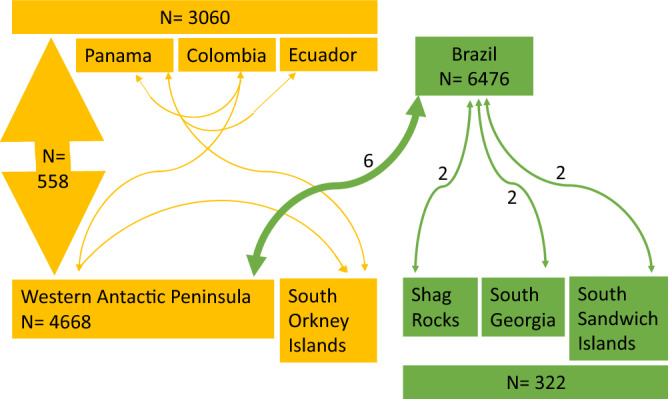
Humpback whales (Megaptera novaeangliae) are a cosmopolitan species and perform long annual migrations between low-latitude breeding areas and high-latitude feeding areas. Their breeding populations appear to be spatially and genetically segregated due to long-term, maternally inherited fidelity to natal breeding areas. In the Southern Hemisphere, some humpback whale breeding populations mix in Southern Ocean waters in summer, but very little movement between Pacific and Atlantic waters has been identified to date, suggesting these waters constituted an oceanic boundary between genetically distinct populations. Here, we present new evidence of summer co-occurrence in the West Antarctic Peninsula feeding area of two recovering humpback whale breeding populations from the Atlantic (Brazil) and Pacific (Central and South America). As humpback whale populations recover, observations like this point to the need to revise our perceptions of boundaries between stocks, particularly on high latitude feeding grounds. We suggest that this "Southern Ocean Exchange" may become more frequent as populations recover from commercial whaling and climate change modifies environmental dynamics and humpback whale prey availability.
座头鲸(Megaptera novaeangliae)是一种世界性物种,在低纬度繁殖区和高纬度觅食区之间进行长距离的年度迁徙。由于长期以来对出生地繁殖区的母系遗传忠诚,它们的繁殖群体在空间和遗传上似乎是隔离的。在南半球,一些座头鲸繁殖群体在夏季混合在南大洋的水域中,但迄今为止,在太平洋和大西洋水域之间很少有发现它们之间有移动,这表明这些水域构成了遗传上不同种群之间的海洋边界。在这里,我们提出了新的证据,表明在西南极半岛的觅食区,来自大西洋(巴西)和太平洋(中美洲和南美洲)的两个正在恢复的座头鲸繁殖群体在夏季同时出现。随着座头鲸数量的恢复,像这样的观察结果表明有必要重新审视我们对种群之间界限的看法,特别是在高纬度觅食场地上。我们认为,随着商业捕鲸的减少以及气候变化改变了环境动态和座头鲸猎物的可获得性,这种“南大洋交换”可能会变得更加频繁。