Rehabilitation Medicine Center, The Second Affiliated Hospital and Yuying Children's Hospital, Wenzhou Medical University, Wenzhou, 325000, Zhejiang, People's Republic of China.
Intelligent Rehabilitation Research Center, China-USA Institute for Acupuncture and Rehabilitation, Wenzhou Medical University, Wenzhou, Zhejiang, People's Republic of China.
Clin Interv Aging. 2021 Dec 1;16:1997-2007. doi: 10.2147/CIA.S339221. eCollection 2021.
Stroke is a disease associated with high mortality. Many inflammatory indicators such as neutrophil-to-lymphocyte ratio (NLR), platelet-to-lymphocyte ratio (PLR), lymphocyte to monocyte ratio (LMR) and red blood cell distribution width (RDW) have been documented to predict stroke prognosis, their predictive power is limited. A novel inflammatory indicator called systemic inflammatory response index (SIRI) has been advocated to have an essential role in the prognostic assessment of cancer and infectious diseases. In this study, we attempted to assess the prognosis of stroke by SIRI. Moreover, we compared SIRI with other clinical parameters, including NLR, PLR, LMR and RDW.
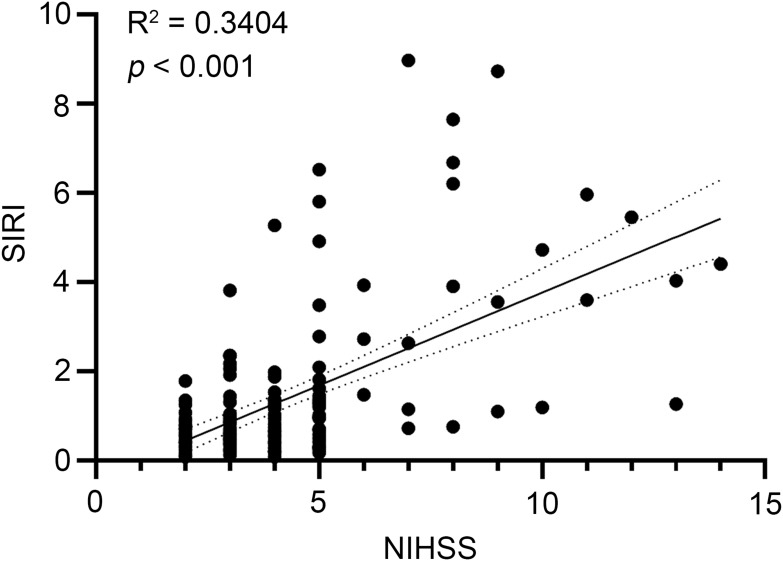
This was a retrospective cohort study. We obtained data of 2450 stroke patients from the Multiparametric Intelligent Monitoring in Intensive Care III database. We used the Cox proportional hazards models to evaluate the relationship between SIRI and all-cause mortality and sepsis. Receiver operating curve (ROC) analysis was used to assess the predictive power of SIRI compared to NLR, PLR, LMR and RDW for the prognosis of stroke. We collected data of 180 patients from the First Affiliated Hospital of Wenzhou Medical University, which used the Pearson's correlation coefficient to assess the relationship between SIRI and the National Institute of Health stroke scale (NIHSS).
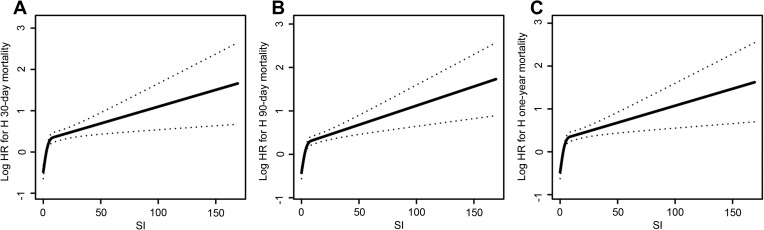
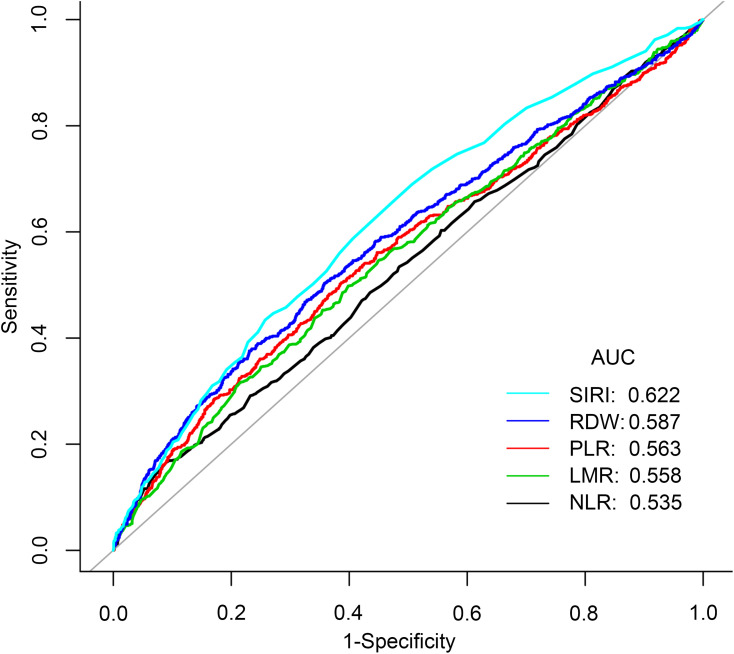
After adjusting multiple covariates, we found that SIRI was associated with all-cause mortality in stroke patients. Rising SIRI accompanied by rising mortality. Besides, ROC analysis showed that the area under the curve of SIRI was significantly greater than for NLR, PLR, LMR and RDW. Besides, Pearson's correlation test confirmed a significant positive correlation between SIRI and NIHSS.
Elevated SIRI was associated with higher risk of mortality and sepsis and higher stroke severity. Therefore, SIRI is a promising low-grade inflammatory factor for predicting stroke prognosis that outperformed NLR, PLR, LMR, and RDW in predictive power.
中风是一种死亡率较高的疾病。许多炎症指标,如中性粒细胞与淋巴细胞比值(NLR)、血小板与淋巴细胞比值(PLR)、淋巴细胞与单核细胞比值(LMR)和红细胞分布宽度(RDW)已被证明可预测中风预后,但它们的预测能力有限。一种新的炎症指标,称为全身炎症反应指数(SIRI),已被认为在癌症和传染病的预后评估中具有重要作用。在本研究中,我们试图通过 SIRI 评估中风的预后。此外,我们将 SIRI 与其他临床参数,包括 NLR、PLR、LMR 和 RDW 进行了比较。
这是一项回顾性队列研究。我们从 Multiparametric Intelligent Monitoring in Intensive Care III 数据库中获得了 2450 例中风患者的数据。我们使用 Cox 比例风险模型评估 SIRI 与全因死亡率和脓毒症的关系。接收者操作曲线(ROC)分析用于评估 SIRI 与 NLR、PLR、LMR 和 RDW 相比对中风预后的预测能力。我们从温州医科大学第一附属医院收集了 180 例患者的数据,使用 Pearson 相关系数评估 SIRI 与国立卫生研究院中风量表(NIHSS)之间的关系。
在调整了多个协变量后,我们发现 SIRI 与中风患者的全因死亡率相关。随着 SIRI 的升高,死亡率也随之升高。此外,ROC 分析显示 SIRI 的曲线下面积明显大于 NLR、PLR、LMR 和 RDW。此外,Pearson 相关检验证实 SIRI 与 NIHSS 之间存在显著的正相关关系。
升高的 SIRI 与更高的死亡率和脓毒症风险以及更高的中风严重程度相关。因此,SIRI 是一种有前途的低水平炎症因子,可预测中风预后,其预测能力优于 NLR、PLR、LMR 和 RDW。