Santos Erin N, Fields R Douglas
Section on Nervous System Development and Plasticity, The Eunice Kennedy Shriver National Institute of Child Health and Human Development (NICHD), National Institutes of Health (NIH), Bethesda, MD 20892, USA.
Sci Adv. 2021 Dec 10;7(50):eabk1131. doi: 10.1126/sciadv.abk1131.
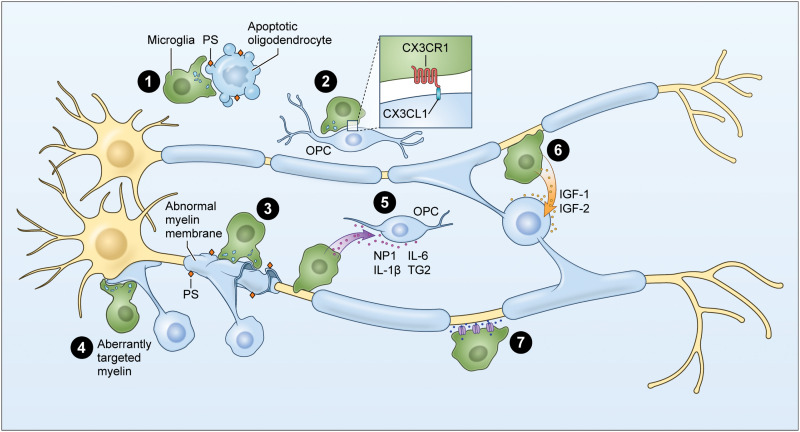
Interactions between microglia, the resident macrophages of the central nervous system (CNS), and myelin, the glial sheath on nerve fibers essential for rapid neural impulse transmission, are commonly studied in the context of neurotrauma and disease. However, interactions between microglia and myelin under normal physiological conditions have been largely overlooked. This review summarizes recent research indicating that the unique properties of microglia evident in disease states also enable microglia to regulate myelination during development and throughout life. This includes phagocytosis of cells and myelin membrane as well as the release of trophic factors, cytokines, and chemokines. The ability of microglia to sense neuronal activity and molecular features of the microenvironment enables them to optimize myelination by influencing early oligodendrogenesis, myelin formation, and removal of aberrantly targeted myelin. Understanding how microglia participate in myelination under normal conditions provides a new perspective that will increase understanding of developmental abnormalities.
小胶质细胞是中枢神经系统(CNS)中的常驻巨噬细胞,与髓磷脂(神经纤维上对快速神经冲动传递至关重要的胶质鞘)之间的相互作用通常在神经创伤和疾病的背景下进行研究。然而,正常生理条件下小胶质细胞与髓磷脂之间的相互作用在很大程度上被忽视了。本综述总结了最近的研究,表明在疾病状态下明显的小胶质细胞独特特性也使小胶质细胞能够在发育过程中和整个生命过程中调节髓鞘形成。这包括细胞和髓磷脂膜的吞噬作用以及营养因子、细胞因子和趋化因子的释放。小胶质细胞感知神经元活动和微环境分子特征的能力使它们能够通过影响早期少突胶质细胞生成、髓磷脂形成和异常靶向髓磷脂的清除来优化髓鞘形成。了解小胶质细胞在正常条件下如何参与髓鞘形成提供了一个新的视角,这将增加对发育异常的理解。