Department of Biological Sciences, National University of Singapore, Singapore.
Centre for Interdisciplinary Archaeological Research, Ashoka University, Sonipat, India.
Mol Biol Evol. 2022 Jan 7;39(1). doi: 10.1093/molbev/msab340.
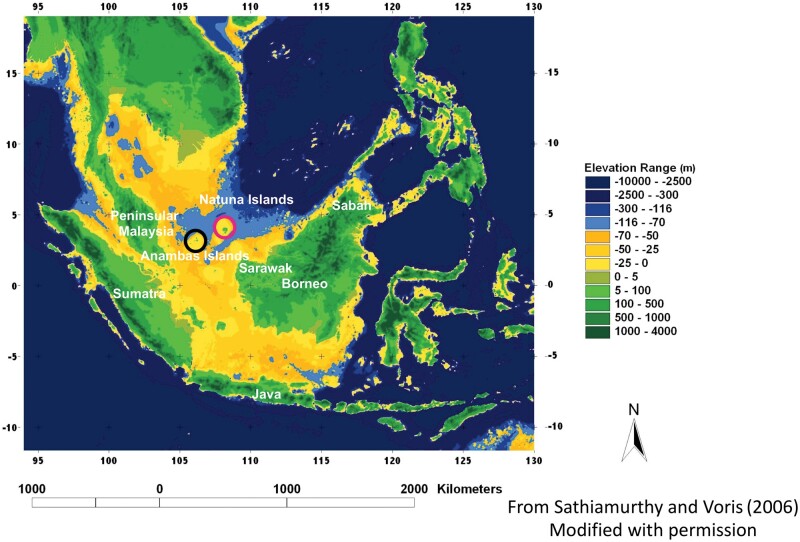
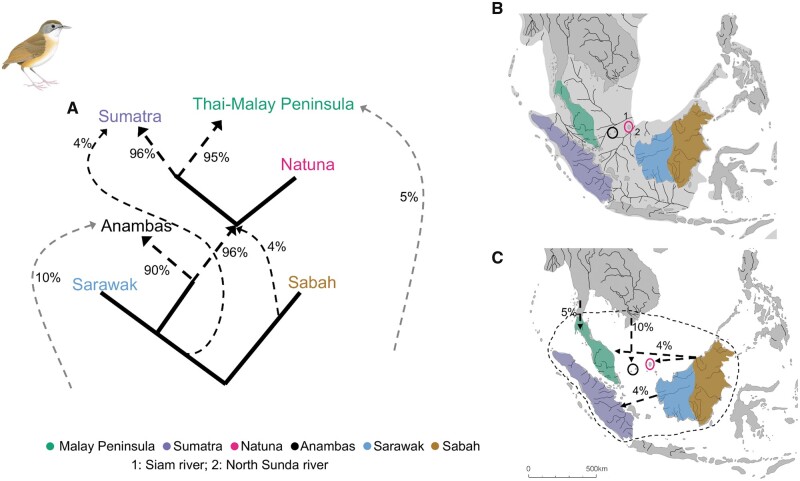
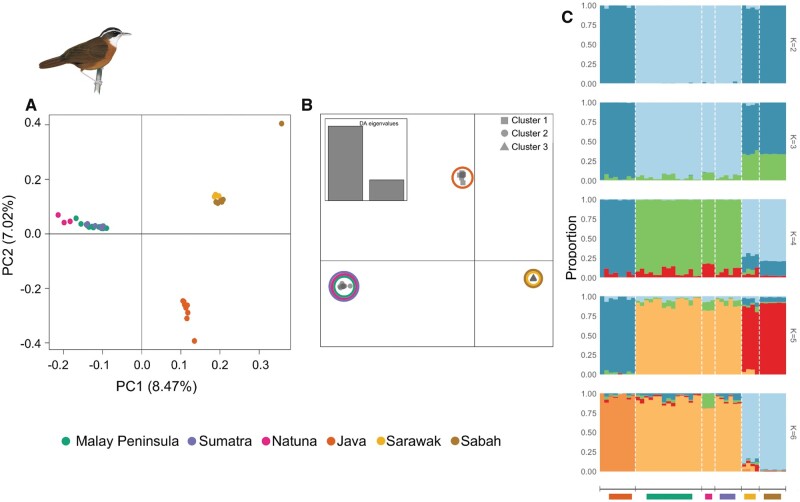
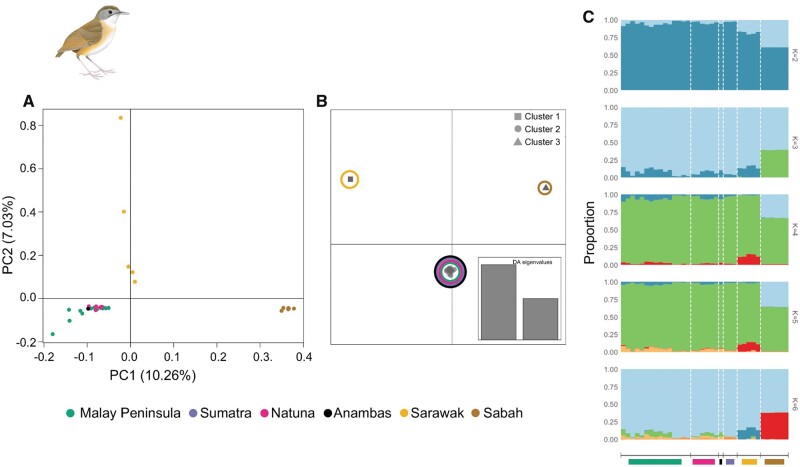
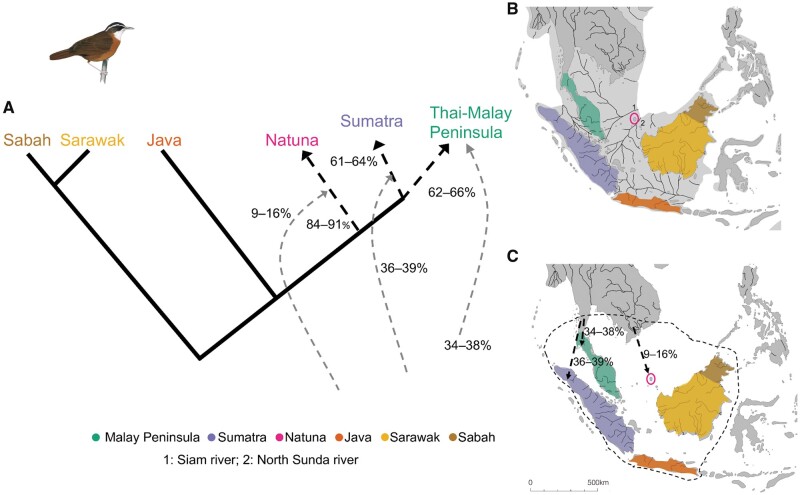
Island biogeography is one of the most powerful subdisciplines of ecology: its mathematical predictions that island size and distance to mainland determine diversity have withstood the test of time. A key question is whether these predictions follow at a population-genomic level. Using rigorous ancient-DNA protocols, we retrieved approximately 1,000 genomic markers from approximately 100 historic specimens of two Southeast Asian songbird complexes from across the Sunda Shelf archipelago collected 1893-1957. We show that the genetic affinities of populations on small shelf islands defy the predictions of geographic distance and appear governed by Earth-historic factors including the position of terrestrial barriers (paleo-rivers) and persistence of corridors (Quaternary land bridges). Our analyses suggest that classic island-biogeographic predictors may not hold well for population-genomic dynamics on the thousands of shelf islands across the globe, which are exposed to dynamic changes in land distribution during Quaternary climate change.
其关于岛屿大小和与大陆距离决定生物多样性的数学预测经受住了时间的考验。一个关键问题是这些预测是否在种群基因组水平上成立。我们使用严格的古 DNA 方案,从 1893 年至 1957 年间收集的跨越巽他陆架群岛的两个东南亚鸣禽复合体的约 100 个历史标本中,提取了约 1000 个基因组标记。我们表明,小陆架岛屿上的种群的遗传亲和力与地理距离的预测相悖,似乎受地球历史因素的控制,包括陆地屏障(古河流)的位置和通道(第四纪陆桥)的持续存在。我们的分析表明,经典的岛屿生物地理学预测因子可能不适用于全球数千个陆架岛屿的种群基因组动态,这些岛屿在第四纪气候变化期间面临着土地分布的动态变化。