Department of Obstetrics, Gynecology and Reproductive Biology, Division of Female Pelvic Medicine and Reconstructive Surgery, Harvard Medical School, Massachusetts General Hospital, Boston, Massachusetts, USA.
Department of Obstetrics and Gynecology, Division of Female Pelvic Medicine and Reconstructive Surgery, Tufts University School of Medicine, Renovia Inc., Boston, Massachusetts, USA.
Neurourol Urodyn. 2022 Jan;41(1):475-481. doi: 10.1002/nau.24854. Epub 2021 Dec 11.
There is limited data addressing the value of vaginal biofeedback (VBF) on fecal incontinence (FI) symptoms. The objective of this pilot study was to evaluate whether use of a motion-based VBF device and app was effective for at-home treatment of women with FI. We hypothesized that VBF would result in improvement in FI symptoms.
A single-arm 10-week prospective pilot trial in women with FI was conducted using the VBF device. The primary outcome was change in St. Mark's score from baseline to week 10. Secondary outcomes included change in 2-week bowel diary and FI quality of life (FIQoL). Statistical analysis included paired t test and Wilcoxon's signed-rank test.
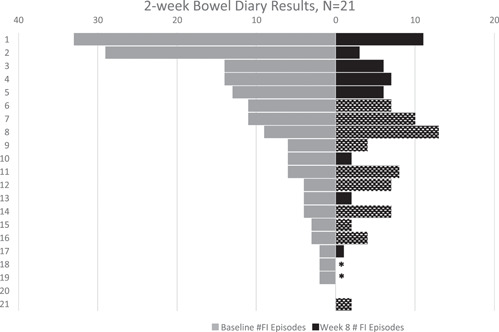
Of 29 enrolled women, 27 had data available for analysis. Mean (±SD) age was 60.9 (±14.4). 63% (17) subjects were White, 33% (9) were Black. Mean St. Mark's score was 14.6 (±4.4) at baseline and 11.6 (±5.1) at 10-weeks (p = 0.005). Changes in the total FIQol, and three of four subsets of the FIQoL scores were also significantly improved (p < 0.001). Bowel diary showed decrease in FI episodes, baseline 8.4 (±8.73) to 10 weeks 4.8 (±3.79), (p = 0.052).
In this pilot study, there was significant improvement in FI symptom-specific severity and quality of life using a vaginal, motion-based device for biofeedback. A larger study is needed to better understand the value of this device, which may be useful for women who prefer a vaginal device, which can be utilized at home compared with standard anal biofeedback for treatment of FI in the clinical setting.
关于阴道生物反馈(VBF)对粪便失禁(FI)症状的价值,数据有限。本研究的目的是评估使用基于运动的 VBF 设备和应用程序是否对 FI 女性的家庭治疗有效。我们假设 VBF 将导致 FI 症状的改善。
对患有 FI 的女性进行了一项为期 10 周的单臂前瞻性试验,使用 VBF 设备。主要结果是从基线到第 10 周时 St. Mark 评分的变化。次要结果包括 2 周排便日记和 FI 生活质量(FIQoL)的变化。统计分析包括配对 t 检验和 Wilcoxon 符号秩检验。
在 29 名入组的女性中,27 名女性有数据分析。平均(±SD)年龄为 60.9(±14.4)岁。63%(17 名)的受试者为白人,33%(9 名)为黑人。基线时 St. Mark 评分平均为 14.6(±4.4),10 周时为 11.6(±5.1)(p=0.005)。FIQol 的总评分以及四个子集中的三个子评分的变化也显著改善(p<0.001)。排便日记显示 FI 发作次数减少,基线 8.4(±8.73)至 10 周 4.8(±3.79)(p=0.052)。
在这项初步研究中,使用阴道运动生物反馈设备,FI 症状的特异性严重程度和生活质量有了显著改善。需要进行更大的研究以更好地了解该设备的价值,对于更喜欢阴道设备的女性可能有用,与标准肛门生物反馈相比,阴道设备可用于家庭治疗 FI,而无需在临床环境中进行治疗。