Lan Yue-Jiao, Sam Napoleon Bellua, Cheng Ming-Han, Pan Hai-Feng, Gao Jian
Pediatric Translational Medicine Institute, Shanghai Children's Medical Center, School of Medicine, Shanghai Jiao Tong University, Shanghai, People's Republic of China.
The Second Affiliated Hospital, Dalian Medical University, Dalian, Liaoning, People's Republic of China.
J Inflamm Res. 2021 Dec 4;14:6543-6556. doi: 10.2147/JIR.S339254. eCollection 2021.
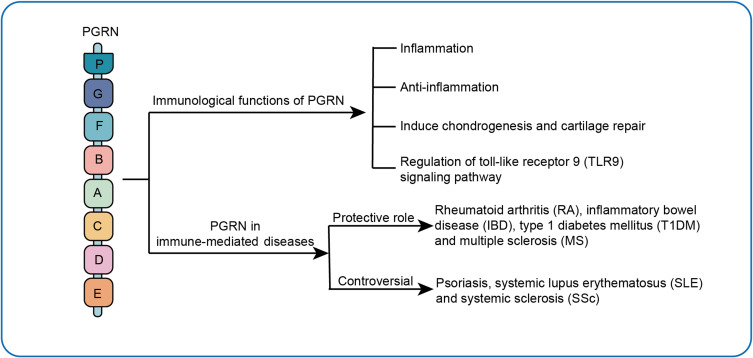
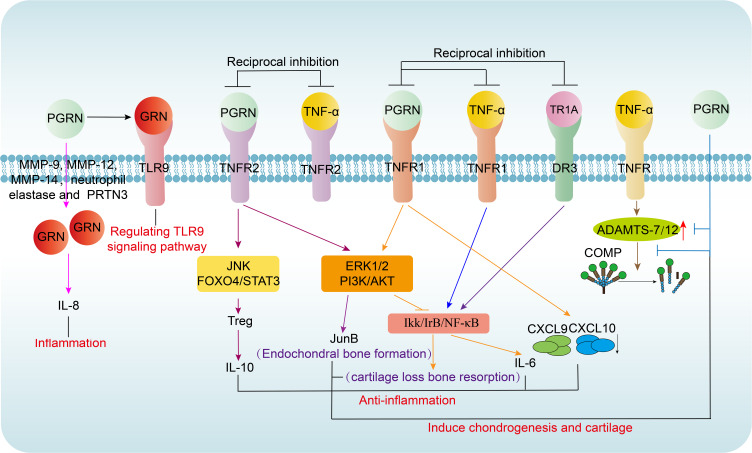
Progranulin (PGRN), a secretory glycoprotein consisting of 593 amino acid residues, is a key actor and regulator of multiple system functions such as innate immune response and inflammation, as well as tissue regeneration. Recently, there is emerging evidence that PGRN is protective in the development of a variety of immune-mediated diseases, including rheumatoid arthritis (RA), inflammatory bowel disease (IBD), type 1 diabetes mellitus (T1DM) and multiple sclerosis (MS) by regulating signaling pathways known to be critical for immunology, particularly the tumor necrosis factor alpha/TNF receptor (TNF-α/TNFR) signaling pathway. Whereas, the role of PGRN in psoriasis, systemic lupus erythematosus (SLE) and systemic sclerosis (SSc) is controversial. This review summarizes the immunological functions of PGRN and its role in the pathogenesis of several immune-mediated diseases, in order to provide new ideas for developing therapeutic strategies for these diseases.
颗粒蛋白前体(PGRN)是一种由593个氨基酸残基组成的分泌性糖蛋白,是多种系统功能(如先天免疫反应、炎症以及组织再生)的关键参与者和调节因子。最近,越来越多的证据表明,PGRN通过调节已知对免疫学至关重要的信号通路,特别是肿瘤坏死因子α/肿瘤坏死因子受体(TNF-α/TNFR)信号通路,在包括类风湿性关节炎(RA)、炎症性肠病(IBD)、1型糖尿病(T1DM)和多发性硬化症(MS)在内的多种免疫介导疾病的发展过程中具有保护作用。然而,PGRN在银屑病、系统性红斑狼疮(SLE)和系统性硬化症(SSc)中的作用存在争议。本综述总结了PGRN的免疫功能及其在几种免疫介导疾病发病机制中的作用,以便为开发这些疾病的治疗策略提供新思路。