
低温对成年个体内分泌和昼夜节律系统的影响
Low Temperature Effect on the Endocrine and Circadian Systems of Adult .
作者信息
Sua-Cespedes Cristhian D, David Daniela Dantas, Souto-Neto José A, Lima Otoniel Gonçalves, Moraes Maria Nathália, de Assis Leonardo V Monteiro, Castrucci Ana Maria de Lauro
机构信息
Laboratory of Comparative Physiology of Pigmentation, Department of Physiology, Institute of Biosciences, University of São Paulo, São Paulo, Brazil.
Laboratory of Neurobiology, Department of Physiology and Biophysics, Institute of Biomedical Sciences, University of São Paulo, São Paulo, Brazil.
出版信息
Front Physiol. 2021 Nov 24;12:707067. doi: 10.3389/fphys.2021.707067. eCollection 2021.
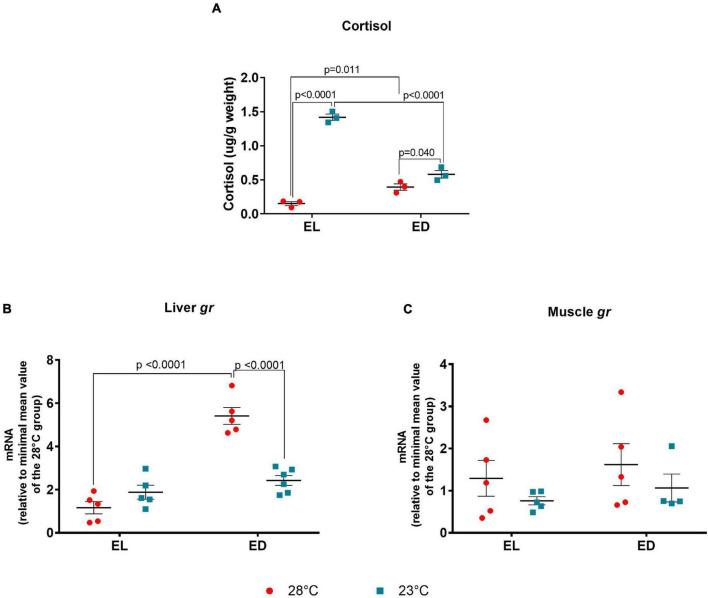
The control of the biological rhythms begins with the activation of photo- and thermosensitive cells located in various organs of the fish such as brain, eye, and skin, but a central clock is still to be identified in teleosts. Thermal changes are stressors which increase cortisol and affect the rhythm of other hormones such as melatonin and growth hormone (GH), in both endo- and ectothermic organisms. Our aim was to investigate how temperature (23°C for 6 days) lower than the optimal (28°C) modulates expression of several gene pathways including growth hormone () and its receptors (), insulin-like growth factor1 () and its receptors (), cortisol and its receptor (), the limiting enzyme of melatonin synthesis (arylalkylamine N-acetyltransferase, ) and melatonin receptors (), as well as their relationship with clock genes in in early light and early dark phases of the day. Lower temperature reduced the expression of the hormone gene , and of the related receptors , and . Cortisol levels were higher at the lower temperature, with a decrease of its receptor () transcripts in the liver. Interestingly, we found higher levels of transcripts in the brain at 23°C. Overall, lower temperature downregulated the transcription of hormone related genes and clock genes. The results suggest a strong correlation of temperature challenge with the clock molecular mechanism and the endocrine systems analyzed, especially the growth hormone and melatonin axes, in tissues.
生物节律的控制始于激活位于鱼类各个器官(如脑、眼和皮肤)中的光敏感和温度敏感细胞,但硬骨鱼的中央时钟仍有待确定。温度变化是应激源,会增加皮质醇,并影响内温动物和外温动物体内褪黑素和生长激素(GH)等其他激素的节律。我们的目的是研究低于最佳温度(28°C)的温度(23°C,持续6天)如何调节几种基因途径的表达,包括生长激素(GH)及其受体(GHR)、胰岛素样生长因子1(IGF1)及其受体(IGF1R)、皮质醇及其受体(GR)、褪黑素合成的限速酶(芳基烷基胺N - 乙酰转移酶,AANAT)和褪黑素受体(MTNR),以及它们在一天的早光期和早暗期与生物钟基因的关系。较低温度降低了激素基因GH、相关受体GHR和IGF1R的表达。较低温度下皮质醇水平较高,其受体(GR)转录本在肝脏中减少。有趣的是,我们发现在23°C时大脑中AANAT转录本水平较高。总体而言,较低温度下调了激素相关基因和生物钟基因的转录。结果表明,温度挑战与所分析的生物钟分子机制和内分泌系统,特别是罗非鱼组织中的生长激素和褪黑素轴,存在很强的相关性。




 Zotero 插件