MOE Key Laboratory of Marine Genetics and Breeding, College of Marine Life Sciences/Key Laboratory of Tropical Aquatic Germplasm of Hainan Province, Sanya Oceanographic Institution, Ocean University of China, Qingdao, Sanya, China.
Hainan Yazhou Bay Seed Laboratory, Sanya, 572025, China.
BMC Genomics. 2024 Nov 4;25(1):1031. doi: 10.1186/s12864-024-10943-6.
The leopard coral grouper (Plectropomus leopardus) is a commercially valuable tropical marine fish species known to be sensitive to low temperatures. A comprehensive understanding of the molecular mechanisms governing its response to acute cold stress is of great importance. However, there is a relative scarcity of fundamental research on low-temperature tolerance in the leopard coral grouper.
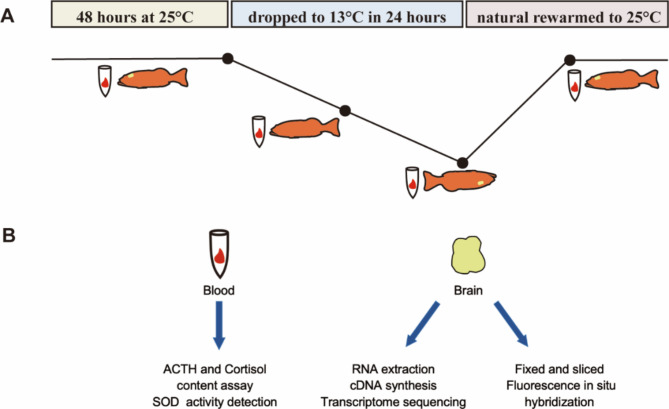
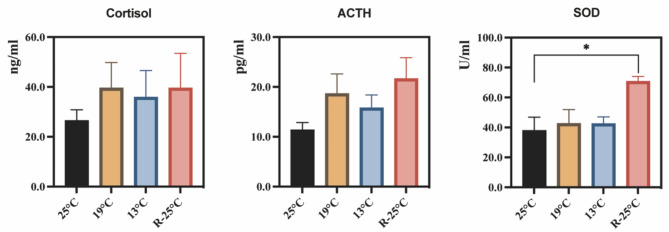
In this study, a cooling and rewarming experiment was conducted on 6-month-old leopard coral groupers. Within 24 h, we decreased the ambient temperature from 25 °C to 13 °C and subsequently allowed it to naturally return to 25 °C. During this process, a comprehensive investigation of serum hormone levels, enzyme activity, and brain transcriptome analysis was performed.
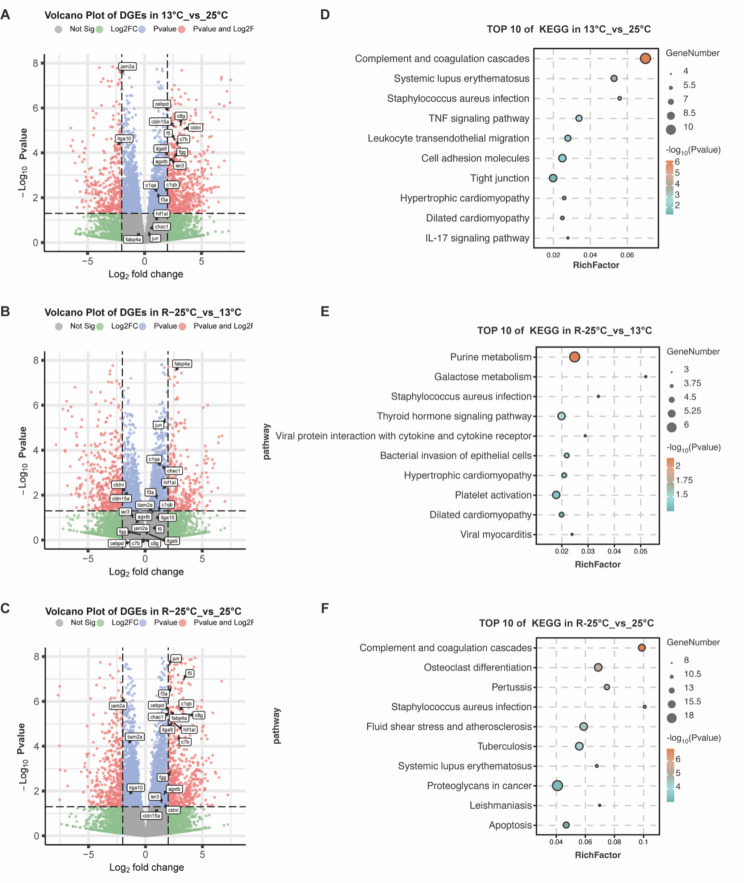
P. leopardus displayed a noticeable adaptive response to the initial temperature decrease by temporarily reducing its life activities. Our transcriptome analysis revealed that the differentially expressed genes (DEGs) were primarily concentrated in crucial pathways including the blood-brain barrier (BBB), inflammatory response, and coagulation cascade. In situ hybridization of claudin 15a (cldn15a), a key gene for BBB maintaining, further confirmed that exposure to low temperatures led to the disruption of the blood-brain barrier and stimulated a pronounced inflammatory reaction within the brain. Upon rewarming, there was a recovery of BBB integrity accompanied by the persistence of inflammation within the brain tissue.
Our study reveals the complex interactions between blood-brain barrier function, inflammation, and recovery in P. leopardus during short-term temperature drops and rewarming. These findings provide valuable insights into the physiological responses of this species under cold stress conditions.
豹纹石斑鱼(Plectropomus leopardus)是一种具有商业价值的热带海水鱼类,其对低温敏感。全面了解控制其对急性冷应激反应的分子机制非常重要。然而,豹纹石斑鱼对低温耐受性的基础研究相对较少。
本研究对 6 月龄豹纹石斑鱼进行了降温复温实验。在 24 小时内,我们将环境温度从 25°C 降至 13°C,然后让其自然回升至 25°C。在此过程中,我们对血清激素水平、酶活性和大脑转录组进行了全面分析。
P. leopardus 对初始温度下降表现出明显的适应反应,暂时降低了其生命活动。我们的转录组分析表明,差异表达基因(DEGs)主要集中在关键途径,包括血脑屏障(BBB)、炎症反应和凝血级联。 Claudin 15a(cldn15a)的原位杂交,这是维持 BBB 的关键基因,进一步证实了低温暴露会破坏血脑屏障,并在大脑中引发明显的炎症反应。复温后,血脑屏障完整性得到恢复,脑组织内的炎症持续存在。
本研究揭示了豹纹石斑鱼在短期温度下降和复温过程中血脑屏障功能、炎症和恢复之间的复杂相互作用。这些发现为该物种在冷应激条件下的生理反应提供了有价值的见解。