Zhang Yupei, Liu Shuhui, Shang Xuequn
School of Computer Science, Northwestern Polytechnical University, Xi'an, China.
Key Laboratory of Big Data Storage and Management, Ministry of Industry and Information Technology, Xi'an, China.
Front Psychol. 2021 Nov 24;12:765754. doi: 10.3389/fpsyg.2021.765754. eCollection 2021.
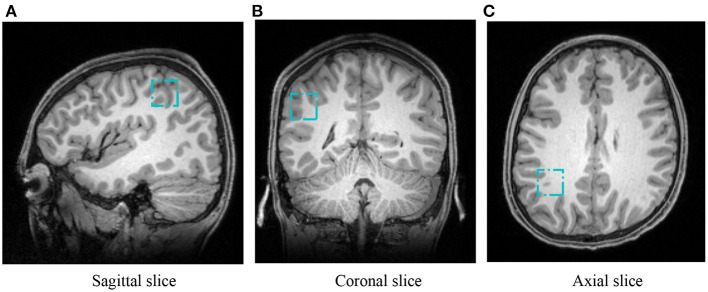
This paper explores whether mathematical education has effects on brain development from the perspective of brain MRIs. While biochemical changes in the left middle front gyrus region of the brain have been investigated, we proposed to classify students by using MRIs from the intraparietal sulcus (IPS) region that was left untouched in the previous study. On the cropped IPS regions, the proposed model developed popular contrastive learning (CL) to solve the problem of multi-instance representation learning. The resulted data representations were then fed into a linear neural network to identify whether students were in the math group or the non-math group. Experiments were conducted on 123 adolescent students, including 72 math students and 51 non-math students. The proposed model achieved an accuracy of 90.24 % for student classification, gaining more than 5% improvements compared to the classical CL frame. Our study provides not only a multi-instance extension to CL and but also an MRI insight into the impact of mathematical studying on brain development.
本文从脑部磁共振成像(MRI)的角度探讨数学教育是否对大脑发育有影响。虽然已经对大脑左中前额回区域的生化变化进行了研究,但我们建议通过使用先前研究中未涉及的顶内沟(IPS)区域的MRI对学生进行分类。在裁剪后的IPS区域上,所提出的模型开发了流行的对比学习(CL)来解决多实例表示学习的问题。然后将得到的数据表示输入到线性神经网络中,以确定学生是属于数学组还是非数学组。对123名青少年学生进行了实验,其中包括72名数学学生和51名非数学学生。所提出的模型在学生分类方面达到了90.24%的准确率,与经典的CL框架相比提高了5%以上。我们的研究不仅为CL提供了多实例扩展,还为数学学习对大脑发育的影响提供了MRI方面的见解。