Department of Medicine, Medical College of Wisconsin, Milwaukee, WI, United States.
Bone Marrow Transplant Program, Medical College of Wisconsin, Milwaukee, WI, United States.
Front Immunol. 2021 Nov 26;12:779076. doi: 10.3389/fimmu.2021.779076. eCollection 2021.
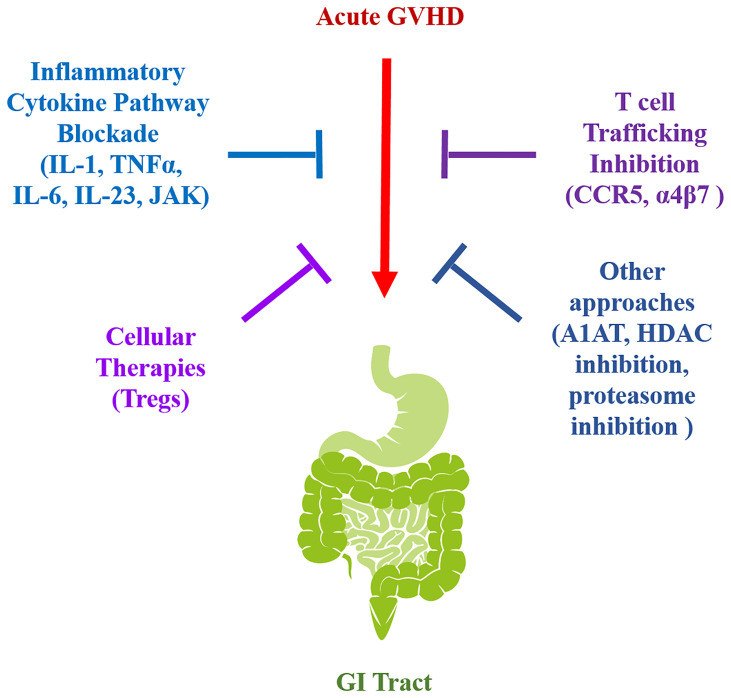
Graft versus host disease (GVHD) is the major non-relapse complication associated with allogeneic hematopoietic stem cell transplantation (HSCT). Unfortunately, GVHD occurs in roughly half of patients following this therapy and can induce severe life-threatening side effects and premature mortality. The pathophysiology of GVHD is driven by alloreactive donor T cells that induce a proinflammatory environment to cause pathological damage in the skin, gastrointestinal (GI) tract, lung, and liver during the acute phase of this disease. Recent work has demonstrated that the GI tract is a pivotal target organ and a primary driver of morbidity and mortality in patients. Prevention of this complication has therefore emerged as an important goal of prophylaxis strategies given the primacy of this tissue site in GVHD pathophysiology. In this review, we summarize foundational pre-clinical studies that have been conducted in animal models to prevent GI tract GVHD and examine the efficacy of these approaches upon subsequent translation into the clinic. Specifically, we focus on therapies designed to block inflammatory cytokine pathways, inhibit cellular trafficking of alloreactive donor T cells to the GI tract, and reconstitute impaired regulatory networks for the prevention of GVHD in the GI tract.
移植物抗宿主病(GVHD)是与异基因造血干细胞移植(HSCT)相关的主要非复发并发症。不幸的是,这种治疗后大约有一半的患者会发生 GVHD,并可能导致严重的危及生命的副作用和过早死亡。GVHD 的病理生理学是由同种反应性供体 T 细胞驱动的,这些细胞诱导促炎环境,在疾病的急性期导致皮肤、胃肠道(GI)道、肺和肝的病理性损伤。最近的工作表明,胃肠道是一个关键的靶器官,也是患者发病率和死亡率的主要驱动因素。鉴于该组织部位在 GVHD 病理生理学中的首要地位,因此预防这种并发症已成为预防策略的一个重要目标。在这篇综述中,我们总结了在动物模型中进行的预防胃肠道 GVHD 的基础临床前研究,并检查了这些方法在随后转化为临床应用中的疗效。具体来说,我们专注于旨在阻断炎症细胞因子途径、抑制同种反应性供体 T 细胞向胃肠道的细胞迁移以及重建受损的调节网络以预防胃肠道 GVHD 的治疗方法。