Maneshi Parniyan, Mason James, Dongre Mitesh, Öhlund Daniel
Department of Radiation Sciences, Umeå University, Umeå, Sweden.
Wallenberg Centre for Molecular Medicine, Umeå University, Umeå, Sweden.
Front Cell Dev Biol. 2021 Nov 25;9:787485. doi: 10.3389/fcell.2021.787485. eCollection 2021.
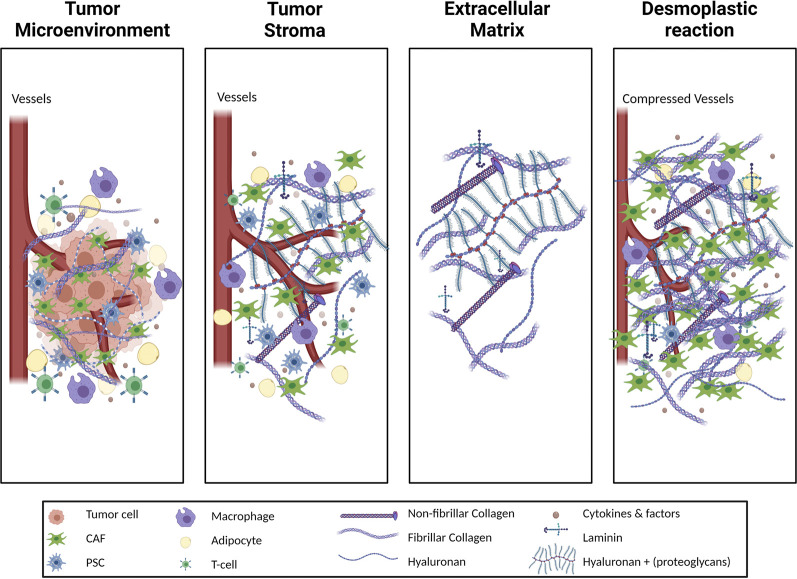
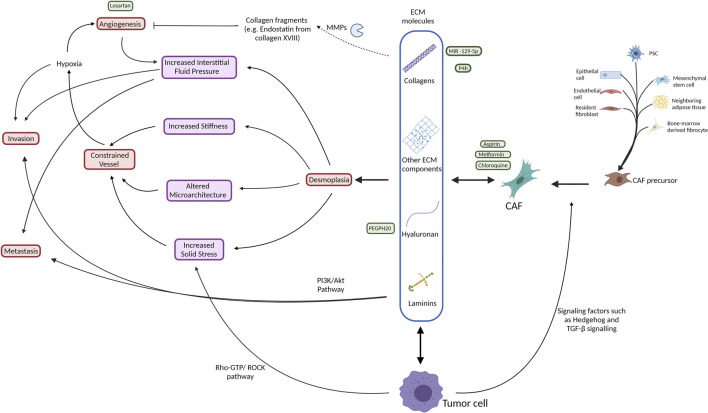
Pancreatic ductal adenocarcinoma (PDAC) has one of the worst outcomes among cancers with a 5-years survival rate of below 10%. This is a result of late diagnosis and the lack of effective treatments. The tumor is characterized by a highly fibrotic stroma containing distinct cellular components, embedded within an extracellular matrix (ECM). This ECM-abundant tumor microenvironment (TME) in PDAC plays a pivotal role in tumor progression and resistance to treatment. Cancer-associated fibroblasts (CAFs), being a dominant cell type of the stroma, are in fact functionally heterogeneous populations of cells within the TME. Certain subtypes of CAFs are the main producer of the ECM components of the stroma, with the most abundant one being the collagen family of proteins. Collagens are large macromolecules that upon deposition into the ECM form supramolecular fibrillar structures which provide a mechanical framework to the TME. They not only bring structure to the tissue by being the main structural proteins but also contain binding domains that interact with surface receptors on the cancer cells. These interactions can induce various responses in the cancer cells and activate signaling pathways leading to epithelial-to-mesenchymal transition (EMT) and ultimately metastasis. In addition, collagens are one of the main contributors to building up mechanical forces in the tumor. These forces influence the signaling pathways that are involved in cell motility and tumor progression and affect tumor microstructure and tissue stiffness by exerting solid stress and interstitial fluid pressure on the cells. Taken together, the TME is subjected to various types of mechanical forces and interactions that affect tumor progression, metastasis, and drug response. In this review article, we aim to summarize and contextualize the recent knowledge of components of the PDAC stroma, especially the role of different collagens and mechanical traits on tumor progression. We furthermore discuss different experimental models available for studying tumor-stromal interactions and finally discuss potential therapeutic targets within the stroma.
胰腺导管腺癌(PDAC)是癌症中预后最差的之一,5年生存率低于10%。这是晚期诊断和缺乏有效治疗的结果。该肿瘤的特征是具有高度纤维化的基质,其中包含不同的细胞成分,嵌入细胞外基质(ECM)中。PDAC中这种富含ECM的肿瘤微环境(TME)在肿瘤进展和治疗抵抗中起关键作用。癌症相关成纤维细胞(CAF)作为基质的主要细胞类型,实际上是TME内功能异质性的细胞群体。某些CAF亚型是基质ECM成分的主要产生者,其中最丰富的是胶原蛋白家族蛋白质。胶原蛋白是大分子,沉积到ECM中后形成超分子纤维结构,为TME提供机械框架。它们不仅作为主要结构蛋白赋予组织结构,还包含与癌细胞表面受体相互作用的结合域。这些相互作用可在癌细胞中诱导各种反应并激活信号通路,导致上皮-间质转化(EMT)并最终发生转移。此外,胶原蛋白是肿瘤中产生机械力的主要因素之一。这些力影响参与细胞运动和肿瘤进展的信号通路,并通过对细胞施加固体应力和间质液压力来影响肿瘤微观结构和组织硬度。综上所述,TME受到各种影响肿瘤进展、转移和药物反应的机械力和相互作用。在这篇综述文章中,我们旨在总结并梳理有关PDAC基质成分的最新知识,尤其是不同胶原蛋白的作用以及机械特性对肿瘤进展的影响。我们还讨论了可用于研究肿瘤-基质相互作用的不同实验模型,最后讨论了基质内潜在的治疗靶点。