Liu Renlong, Long Youqin, Zhou Yuhe, Liu Zuohua, Liu Xin, Huo Xuejian, Xie Zhaoming, Tao Changyuan
School of Chemistry and Chemical Engineering, Chongqing University, Chongqing 400044, China.
State Key Laboratory of Coal Mine Disaster Dynamics and Control, Chongqing University, Chongqing 400044, China.
ACS Omega. 2021 Nov 22;6(48):33206-33214. doi: 10.1021/acsomega.1c05836. eCollection 2021 Dec 7.
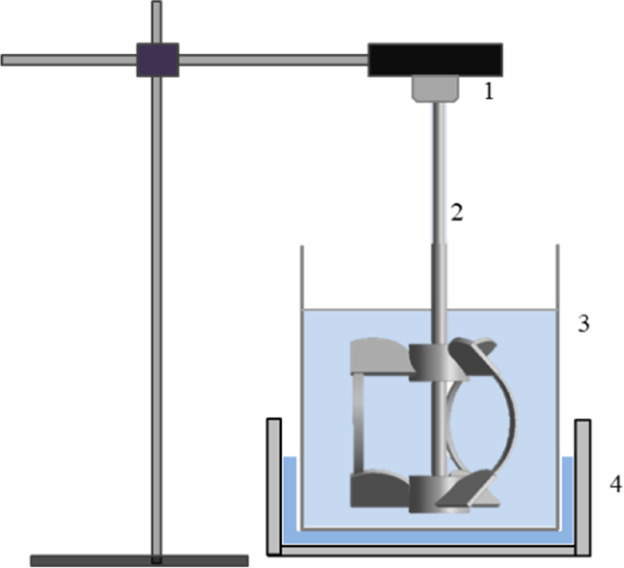
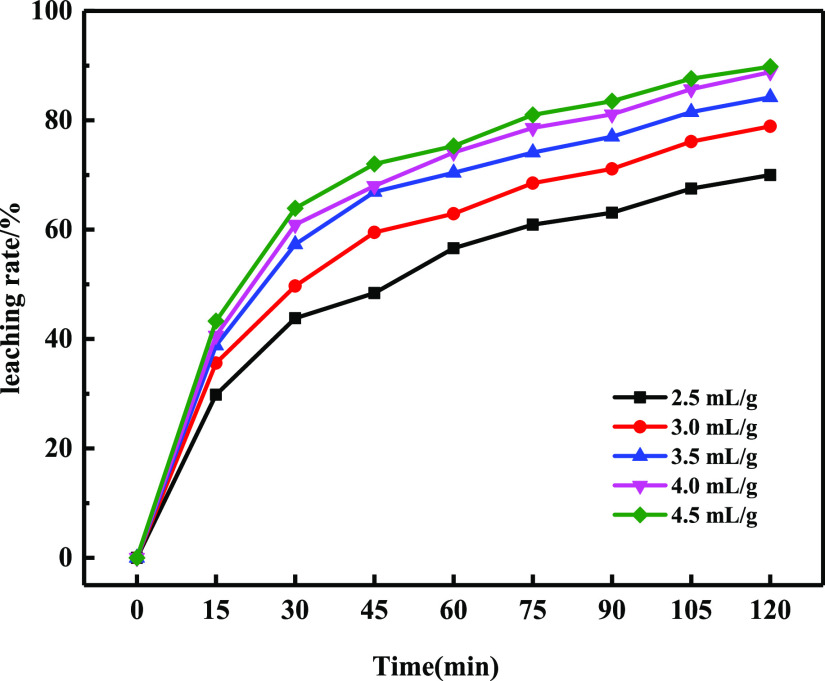
Conventional rigid impellers are frequently used in the leaching process of phosphate rock, which often form a symmetrical flow field in the reactor, leading to a reduction in the leaching efficiency. In this work, a rigid-flexible combined impeller was applied to the leaching process of phosphate rock to increase the leaching efficiency. The effects of the reaction temperature (), sulfuric acid excess coefficient (ε), liquid-solid ratio (L/S), agitation speed (), and leaching time () on the leaching of phosphate rock were investigated, and based on this, the leaching kinetics was studied. The results indicated that under the optimum parameters of a reaction temperature of 353 K, a sulfuric acid excess coefficient of 1.15, a liquid-solid ratio of 4.0 mL/g, an agitation speed of 280 rpm, and a leaching time of 120 min, the leaching rate of phosphate rock using the rigid-flexible combined impeller reached 89.1%, which was 7.1% higher than that of the conventional rigid impeller under the same electric energy consumption. The leaching process complied with the unreacted core shrinking model, and the reaction rate was controlled by product layer diffusion. The apparent rate equation of the leaching process was 1 - 2/3 - (1 - ) = 2.06 × 10[ε][L/S][] exp(-19.03 × 10/)·, and the apparent activation energy was 19.03 kJ/mol. The numerical simulation and analysis of the leaching residue showed that the system temperature in the rigid-flexible combined impeller system was homogenized, and the mixing effect of reactants was enhanced through the multiposition movement of the flexible connection piece in the axial direction, so that the reactants participated in the chemical reaction more efficiently.
传统刚性搅拌桨在磷矿浸出过程中经常被使用,其在反应器中常形成对称流场,导致浸出效率降低。在本研究中,将刚柔组合搅拌桨应用于磷矿浸出过程以提高浸出效率。考察了反应温度()、硫酸过量系数(ε)、液固比(L/S)、搅拌速度()和浸出时间()对磷矿浸出的影响,并在此基础上研究了浸出动力学。结果表明,在反应温度353 K、硫酸过量系数1.15、液固比4.0 mL/g、搅拌速度280 rpm和浸出时间120 min的最佳参数下,使用刚柔组合搅拌桨时磷矿的浸出率达到89.1%,在相同电能消耗下比传统刚性搅拌桨高7.1%。浸出过程符合未反应核收缩模型,反应速率受产物层扩散控制。浸出过程的表观速率方程为1 - 2/3 - (1 - ) = 2.06 × 10[ε][L/S][] exp(-19.03 × 10/)·,表观活化能为19.03 kJ/mol。对浸出残渣的数值模拟与分析表明,刚柔组合搅拌桨系统内体系温度均匀化,通过柔性连接件在轴向的多位置运动增强了反应物的混合效果,使反应物更高效地参与化学反应。