Department of Human Genetics, Leiden University Medical Center, Leiden, the Netherlands.
Bio-Prodict, Nijmegen, the Netherlands.
Cancer Res. 2022 Feb 15;82(4):615-631. doi: 10.1158/0008-5472.CAN-21-1845.
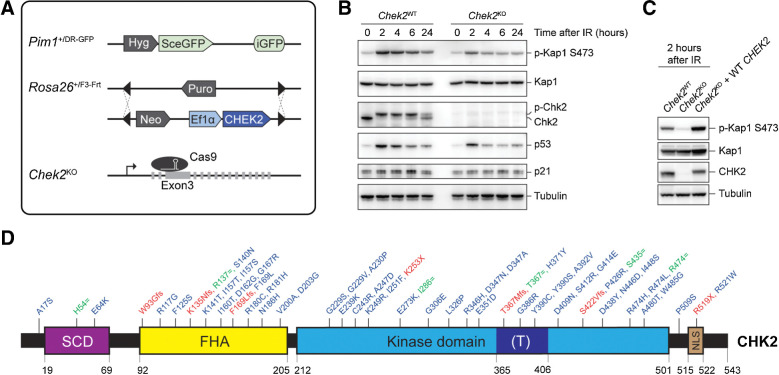
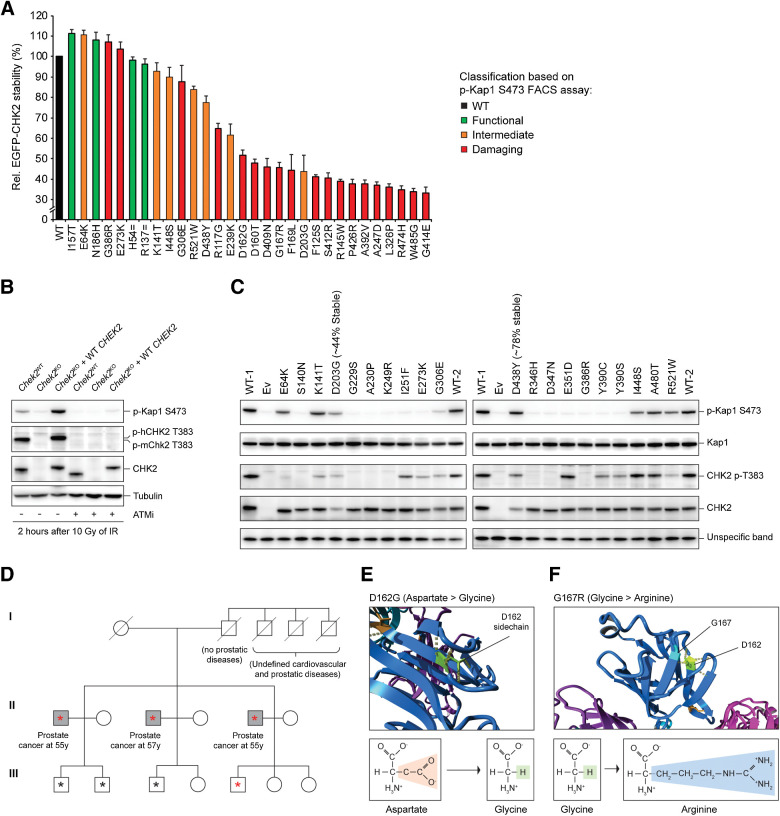
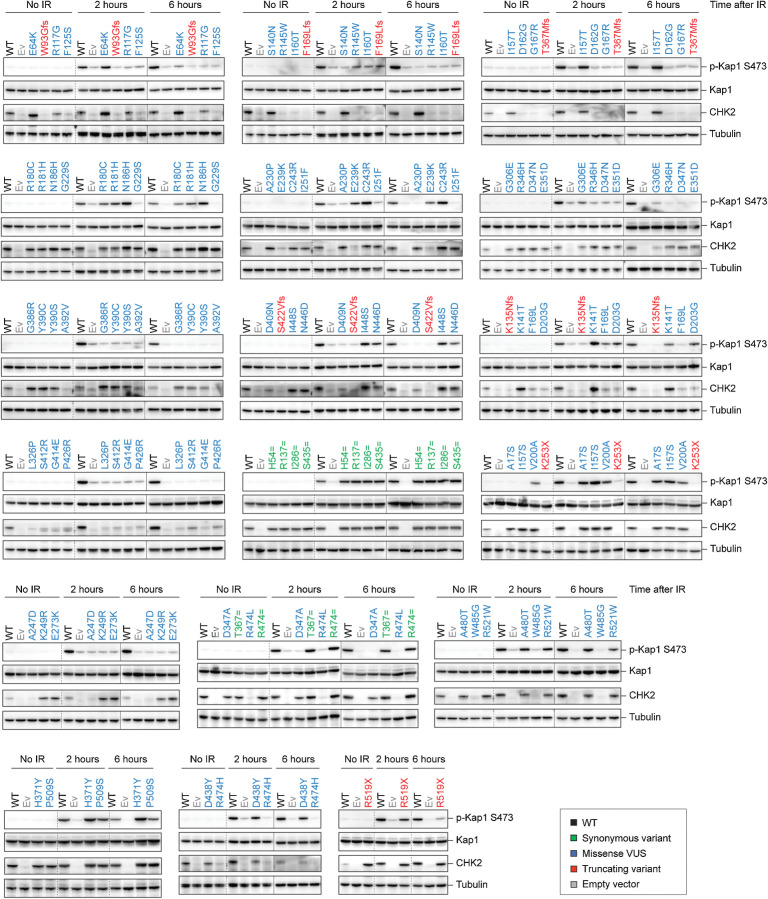
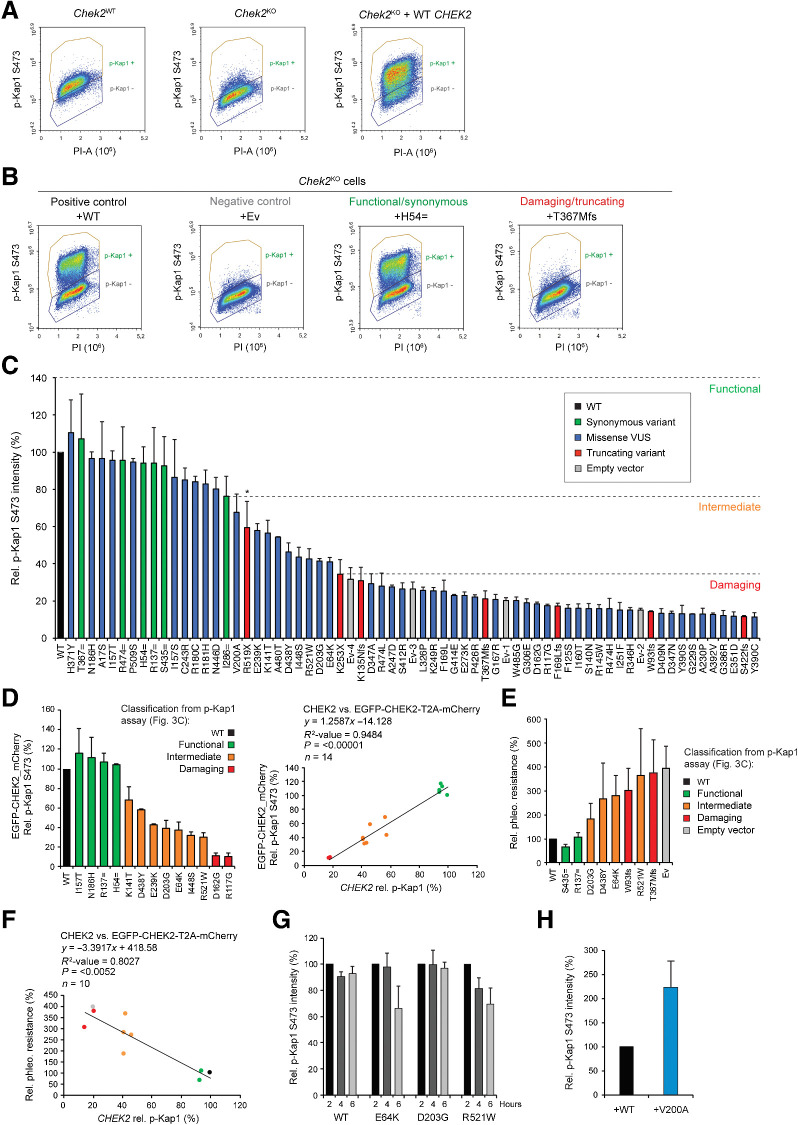
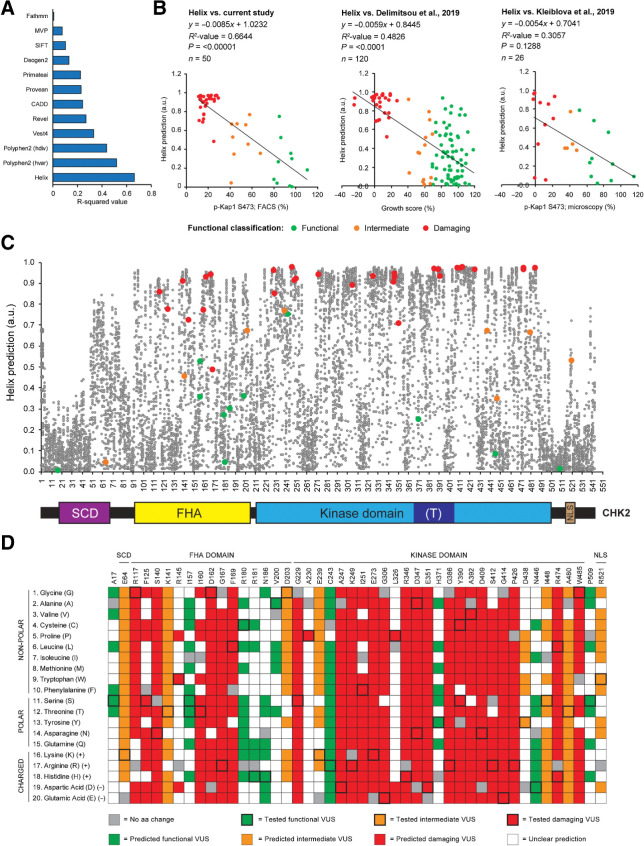
Heterozygous carriers of germline loss-of-function variants in the tumor suppressor gene checkpoint kinase 2 (CHEK2) are at an increased risk for developing breast and other cancers. While truncating variants in CHEK2 are known to be pathogenic, the interpretation of missense variants of uncertain significance (VUS) is challenging. Consequently, many VUS remain unclassified both functionally and clinically. Here we describe a mouse embryonic stem (mES) cell-based system to quantitatively determine the functional impact of 50 missense VUS in human CHEK2. By assessing the activity of human CHK2 to phosphorylate one of its main targets, Kap1, in Chek2 knockout mES cells, 31 missense VUS in CHEK2 were found to impair protein function to a similar extent as truncating variants, while 9 CHEK2 missense VUS resulted in intermediate functional defects. Mechanistically, most VUS impaired CHK2 kinase function by causing protein instability or by impairing activation through (auto)phosphorylation. Quantitative results showed that the degree of CHK2 kinase dysfunction correlates with an increased risk for breast cancer. Both damaging CHEK2 variants as a group [OR 2.23; 95% confidence interval (CI), 1.62-3.07; P < 0.0001] and intermediate variants (OR 1.63; 95% CI, 1.21-2.20; P = 0.0014) were associated with an increased breast cancer risk, while functional variants did not show this association (OR 1.13; 95% CI, 0.87-1.46; P = 0.378). Finally, a damaging VUS in CHEK2, c.486A>G/p.D162G, was also identified, which cosegregated with familial prostate cancer. Altogether, these functional assays efficiently and reliably identified VUS in CHEK2 that associate with cancer.
Quantitative assessment of the functional consequences of CHEK2 variants of uncertain significance identifies damaging variants associated with increased cancer risk, which may aid in the clinical management of patients and carriers.
种系细胞中肿瘤抑制基因检查点激酶 2(CHEK2)失活变体的杂合子携带者,其罹患乳腺癌和其他癌症的风险增加。虽然已知 CHEK2 中的截断变体具有致病性,但对意义未明的错义变体(VUS)的解释具有挑战性。因此,许多 VUS 在功能和临床上仍未分类。在这里,我们描述了一种基于小鼠胚胎干细胞(mES)的系统,用于定量测定 50 种人 CHEK2 错义 VUS 的功能影响。通过评估人 CHK2 对 Chek2 敲除 mES 细胞中其主要靶标 Kap1 的磷酸化活性,发现 31 种 CHEK2 错义 VUS 对蛋白功能的损害程度与截断变体相似,而 9 种 CHEK2 错义 VUS 导致中间功能缺陷。从机制上讲,大多数 VUS 通过导致蛋白不稳定或通过(自身)磷酸化来损害激活,从而损害 CHK2 激酶功能。定量结果表明,CHK2 激酶功能障碍的程度与乳腺癌风险增加相关。作为一个整体,具有破坏性的 CHEK2 变体[OR 2.23;95%置信区间(CI),1.62-3.07;P < 0.0001]和中间变体(OR 1.63;95% CI,1.21-2.20;P = 0.0014)与乳腺癌风险增加相关,而功能变体则没有显示出这种相关性(OR 1.13;95% CI,0.87-1.46;P = 0.378)。最后,还鉴定了 CHEK2 中的一个破坏性 VUS,c.486A>G/p.D162G,其与家族性前列腺癌共分离。总之,这些功能测定有效地和可靠地鉴定了与癌症相关的 CHEK2 VUS。
对 CHEK2 意义未明的变体的功能后果进行定量评估,可识别出与癌症风险增加相关的破坏性变体,这可能有助于患者和携带者的临床管理。