Gopan Amrit, Sarma Moinak Sen
Department of Gastroenterology, Seth G.S Medical College and K.E.M Hospital, Mumbai 400012, India.
Department of Pediatric Gastroenterology, Sanjay Gandhi Postgraduate Institute of Medical Sciences, Lucknow 226014, India.
World J Hepatol. 2021 Nov 27;13(11):1707-1726. doi: 10.4254/wjh.v13.i11.1707.
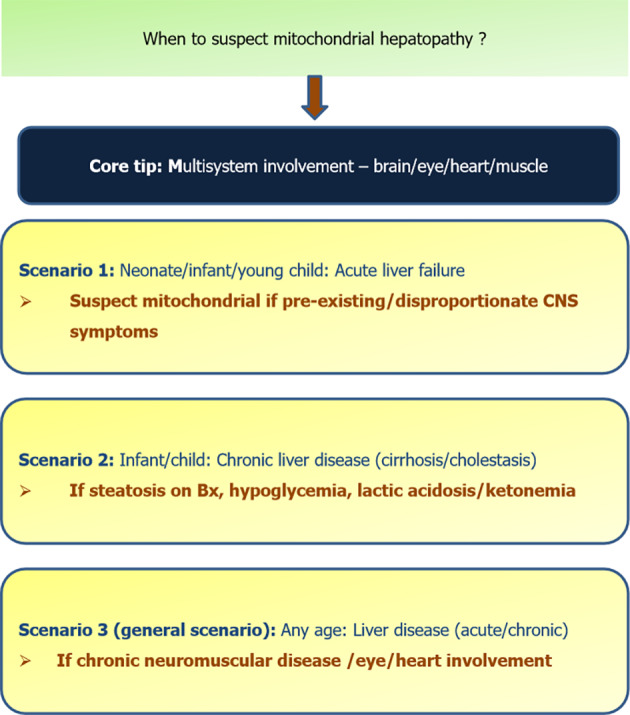
Mitochondria, the powerhouse of a cell, are closely linked to the pathophysiology of various common as well as not so uncommon disorders of the liver and beyond. Evolution supports a prokaryotic descent, and, unsurprisingly, the organelle is worthy of being labeled an organism in itself. Since highly metabolically active organs require a continuous feed of energy, any dysfunction in the structure and function of mitochondria can have variable impact, with the worse end of the spectrum producing catastrophic consequences with a multisystem predisposition. Though categorized a hepatopathy, mitochondrial respiratory chain defects are not limited to the liver in time and space. The liver involvement is also variable in clinical presentation as well as in age of onset, from acute liver failure, cholestasis, or chronic liver disease. Other organs like eye, muscle, central and peripheral nervous system, gastrointestinal tract, hematological, endocrine, and renal systems are also variably involved. Diagnosis hinges on recognition of subtle clinical clues, screening metabolic investigations, evaluation of the extra-hepatic involvement, and role of genetics and tissue diagnosis. Treatment is aimed at both circumventing the acute metabolic crisis and long-term management including nutritional rehabilitation. This review lists and discusses the burden of mitochondrial respiratory chain defects, including various settings when to suspect, their evolution with time, including certain specific disorders, their tiered evaluation with diagnostic algorithms, management dilemmas, role of liver transplantation, and the future research tools.
线粒体,作为细胞的动力源,与肝脏及其他多种常见和不那么常见疾病的病理生理学密切相关。进化支持其原核生物起源,不出所料,这个细胞器本身就值得被视为一种生物体。由于高代谢活性的器官需要持续的能量供应,线粒体结构和功能的任何功能障碍都可能产生不同的影响,最严重的情况会导致多系统易感性的灾难性后果。尽管线粒体呼吸链缺陷被归类为肝病,但在时间和空间上并不局限于肝脏。肝脏受累在临床表现和发病年龄方面也各不相同,包括急性肝衰竭、胆汁淤积或慢性肝病。眼睛、肌肉、中枢和外周神经系统、胃肠道、血液、内分泌和肾脏系统等其他器官也会不同程度地受累。诊断取决于对细微临床线索的识别、代谢筛查检查、肝外受累情况的评估以及遗传学和组织诊断的作用。治疗旨在规避急性代谢危机并进行长期管理,包括营养康复。本综述列出并讨论了线粒体呼吸链缺陷的负担,包括何时怀疑的各种情况、其随时间的演变(包括某些特定疾病)、使用诊断算法的分层评估、管理困境、肝移植的作用以及未来的研究工具。