Department of Life Sciences and Biotechnology, University of Ferrara, Via Fossato di Mortara 74, 44121, Ferrara, Italy.
Department of Molecular Genetics, University of Maastricht, Maastricht, The Netherlands.
Mol Med. 2021 Dec 14;27(1):157. doi: 10.1186/s10020-021-00418-9.
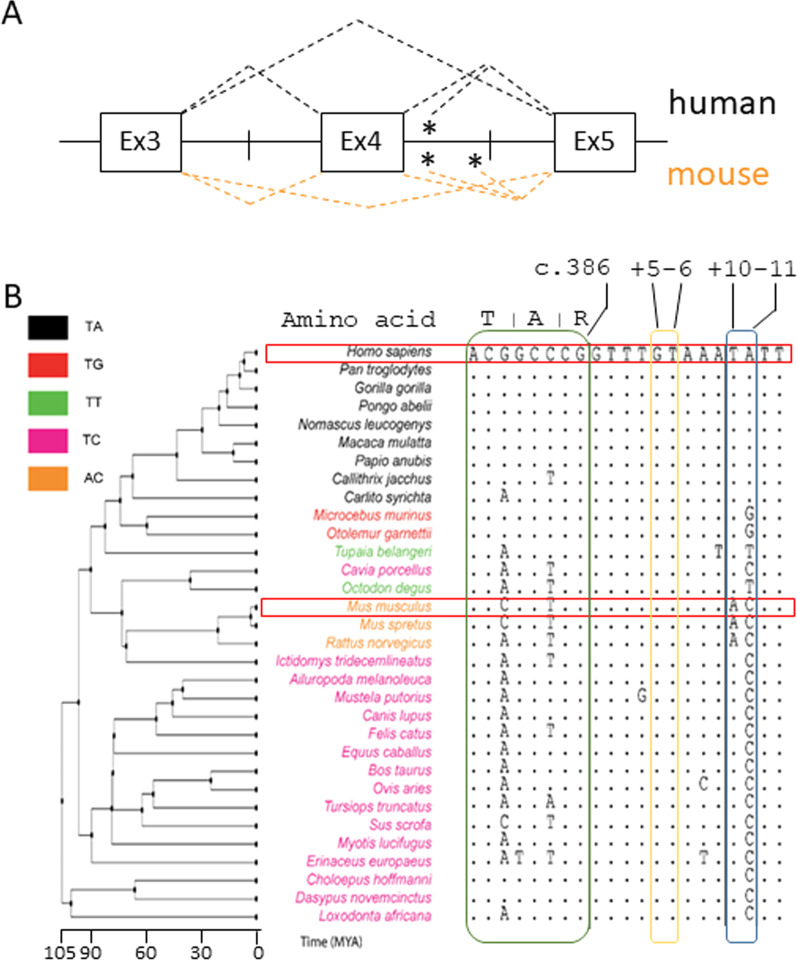
Aberrant splicing is a common outcome in the presence of exonic or intronic variants that might hamper the intricate network of interactions defining an exon in a specific gene context. Therefore, the evaluation of the functional, and potentially pathological, role of nucleotide changes remains one of the major challenges in the modern genomic era. This aspect has also to be taken into account during the pre-clinical evaluation of innovative therapeutic approaches in animal models of human diseases. This is of particular relevance when developing therapeutics acting on splicing, an intriguing and expanding research area for several disorders. Here, we addressed species-specific splicing mechanisms triggered by the OTC c.386G>A mutation, relatively frequent in humans, leading to Ornithine TransCarbamylase Deficiency (OTCD) in patients and spf mice, and its differential susceptibility to RNA therapeutics based on engineered U1snRNA.
Creation and co-expression of engineered U1snRNAs with human and mouse minigenes, either wild-type or harbouring different nucleotide changes, in human (HepG2) and mouse (Hepa1-6) hepatoma cells followed by analysis of splicing pattern. RNA pulldown studies to evaluate binding of specific splicing factors.
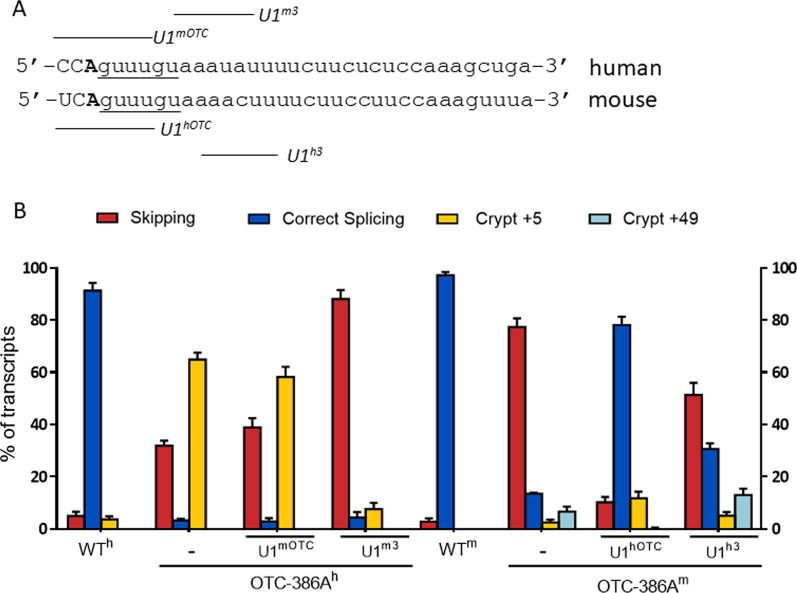
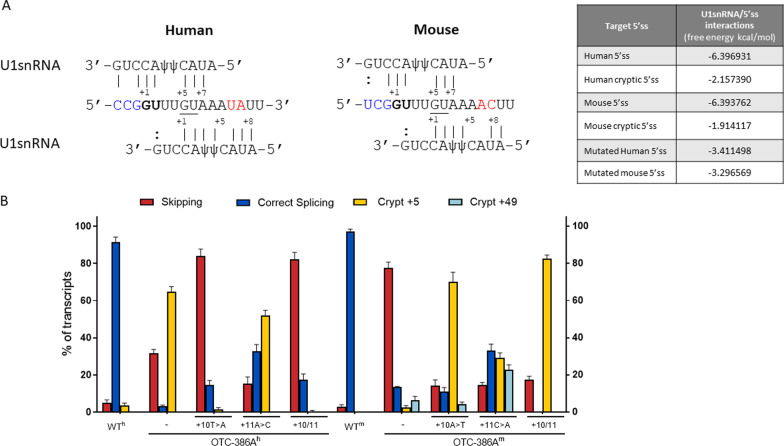
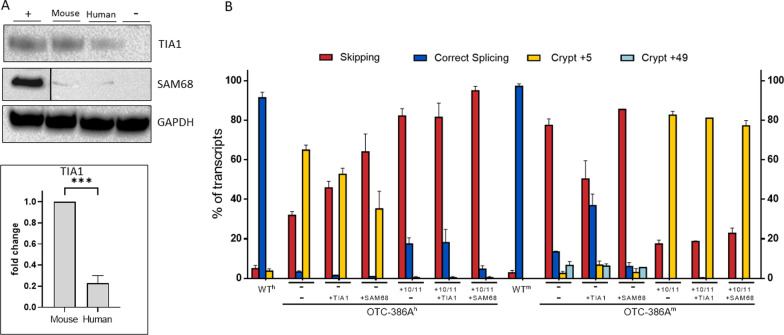
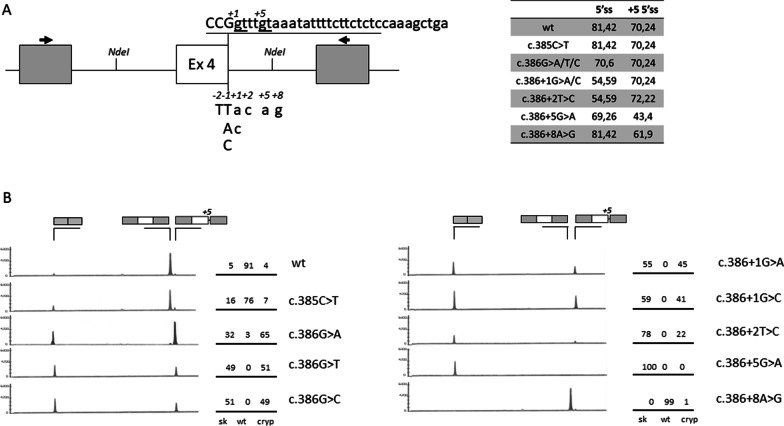
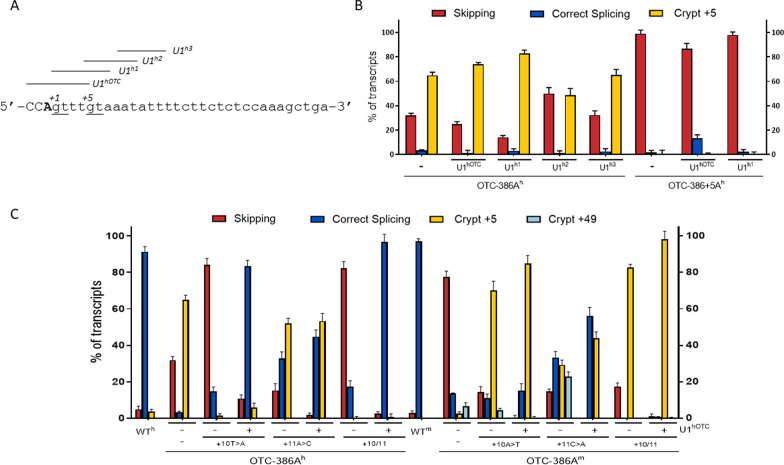
Comparative nucleotide analysis suggested a role for the intronic +10-11 nucleotides, and pull-down assays showed that they confer preferential binding to the TIA1 splicing factor in the mouse context, where TIA1 overexpression further increases correct splicing. Consistently, the splicing profile of the human minigene with mouse +10-11 nucleotides overlapped that of mouse minigene, and restored responsiveness to TIA1 overexpression and to compensatory U1snRNA. Swapping the human +10-11 nucleotides into the mouse context had opposite effects. Moreover, the interplay between the authentic and the adjacent cryptic 5'ss in the human OTC dictates pathogenic mechanisms of several OTCD-causing 5'ss mutations, and only the c.386+5G>A change, abrogating the cryptic 5'ss, was rescuable by engineered U1snRNA.
Subtle intronic variations explain species-specific OTC splicing patterns driven by the c.386G>A mutation, and the responsiveness to engineered U1snRNAs, which suggests careful elucidation of molecular mechanisms before proposing translation of tailored therapeutics from animal models to humans.
外显子或内含子变异会导致剪接异常,这可能会破坏特定基因中外显子相互作用的复杂网络。因此,评估核苷酸变化的功能和潜在病理作用仍然是现代基因组时代的主要挑战之一。在人类疾病的动物模型中,评估创新治疗方法的临床前评估中也必须考虑到这一点。当开发针对剪接的治疗方法时,这一点尤其相关,剪接是几个疾病领域中一个有趣且不断扩展的研究领域。在这里,我们研究了由 OTC c.386G>A 突变引起的物种特异性剪接机制,该突变在人类中相对常见,导致患者和 spf 小鼠的鸟氨酸转氨甲酰酶缺乏症(OTCD),以及其对基于工程 U1snRNA 的 RNA 治疗的差异敏感性。
在人类(HepG2)和小鼠(Hepa1-6)肝癌细胞中共同表达携带不同核苷酸变化的工程 U1snRNA 和人源或鼠源的 minigene,然后分析剪接模式。通过 RNA 下拉研究评估特定剪接因子的结合。
比较核苷酸分析表明内含子+10-11 个核苷酸起作用,下拉实验表明它们在小鼠中优先与 TIA1 剪接因子结合,在小鼠中 TIA1 过表达进一步增加正确剪接。一致地,具有鼠源+10-11 个核苷酸的人源 minigene 的剪接谱与鼠源 minigene重叠,并恢复了对 TIA1 过表达和补偿性 U1snRNA 的反应性。将人源+10-11 个核苷酸交换到鼠源中会产生相反的效果。此外,人源 OTC 中真实和相邻的隐匿 5'ss 之间的相互作用决定了几种导致 OTCD 的 5'ss 突变的致病机制,只有 c.386+5G>A 变化,破坏了隐匿 5'ss,才能被工程 U1snRNA 挽救。
由 c.386G>A 突变驱动的 OTC 剪接模式的物种特异性是由微妙的内含子变异引起的,并且对工程 U1snRNA 有反应性,这表明在提出从动物模型向人类转化定制治疗方法之前,应仔细阐明分子机制。