
用新型 MUC16 靶向治疗性抗体 AR9.6 进行卵巢癌和胰腺癌的免疫 PET 研究。
ImmunoPET of Ovarian and Pancreatic Cancer with AR9.6, a Novel MUC16-Targeted Therapeutic Antibody.
机构信息
Department of Radiology, Memorial Sloan Kettering Cancer Center, New York, New York.
Department of Pharmacology, Weill Cornell Medical College, New York, New York.
出版信息
Clin Cancer Res. 2022 Mar 1;28(5):948-959. doi: 10.1158/1078-0432.CCR-21-1798.
PURPOSE
Advances in our understanding of the contribution of aberrant glycosylation to the pro-oncogenic signaling and metastasis of tumor cells have reinvigorated the development of mucin-targeted therapies. Here, we validate the tumor-targeting ability of a novel monoclonal antibody (mAb), AR9.6, that binds MUC16 and abrogates downstream oncogenic signaling to confer a therapeutic response.
EXPERIMENTAL DESIGN
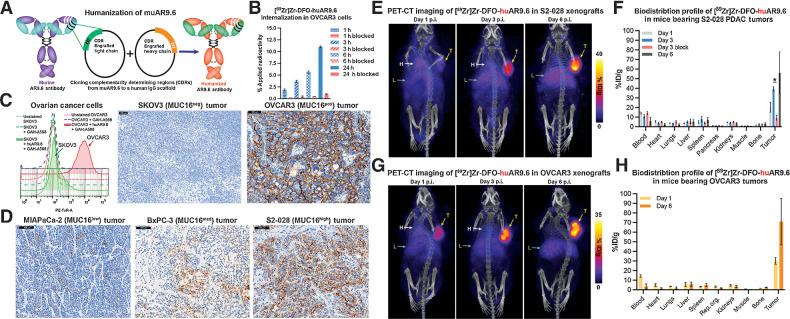
The in vitro and ex vivo validation of the binding of AR9.6 to MUC16 was achieved via flow cytometry, radioligand binding assay (RBA), and immunohistochemistry (IHC). The in vivo MUC16 targeting of AR9.6 was validated by creating a 89Zr-labeled radioimmunoconjugate of the mAb and utilizing immunoPET and ex vivo biodistribution studies in xenograft models of human ovarian and pancreatic cancer.
RESULTS
Flow cytometry, RBA, and IHC revealed that AR9.6 binds to ovarian and pancreatic cancer cells in an MUC16-dependent manner. The in vivo radiopharmacologic profile of 89Zr-labeled AR9.6 in mice bearing ovarian and pancreatic cancer xenografts confirmed the MUC16-dependent tumor targeting by the radioimmunoconjugate. Radioactivity uptake was also observed in the distant lymph nodes (LNs) of mice bearing xenografts with high levels of MUC16 expression (i.e., OVCAR3 and Capan-2). IHC analyses of these PET-positive LNs highlighted the presence of shed antigen as well as necrotic, phagocytized, and actively infiltrating neoplastic cells. The humanization of AR9.6 did not compromise its ability to target MUC16-expressing tumors.
CONCLUSIONS
The unique therapeutic mechanism of AR9.6 combined with its excellent in vivo tumor targeting makes it a highly promising theranostic agent. huAR9.6 is poised for clinical translation to impact the management of metastatic ovarian and pancreatic cancers.
目的
我们对异常糖基化促进肿瘤细胞致癌信号和转移能力的认识的提高,重新激发了针对粘蛋白的治疗方法的发展。在这里,我们验证了一种新型单克隆抗体(mAb)AR9.6 的肿瘤靶向能力,该抗体与 MUC16 结合并阻断下游致癌信号,从而产生治疗反应。
实验设计
通过流式细胞术、放射性配体结合分析(RBA)和免疫组织化学(IHC)验证了 AR9.6 与 MUC16 的结合。通过创建 mAb 的 89Zr 标记放射性免疫偶联物,并在卵巢癌和胰腺癌的异种移植模型中利用免疫 PET 和体外生物分布研究,验证了 AR9.6 在体内对 MUC16 的靶向性。
结果
流式细胞术、RBA 和 IHC 显示 AR9.6 以 MUC16 依赖的方式与卵巢癌和胰腺癌细胞结合。在携带卵巢癌和胰腺癌异种移植瘤的小鼠中,89Zr 标记的 AR9.6 的体内放射药理学特征证实了放射性免疫偶联物对 MUC16 依赖性肿瘤的靶向性。在高表达 MUC16 的异种移植瘤小鼠的远处淋巴结(LN)中也观察到放射性摄取(即 OVCAR3 和 Capan-2)。这些 PET 阳性 LN 的 IHC 分析突出了存在脱落抗原以及坏死、吞噬和活跃浸润的肿瘤细胞。AR9.6 的人源化并没有损害其靶向表达 MUC16 的肿瘤的能力。
结论
AR9.6 的独特治疗机制与其出色的体内肿瘤靶向性相结合,使其成为一种极具前途的治疗诊断剂。huAR9.6 有望进行临床转化,从而影响转移性卵巢癌和胰腺癌的治疗管理。


 Zotero 插件