Center for Innovation in Healthy and Resilient Aging, Arizona State University, 550 North 3rd St, Phoenix, AZ, 85004, USA.
Edson College of Nursing and Health Innovation, Arizona State University, 550 North 3rd St, Phoenix, AZ, 85004, USA.
BMC Health Serv Res. 2021 Dec 19;21(1):1355. doi: 10.1186/s12913-021-07353-9.
Chronic conditions are common and require ongoing continuous management and preventive measures. The COVID-19 pandemic may have affected the management of chronic conditions by delaying care. We sought to understand the impact of personal characteristics (i.e., age) and healthcare factors (i.e., access to a provider) on healthcare access in a sample of Americans 50 years of age or older during COVID-19.
Participants completed an online survey at the start of the COVID-19 pandemic - the Aging in the Time of COVID Survey. Questions focused on health status, health care access, COVID-19 fear, and social connectedness. Participants were recruited through social media advertisements, list serves, and snowball sampling. Data collection started in early April 2020 and concluded in late May 2020. Logistic regression models examined the results of two key access points: healthcare provider/doctor (n = 481) and medication (n = 765), with 56 and 93% of participants reporting access to a provider and medications, respectively.
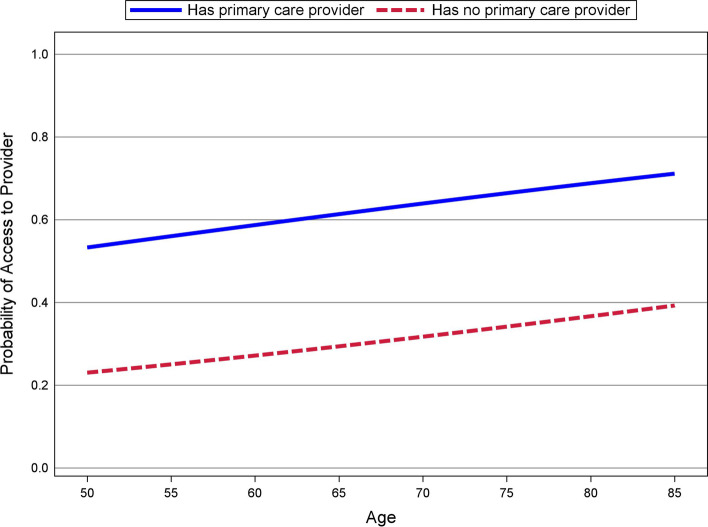
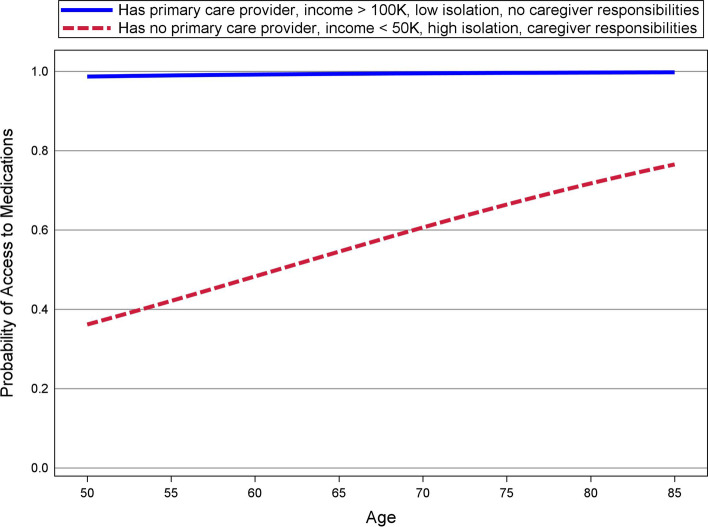
Individuals with an established primary care provider were much more likely to obtain access to a healthcare provider, OR = 3.81 (95% CI: 1.69, 8.77), and to receive medication, OR = 4.48 (95% CI: 1.61, 11.48), during the time of COVID-19. In addition, access to medication was (a) higher for those who were older, OR = 1.05 (95% CI: 1.01, 1.09), had a higher income (greater than 100 k compared to less than 50 k, OR = 3.04 (95% CI: 1.11, 8.98), and (b) lower for those having caregiving responsibilities, OR = 0.41 (95% CI: 0.21, 0.78), or greater social isolation, OR = 0.93 (95% CI: 0.87, 0.98).
Although most participants had access to medication, just over half had access to a healthcare provider when needed. Notably, health-seeking behaviors for individuals who do not have an established primary care providers as well as those who provide unpaid care, are socially isolated, and younger may require more proactive approaches to care monitoring, management, and maintenance.
慢性病很常见,需要持续不断地进行管理和预防措施。COVID-19 大流行可能通过延迟护理来影响慢性病的管理。我们试图了解个人特征(即年龄)和医疗保健因素(即获得提供者)对 COVID-19 期间 50 岁及以上美国人群体医疗保健获取的影响。
参与者在 COVID-19 大流行开始时完成了一项在线调查 - COVID-19 时代的老龄化调查。问题集中在健康状况、医疗保健获取、COVID-19 恐惧和社会联系上。参与者是通过社交媒体广告、列表服务和滚雪球抽样招募的。数据收集始于 2020 年 4 月初,于 2020 年 5 月底结束。逻辑回归模型检查了两个关键接入点的结果:医疗保健提供者/医生(n=481)和药物(n=765),分别有 56%和 93%的参与者报告获得了提供者和药物。
有固定初级保健提供者的个人更有可能获得医疗保健提供者的访问,OR=3.81(95%CI:1.69,8.77),并获得药物,OR=4.48(95%CI:1.61,11.48),在 COVID-19 期间。此外,药物的获取(a)对于年龄较大的人更高,OR=1.05(95%CI:1.01,1.09),收入较高(高于 100k 而不是低于 50k,OR=3.04(95%CI:1.11,8.98),(b)对于有护理责任的人较低,OR=0.41(95%CI:0.21,0.78),或社会隔离程度较高,OR=0.93(95%CI:0.87,0.98)。
尽管大多数参与者都能获得药物,但只有一半以上的人在需要时能够获得医疗保健提供者。值得注意的是,对于那些没有固定初级保健提供者以及那些提供无偿护理、社会孤立和年轻的人来说,他们的健康寻求行为可能需要更积极的护理监测、管理和维持方法。