Cieslikowski Wojciech A, Haber Tobias, Krajnak Slavomir, Anic Katharina, Hasenburg Annette, Mager René, Thüroff Joachim W, Brenner Walburgis
Department of Urology and Pediatric Urology, Johannes Gutenberg University Medical Center, Langenbeckstr. 1, 55131 Mainz, Germany.
Department of Urology, Poznan University of Medical Sciences, 61-701 Poznan, Poland.
EXCLI J. 2021 Nov 19;20:1585-1596. doi: 10.17179/excli2021-3980. eCollection 2021.
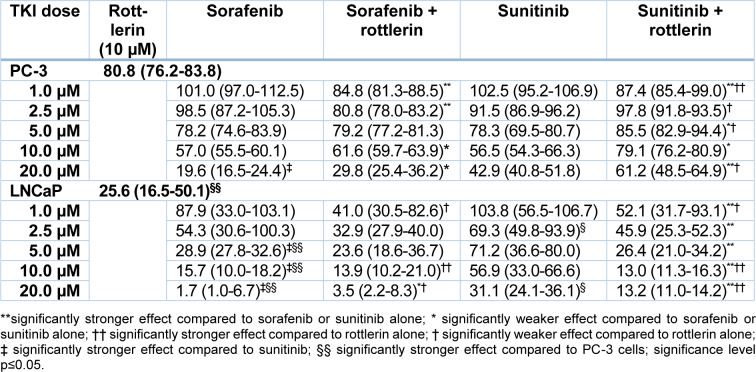
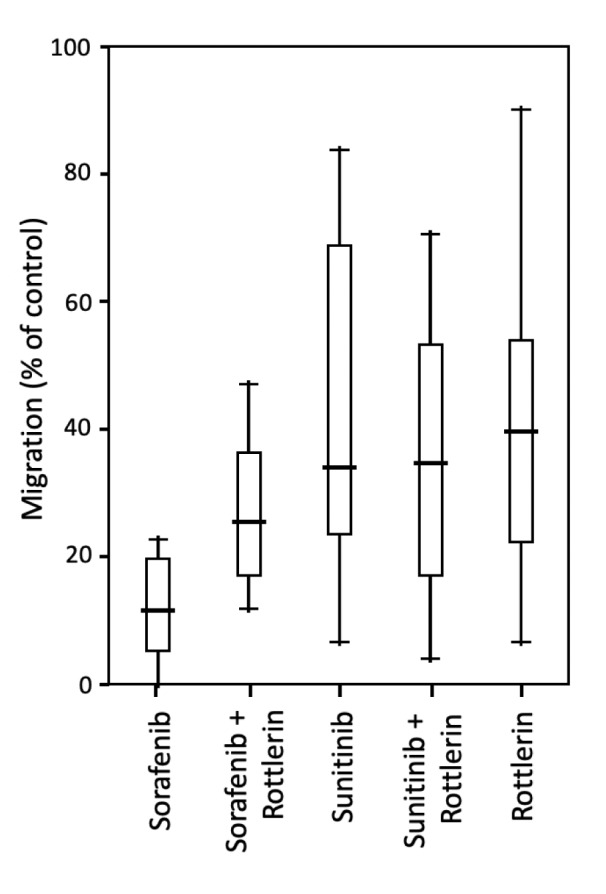
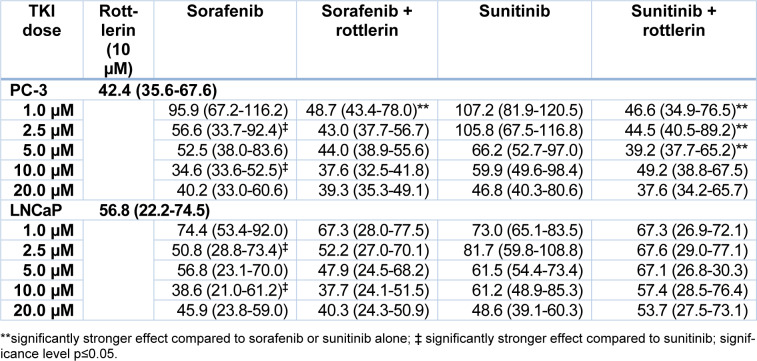
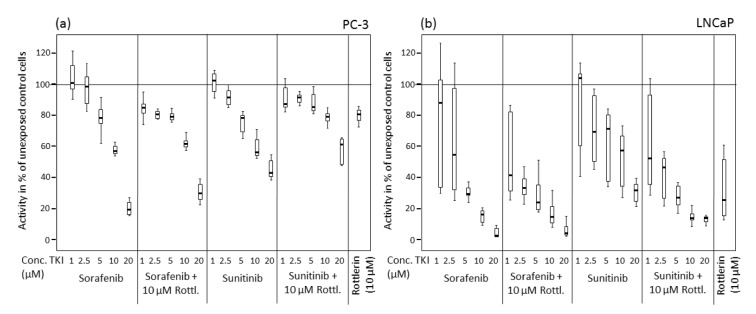
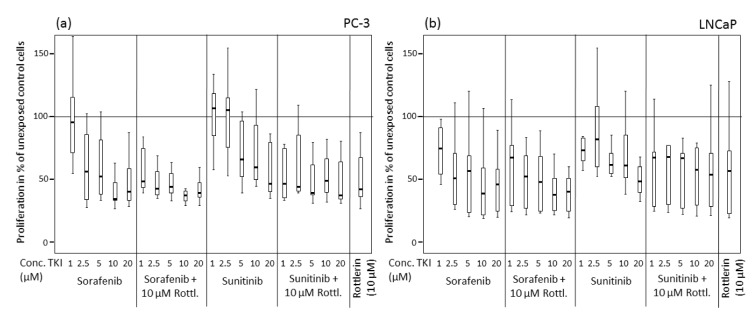
After prostatectomy due to prostate carcinoma, patients often develop metastases. Although prostate cancer is susceptible to hormonal manipulation, many patients become castration-resistant. Therefore, new therapies are the focus of investigations. We analyzed the effect of the tyrosine kinase inhibitors (TKIs), sorafenib and sunitinib, in combination with rottlerin, a PKCδ inhibitor, on metastatic mechanisms in prostate carcinoma cells. LNCaP and PC-3 prostate carcinoma cells were treated with sorafenib or sunitinib alone at various concentrations (1-20 µM) or in combination with rottlerin (10 µM) for 24 h. Then, cell toxicity (MTT test) and cell proliferation (BrdU incorporation assay) were quantified. The study demonstrated a dose-dependent inhibitory effect of sorafenib and sunitinib on PC-3 and LNCaP cell activity and proliferation. Both agents showed significantly stronger cytotoxic effects in LNCaP cells. At the highest concentrations, sorafenib and sunitinib inhibited the viability of LNCaP cells up to 2 % and 31 %, respectively, and the viability of PC-3 cell line up to 20 % and 43 %, respectively. The proliferation of both cell lines was significantly stronger inhibited by sorafenib than by sunitinib. In LNCaP cells, sorafenib and sunitinib at the highest concentrations inhibited cell proliferation up to 46 % and 49 %, respectively, and the proliferation of PC-3 line up to 40 % and 47 %, respectively. Rottlerin reduced the viability and proliferation of PC3 cells to 81 % and 42 %, whereas the viability and proliferation of LNCaP cells were reduced to 25 % and 57 %, respectively. Sorafenib and sunitinib at low concentrations partly neutralized the inhibitory effect of rottlerin on cell viability and proliferation. On the other hand, in PC-3 cells, rottlerin reduced the inhibitory effects of sorafenib and sunitinib at the highest concentrations on cell viability from 20 % to 30 % and from 43 % to 61 %, respectively. An additive effect on cell activity was observed after treating LNCaP cells with both sunitinib at high concentrations and rottlerin. This combination increased the cytotoxic effect from 31 % to 13 % at the highest sunitinib concentration. Our results showed that monotherapy with sorafenib was the most efficient in both PCa cell lines. A marginally additive effect of rottlerin was only observed in LNCaP cells treated with sunitinib at a high concentration. Sorafenib and sunitinib reduced cell migration in PC-3 cells to 10 % and 32 % of untreated cells, respectively. Co-treatment with sorafenib/sunitinib and rottlerin did not result in a significantly stronger anti-migratory effect than the treatment with each TKI alone. Given the strong cytotoxic effect of TKIs, especially sorafenib, on LNCaP cells, the results of the migration assay in this line were severely biased and not considered in the analysis. Unlike in other malignancies, combination therapy with TKI and rottlerin seems not beneficial in prostate cancer. More promising seems to be monotherapy with rottlerin, but further studies are needed to confirm this observation.
前列腺癌患者在接受前列腺切除术后常发生转移。尽管前列腺癌对激素操纵敏感,但许多患者会发展为去势抵抗性。因此,新的治疗方法是研究的重点。我们分析了酪氨酸激酶抑制剂(TKIs)索拉非尼和舒尼替尼与PKCδ抑制剂rottlerin联合应用对前列腺癌细胞转移机制的影响。LNCaP和PC-3前列腺癌细胞分别用不同浓度(1-20μM)的索拉非尼或舒尼替尼单独处理,或与rottlerin(10μM)联合处理24小时。然后,对细胞毒性(MTT试验)和细胞增殖(BrdU掺入试验)进行定量分析。研究表明,索拉非尼和舒尼替尼对PC-3和LNCaP细胞活性及增殖具有剂量依赖性抑制作用。两种药物在LNCaP细胞中均表现出明显更强的细胞毒性作用。在最高浓度下,索拉非尼和舒尼替尼分别将LNCaP细胞活力抑制至2%和31%,将PC-3细胞系活力抑制至20%和43%。索拉非尼对两种细胞系增殖的抑制作用明显强于舒尼替尼。在LNCaP细胞中,最高浓度的索拉非尼和舒尼替尼分别将细胞增殖抑制至46%和49%,将PC-3细胞系增殖抑制至40%和47%。Rottlerin将PC3细胞的活力和增殖分别降低至81%和42%,而LNCaP细胞的活力和增殖分别降低至25%和57%。低浓度的索拉非尼和舒尼替尼部分抵消了rottlerin对细胞活力和增殖的抑制作用。另一方面,在PC-3细胞中,rottlerin将索拉非尼和舒尼替尼在最高浓度下对细胞活力的抑制作用分别从20%降低至30%,从43%降低至61%。在用高浓度舒尼替尼和rottlerin处理LNCaP细胞后,观察到对细胞活性有相加作用。在舒尼替尼最高浓度下,这种联合用药将细胞毒性作用从31%提高至13%。我们的结果表明,索拉非尼单药治疗在两种前列腺癌细胞系中最为有效。仅在高浓度舒尼替尼处理的LNCaP细胞中观察到rottlerin有轻微的相加作用。索拉非尼和舒尼替尼分别将PC-3细胞的迁移能力降低至未处理细胞的10%和32%。索拉非尼/舒尼替尼与rottlerin联合处理并未产生比单独使用每种TKI更强的抗迁移作用。鉴于TKIs尤其是索拉非尼对LNCaP细胞有很强的细胞毒性作用,该细胞系迁移试验的结果存在严重偏差,因此在分析中未予考虑。与其他恶性肿瘤不同,TKI与rottlerin联合治疗在前列腺癌中似乎并无益处。rottlerin单药治疗似乎更有前景,但需要进一步研究来证实这一观察结果。