Shoham Shmuel, Bloch Evan M, Casadevall Arturo, Hanley Daniel, Lau Bryan, Gebo Kelly, Cachay Edward, Kassaye Seble G, Paxton James H, Gerber Jonathan, Levine Adam C, Currier Judith, Patel Bela, Allen Elizabeth S, Anjan Shweta, Appel Lawrence, Baksh Sheriza, Blair Paul W, Bowen Anthony, Broderick Patrick, Caputo Christopher A, Cluzet Valerie, Cordisco Marie Elena, Cruser Daniel, Ehrhardt Stephan, Forthal Donald, Fukuta Yuriko, Gawad Amy L, Gniadek Thomas, Hammel Jean, Huaman Moises A, Jabs Douglas A, Jedlicka Anne, Karlen Nicky, Klein Sabra, Laeyendecker Oliver, Lane Karen, McBee Nichol, Meisenberg Barry, Merlo Christian, Mosnaim Giselle, Park Han-Sol, Pekosz Andrew, Petrini Joann, Rausch William, Shade David M, Shapiro Janna R, Singleton J Robinson, Sutcliffe Catherine, Thomas David L, Yarava Anusha, Zand Martin, Zenilman Jonathan M, Tobian Aaron A R, Sullivan David
Department of Medicine (S.S., K.G., D.T., P.B., J.Z., A.B., L.A., C.M.) Department of Pathology (E.B., A.T.), Department of Neurology (K.L., N.M., D.H., A.G., A.Y.) and the Department of Ophthalmology (DJ), The Johns Hopkins University School of Medicine, Baltimore, MD, Departments of Molecular Microbiology and Immunology (A.C., D.S., S.K., H.S.P., C.A.C., J.R.S., A.P. A.J.) and Epidemiology (B.L., D.S., D.J., S.E.,S.B., C.S.) The Johns Hopkins Bloomberg School of Public Health, Baltimore, MD, Mosaic Consulting Ltd., Israel (N.K.), Department of Medicine, Luminis Health, Annapolis, MD (B.M.), Department of Medicine, Section of Infectious Diseases, Baylor College of Medicine, Houston, TX (Y.F), Department of Emergency Medicine, Rhode Island Hospital/Brown University, Providence, RI (A.L.), Division of Infectious Diseases/Department of Medicine, Georgetown University Medical Center, Washington, DC (S.K.), Division of Allergy and Immunology, Department of Medicine (G.M.), and Department of Pathology (T.G.), Northshore University Health System, Evanston, IL, Department of Medicine, Division of Infectious Diseases University of Cincinnati, Cincinnati, OH (M.H.), Department of Medicine, Division of Infectious Diseases, University of California, Irvine, Irvine, CA (D.F.), Department of Medicine, Division of Infectious Diseases, University of California, Los Angeles, Los Angeles, CA (J.S.), Department of Medicine, Division of Infectious Diseases (E.C.) and Department of Pathology (E.A.), University of California, San Diego, San Diego, CA, Department of Medicine, Division of Hematology and Oncology, University of Massachusetts, Worchester, MA (J.G.), Department of Medicine, Division of Infectious Diseases, University of Miami Miller School of Medicine, Miami, FL (SA), Department of Medicine, University of Rochester, Rochester, NY (MZ), Department of Neurology, University of Utah, Salt Lake City, UT (J.R.S), Department of Medicine, Division Critical Care Medicine, University of Texas Health, Houston, TX (B.P.), Department of Emergency Medicine Wayne State University, Detroit, MI (J.P.), Danbury Hospital (P.B.), Norwalk Hospital (J.H.), Vassar Brothers Medical Center, Nuvance Health, Poughkeepsie, NY (VC) and University of Vermont (J.P., W.R., M.E.C.), Nuvance Health, Danbury, CT, Division of Intramural Research, National Institute of Allergy and Infectious Diseases, National Institutes of Health Baltimore, MD (O.L.).
medRxiv. 2021 Dec 14:2021.12.13.21267611. doi: 10.1101/2021.12.13.21267611.
The efficacy of SARS-CoV-2 convalescent plasma (CCP) for preventing infection in exposed, uninfected individuals is unknown. We hypothesized that CCP might prevent infection when administered before symptoms or laboratory evidence of infection.
This double-blinded, phase 2 randomized, controlled trial (RCT) compared the efficacy and safety of prophylactic high titer (≥1:320) CCP with standard plasma. Asymptomatic participants aged ≥18 years with close contact exposure to a person with confirmed COVID-19 in the previous 120 hours and negative SARS-CoV-2 test within 24 hours before transfusion were eligible. The primary outcome was development of SARS-CoV-2 infection.
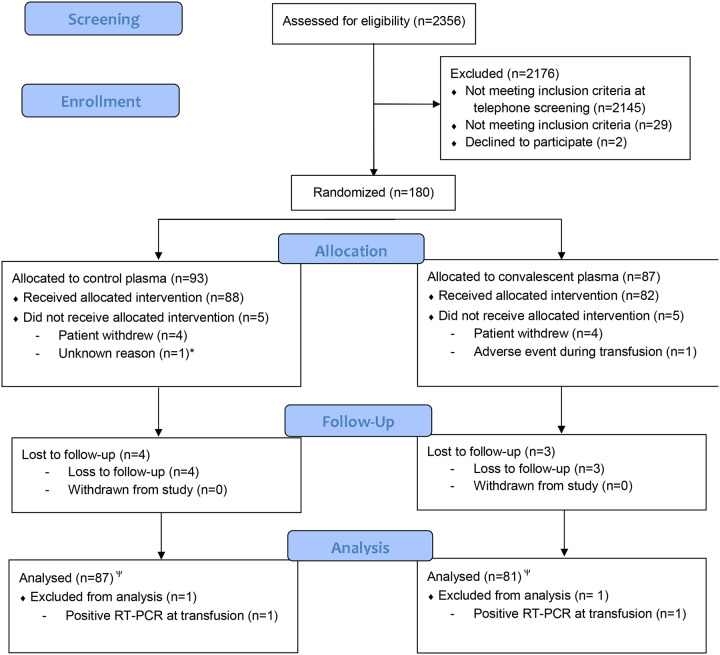
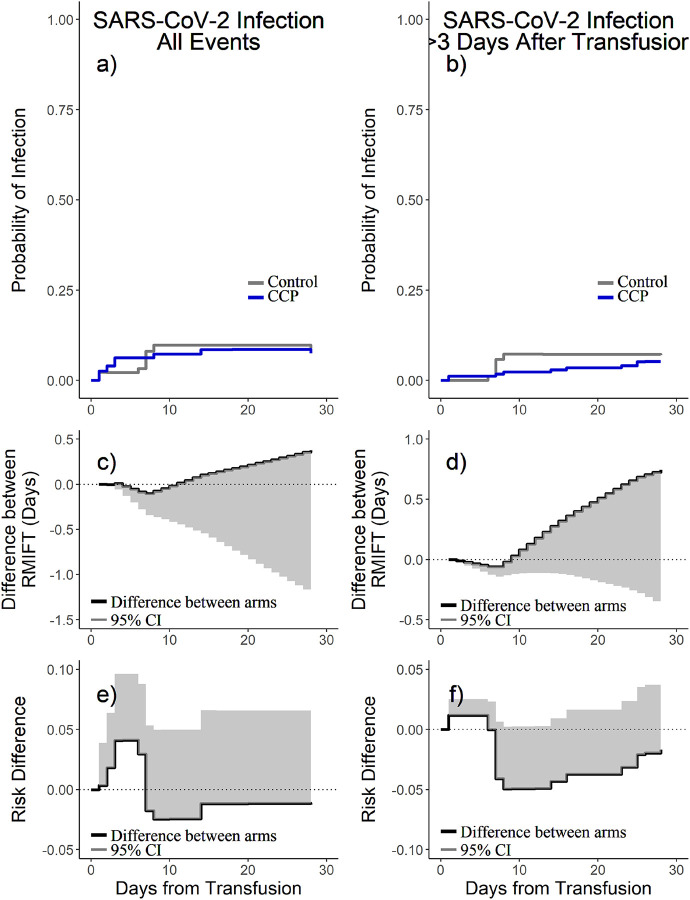
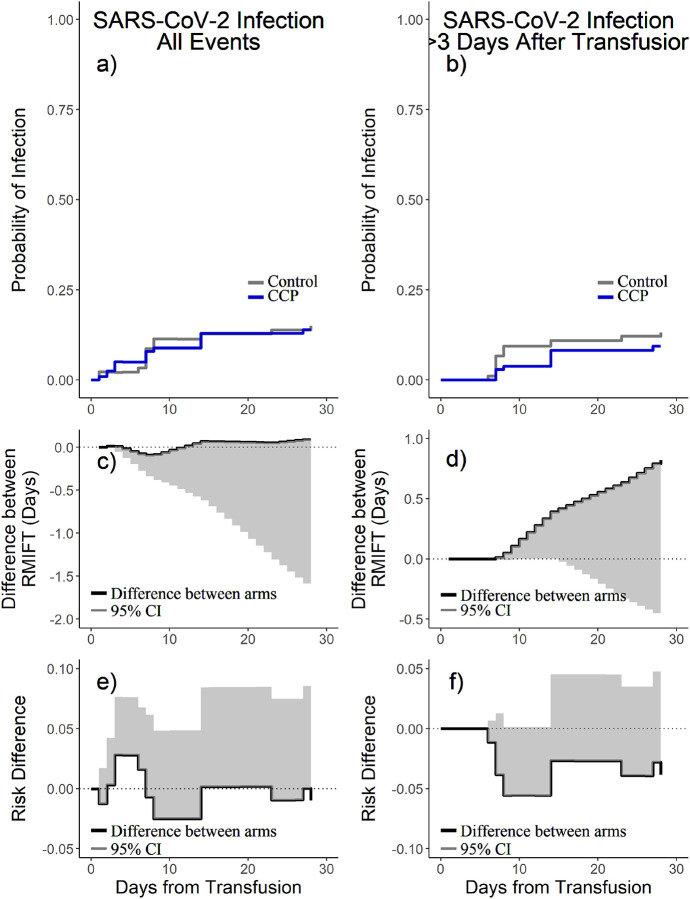
180 participants were enrolled; 87 were assigned to CCP and 93 to control plasma, and 170 transfused at 19 sites across the United States from June 2020 to March 2021. Two were excluded for SARS-CoV-2 RT-PCR positivity at screening. Of the remaining 168 participants, 12/81 (14.8%) CCP and 13/87 (14.9%) control recipients developed SARS-CoV-2 infection; 6 (7.4%) CCP and 7 (8%) control recipients developed COVID-19 (infection with symptoms). There were no COVID-19-related hospitalizations in CCP and 2 in control recipients. There were 28 adverse events in CCP and 58 in control recipients. Efficacy by restricted mean infection free time (RMIFT) by 28 days for all SARS-CoV-2 infections (25.3 vs. 25.2 days; p=0.49) and COVID-19 (26.3 vs. 25.9 days; p=0.35) were similar for both groups.
In this trial, which enrolled persons with recent exposure to a person with confirmed COVID-19, high titer CCP as post-exposure prophylaxis appeared safe, but did not prevent SARS-CoV-2 infection.
Clinicaltrial.gov number NCT04323800 .
严重急性呼吸综合征冠状病毒2(SARS-CoV-2)康复期血浆(CCP)对预防暴露但未感染个体感染的疗效尚不清楚。我们假设CCP在出现感染症状或实验室证据之前给药可能预防感染。
这项双盲、2期随机对照试验(RCT)比较了预防性高滴度(≥1:320)CCP与标准血浆的疗效和安全性。年龄≥18岁、在过去120小时内与确诊COVID-19患者有密切接触且输血前24小时内SARS-CoV-2检测呈阴性的无症状参与者符合条件。主要结局是发生SARS-CoV-2感染。
共纳入180名参与者;87名被分配接受CCP,93名接受对照血浆,2020年6月至2021年3月期间在美国19个地点对170名进行了输血。2名因筛查时SARS-CoV-2逆转录聚合酶链反应(RT-PCR)呈阳性而被排除。在其余168名参与者中,接受CCP的81人中有12人(14.8%)、接受对照的87人中有13人(14.9%)发生SARS-CoV-2感染;接受CCP的6人(7.4%)、接受对照的7人(8%)发生COVID-19(有症状感染)。接受CCP的参与者中没有与COVID-19相关的住院病例,接受对照的参与者中有2例。接受CCP的参与者发生28起不良事件,接受对照的参与者发生58起。两组在28天内所有SARS-CoV-2感染的受限平均无感染时间(RMIFT)(25.3天对25.2天;p=0.49)和COVID-19(26.3天对25.9天;p=0.35)方面的疗效相似。
在这项纳入近期接触确诊COVID-19患者的人员的试验中,高滴度CCP作为暴露后预防措施似乎是安全的,但未能预防SARS-CoV-2感染。
Clinicaltrial.gov编号NCT04323800 。