Shahzadi Syeda Kiran, Karuvantevida Noushad, Banerjee Yajnavalka
Department of Basic Medical Sciences, Mohammed Bin Rashid University of Medicine and Health Sciences, Dubai, United Arab Emirates.
JMIR Res Protoc. 2021 Dec 21;10(12):e31128. doi: 10.2196/31128.
Cancer is the third leading cause of death in the United Arab Emirates (UAE), after cardiovascular diseases and accidents. In the UAE, colorectal cancer (CRC) is the first and fourth most common cancer in males and females, respectively. Several treatment modalities have been employed for cancer treatment, such as surgery, radiotherapy, chemotherapy, hormone replacement therapy, and immunotherapy. These treatment modalities often elicit adverse effects on normal cells, causing toxic side effects. To circumvent these toxicities, there has been an increased impetus towards the identification of alternate treatment strategies. Animal venoms are rich sources of pharmacologically active polypeptides and proteins.
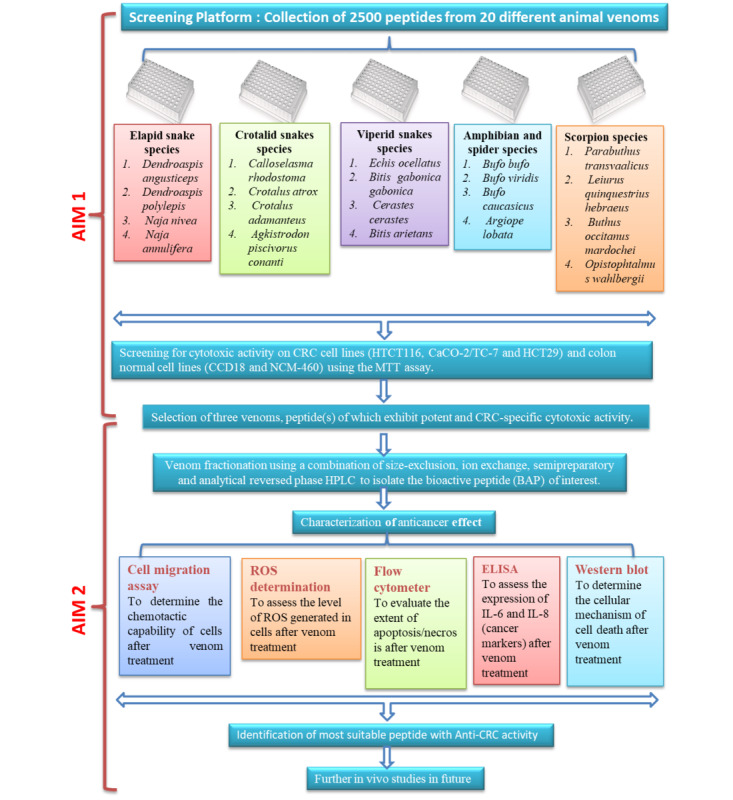
In this proof-of-concept study, we will apply a high-throughput venomics strategy to identify and characterize anticancer bioactive peptides (BAPs) from 20 different animal venoms, specifically targeting CRC. We chose to focus on CRC because it is one of the foremost health issues in the UAE.
In the initial study, we will screen 2500 different peptides derived from 20 different animal venoms for anticancer activity specifically directed against 3 CRC cell lines and two control cell lines employing the 3-(4,5-dimethylthiazol-2-yl)-2,5-diphenyltetrazolium bromide (MTT) colorimetric assay for cytotoxicity. Of the 20 venoms, 3 that exhibit specific and potent anticancer activity directed against the 3 CRC cell lines will be selected; and from these 3 venoms, the specific peptides with anti-CRC activity will be isolated and characterized.
This study is at the protocol development stage only, and as such, no results are available. However, we have initiated the groundwork required to disseminate the proposed study, which includes culturing of colorectal cancer cell lines and preparation of venom screens.
In summary, the proposed study will generate therapeutic leads to manage and treat one of the leading health issues in the UAE, namely, CRC.
INTERNATIONAL REGISTERED REPORT IDENTIFIER (IRRID): PRR1-10.2196/31128.
癌症是阿拉伯联合酋长国(阿联酋)继心血管疾病和事故之后的第三大死因。在阿联酋,结直肠癌(CRC)分别是男性和女性中最常见的癌症,位列第一和第四。已经采用了多种治疗方式来治疗癌症,如手术、放疗、化疗、激素替代疗法和免疫疗法。这些治疗方式常常对正常细胞产生不良影响,导致毒性副作用。为了规避这些毒性,人们越来越倾向于寻找替代治疗策略。动物毒液是药理活性多肽和蛋白质的丰富来源。
在这项概念验证研究中,我们将应用高通量毒液组学策略,从20种不同动物毒液中鉴定并表征抗癌生物活性肽(BAPs),特别针对结直肠癌。我们选择专注于结直肠癌,因为它是阿联酋最重要的健康问题之一。
在初始研究中,我们将使用3-(4,5-二甲基噻唑-2-基)-2,5-二苯基四氮唑溴盐(MTT)比色法检测细胞毒性,筛选来自20种不同动物毒液的2500种不同肽针对3种结直肠癌细胞系和两种对照细胞系的抗癌活性。从这20种毒液中,选择3种对3种结直肠癌细胞系表现出特异性和强效抗癌活性的毒液;并从这3种毒液中分离和表征具有抗结直肠癌活性的特定肽。
本研究仅处于方案制定阶段,因此尚无结果。然而,我们已经启动了开展拟议研究所需的基础工作,包括培养结直肠癌细胞系和制备毒液筛选。
总之,拟议的研究将产生治疗线索,以管理和治疗阿联酋主要健康问题之一,即结直肠癌。
国际注册报告识别码(IRRID):PRR1-10.2196/31128