Department of Psychiatry, Washington University in St. Louis, USA.
Department of Psychiatry, Washington University in St. Louis, USA.
Dev Cogn Neurosci. 2022 Feb;53:101053. doi: 10.1016/j.dcn.2021.101053. Epub 2021 Dec 16.
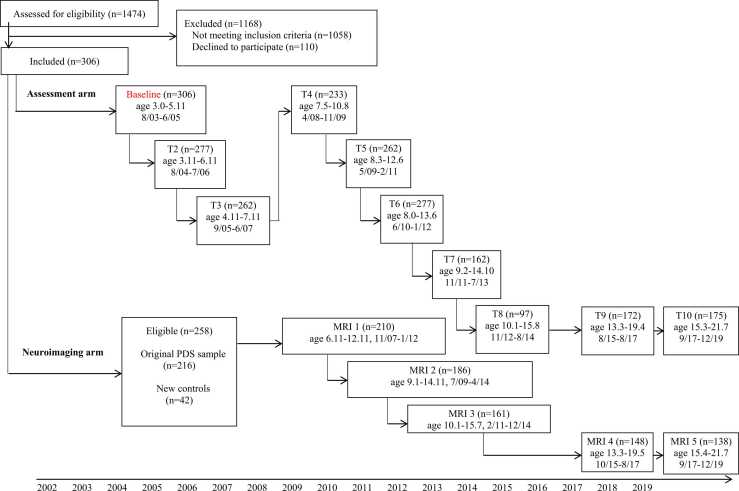
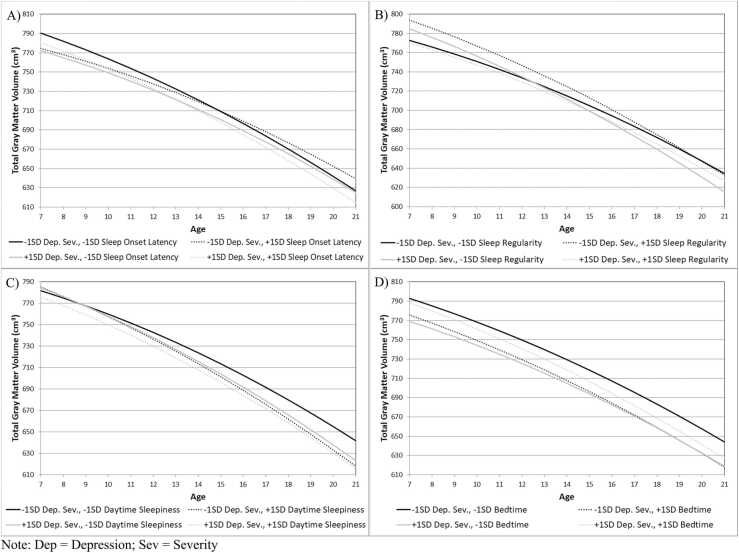
There is a close relationship between sleep and depression, and certain maladaptive outcomes of sleep problems may only be apparent in individuals with heightened levels of depression. In a sample enriched for preschool depression, we examined how sleep and depression in early childhood interact to predict later trajectories of gray matter volume. Participants (N = 161) were recruited and assessed during preschool (ages 3-6 years) and were later assessed with five waves of structural brain imaging, spanning from late childhood to adolescence. Sleep and depression were assessed using a semi-structured parent interview when the children were preschool-aged, and total gray matter volume was calculated at each scan wave. Although sleep disturbances alone did not predict gray matter volume/trajectories, preschool sleep and depression symptoms interacted to predict later total gray matter volume and the trajectory of decline in total gray matter volume. Sleep disturbances in the form of longer sleep onset latencies, increased irregularity in the child's sleep schedule, and higher levels of daytime sleepiness in early childhood were all found to interact with early childhood depression severity to predict later trajectories of cortical gray matter volume. Findings provide evidence of the interactive effects of preschool sleep and depression symptoms on later neurodevelopment.
睡眠与抑郁之间存在密切关系,睡眠问题的某些适应不良后果可能仅在抑郁程度较高的个体中表现明显。在一个针对学龄前抑郁症的样本中,我们研究了幼儿期的睡眠和抑郁如何相互作用,从而预测灰质体积的后续轨迹。参与者(N=161)在学龄前(3-6 岁)期间被招募并进行评估,随后进行了五次结构脑成像评估,从儿童晚期到青春期。当孩子还处于学龄前时,使用半结构化的家长访谈来评估睡眠和抑郁情况,并在每次扫描时计算总灰质体积。尽管单独的睡眠障碍本身并不能预测灰质体积/轨迹,但学龄前的睡眠和抑郁症状相互作用,预测了随后的总灰质体积和总灰质体积下降的轨迹。在幼儿期,以更长的入睡潜伏期、儿童睡眠时间表不规则性增加和更高水平的日间嗜睡形式出现的睡眠障碍,都被发现与幼儿期抑郁严重程度相互作用,从而预测皮质灰质体积的后续轨迹。研究结果为学龄前睡眠和抑郁症状对后期神经发育的交互影响提供了证据。