Lee Seok Woo, Hussain M D Waseem, Shome Sanchari, Ha Su Ryong, Oh Jae Taek, Whang Dong Ryeol, Kim Yunseul, Kim Dong-Yu, Choi Hyosung, Chang Dong Wook
Department of Industrial Chemistry, Pukyong National University, 48513, Busan, Republic of Korea.
Department of Chemistry, Research Institute for Natural Science and Institute of Nano Science and Technology, Hanyang University, 04730, Seoul, Republic of Korea.
Sci Rep. 2021 Dec 21;11(1):24381. doi: 10.1038/s41598-021-03763-1.
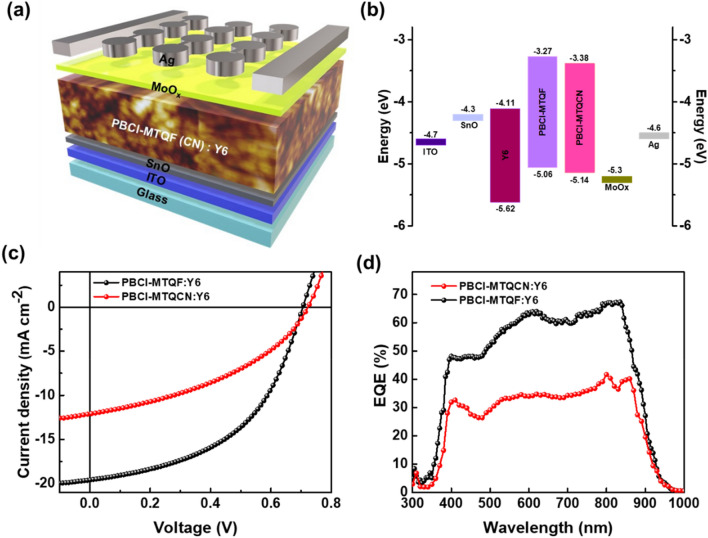
In this study, strong electron-withdrawing fluorine (F) and cyano (CN) substituents are selectively incorporated into the quinoxaline unit of two-dimensional (2D) D-A-type polymers to investigate their effects on the photovoltaic properties of the polymers. To construct the 2D polymeric structure, electron-donating benzodithiophene and methoxy-substituted triphenylamine are directly linked to the horizontal and vertical directions of the quinoxaline acceptor, respectively. After analyzing the structural, optical, and electrochemical properties of the resultant F- and CN-substituted polymers, labeled as PBCl-MTQF and PBCl-MTQCN, respectively, inverted-type polymer solar cells with a non-fullerene Y6 acceptor are fabricated to investigate the photovoltaic performances of the polymers. It is discovered that the maximum power conversion efficiency of PBCl-MTQF is 7.48%, whereas that of PBCl-MTQCN is limited to 3.52%. This significantly reduced PCE of the device based on PBCl-MTQCN is ascribed to the formation of irregular, large aggregates in the active layer, which can readily aggravate the charge recombination and charge transport kinetics of the device. Therefore, the photovoltaic performance of 2D quinoxaline-based D-A-type polymers is significantly affected by the type of electron-withdrawing substituent.
在本研究中,强吸电子的氟(F)和氰基(CN)取代基被选择性地引入二维(2D)给体-受体(D-A)型聚合物的喹喔啉单元中,以研究它们对聚合物光伏性能的影响。为构建二维聚合物结构,给电子的苯并二噻吩和甲氧基取代的三苯胺分别直接连接到喹喔啉受体的水平和垂直方向。在分析了所得分别标记为PBCl-MTQF和PBCl-MTQCN的F取代和CN取代聚合物的结构、光学和电化学性质后,制备了具有非富勒烯Y6受体的倒置型聚合物太阳能电池,以研究这些聚合物的光伏性能。发现PBCl-MTQF的最大功率转换效率为7.48%,而PBCl-MTQCN的最大功率转换效率仅为3.52%。基于PBCl-MTQCN的器件的这种显著降低的功率转换效率归因于活性层中不规则大聚集体的形成,这会容易加剧器件的电荷复合和电荷传输动力学。因此,二维喹喔啉基D-A型聚合物的光伏性能受吸电子取代基类型的显著影响。