Department of Nephrology, University of Heidelberg, Heidelberg, Germany.
Department of Infectious Diseases, Molecular Virology, University of Heidelberg, Heidelberg, Germany.
Clin J Am Soc Nephrol. 2022 Jan;17(1):98-106. doi: 10.2215/CJN.11820921. Epub 2021 Dec 22.
Antibody response after severe acute respiratory syndrome coronavirus 2 (SARS-CoV-2) vaccination is impaired in kidney transplant recipients. Emerging variants, such as B.1.617.2 (), are of particular concern because of their higher transmissibility and partial immune escape. Little is known about protection against these variants in immunocompromised patients.
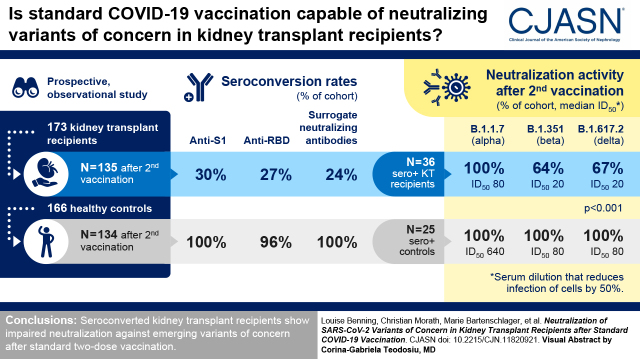
DESIGN, SETTING, PARTICIPANTS, & MEASUREMENTS: In this prospective two-center study, antispike 1 IgG and surrogate neutralizing antibodies were measured in 173 kidney transplant recipients and 166 healthy controls with different vaccination schedules. In addition, different SARS-CoV-2 epitope antibodies from 135 vaccinated kidney transplant recipients were compared with antibodies in 25 matched healthy controls after second vaccination. In 36 kidney transplant recipients with seroconversion, neutralization against B.1.1.7 (), B.1.351 (), and B.1.617.2 () was determined on VeroE6 cells and compared with neutralization in 25 healthy controls.
Kidney transplant recipients had significantly lower seroconversion rates compared with healthy controls. After the second vaccination, antispike 1, antireceptor-binding domain, and surrogate neutralizing antibodies were detectable in 30%, 27%, and 24% of kidney transplant recipients, respectively. This compares with 100%, 96%, and 100% in healthy controls, respectively (<0.001). Neutralization against B.1.1.7 was detectable in all kidney transplant recipients with seroconversion, with a median serum dilution that reduces infection of cells by 50% of 80 (interquartile range, 80-320). In contrast, only 23 of 36 (64%) and 24 of 36 (67%) kidney transplant recipients showed neutralization against B.1.351 and B.1.617.2, respectively, with median serum dilutions that reduce infection of cells by 50% of 20 (interquartile range, 0-40) and 20 (interquartile range, 0-40), respectively. Neutralization against different variants was significantly higher in healthy controls (<0.001), with all patients showing neutralization against all tested variants.
Seroconverted kidney transplant recipients show impaired neutralization against emerging variants of concern after standard two-dose vaccination.
Observational study to assess the SARS-CoV-2 specific immune response in kidney transplant recipients (COVID-19 related immune response), DRKS00024668.
严重急性呼吸综合征冠状病毒 2(SARS-CoV-2)疫苗接种后,肾移植受者的抗体反应受损。新兴变体,如 B.1.617.2(),因其更高的传染性和部分免疫逃逸而引起特别关注。关于免疫功能低下患者对这些变体的保护作用,我们知之甚少。
设计、地点、参与者和测量方法:在这项前瞻性的双中心研究中,173 名肾移植受者和 166 名健康对照者按照不同的疫苗接种方案,测量了针对刺突 1 区 IgG 和替代中和抗体。此外,在第二次接种后,将 135 名接种疫苗的肾移植受者的不同 SARS-CoV-2 表位抗体与 25 名匹配的健康对照者的抗体进行了比较。在 36 名血清转换的肾移植受者中,在 VeroE6 细胞上测定了对 B.1.1.7()、B.1.351()和 B.1.617.2()的中和作用,并与 25 名健康对照者的中和作用进行了比较。
与健康对照组相比,肾移植受者的血清转换率明显较低。在第二次接种后,分别有 30%、27%和 24%的肾移植受者检测到抗刺突 1、抗受体结合域和替代中和抗体,而健康对照组分别为 100%、96%和 100%(<0.001)。所有血清转换的肾移植受者均能检测到针对 B.1.1.7 的中和作用,血清稀释度中位数为 80(四分位距,80-320),可使细胞感染减少 50%。相比之下,只有 36 名肾移植受者中的 23 名(64%)和 36 名中的 24 名(67%)对 B.1.351 和 B.1.617.2 显示出中和作用,血清稀释度中位数分别为 20(四分位距,0-40)和 20(四分位距,0-40),可使细胞感染减少 50%。与健康对照组相比,针对不同变体的中和作用明显更高(<0.001),所有患者均显示针对所有测试变体的中和作用。
标准两剂接种后,血清转换的肾移植受者对新兴关注变体的中和作用受损。
评估肾移植受者中 SARS-CoV-2 特异性免疫反应的观察性研究(与 COVID-19 相关的免疫反应),DRKS00024668。